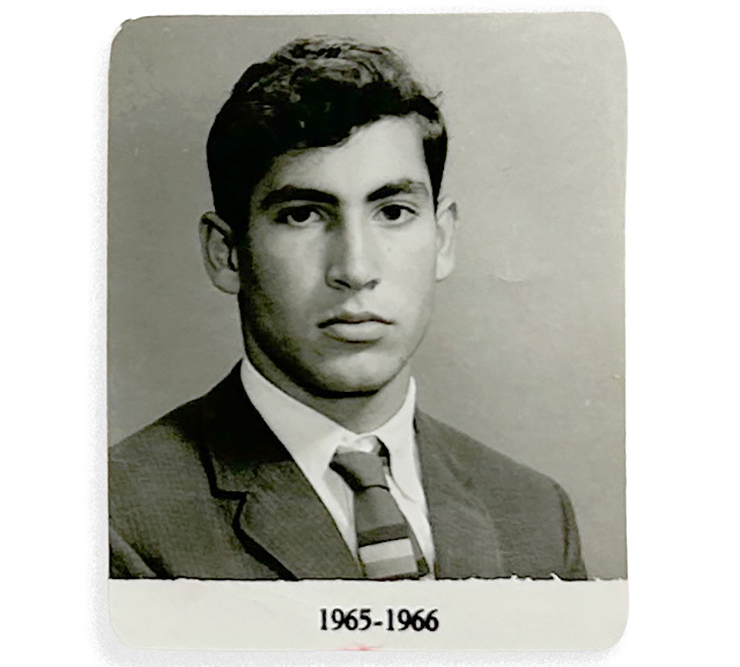
Israeli Prime Minister Benjamin “Bibi” Netanyahu grew up in West Jerusalem but spent his high school years in Elkins Park, a northern Philadelphia suburb. His father, Benzion, got a job at Dropsie College for Hebrew and Cognate Learning, the first school to offer a degree in Judaic Studies. Benzion and his wife, Tzila, wanted a similar academic environment for their children and hoped that Cheltenham High School would prepare them well. Little did Mr. and Mrs. Netanyahu realize that their children would grow up to be an Israeli military commander, Prime Minister, and doctor, respectively. Netanyahu would serve in Israel’s Special Forces and as Prime Minister from 1996 to 1999, then from 2009 to 2021, and from 2022 through the present.
Elkins Park was mostly Jewish, and the Netanyahu family acclimated well. However, Bibi was dissatisfied with the cliquishness and superficiality of high school life. He even stated the same to Michael Comay, the Israeli Ambassador to the UN at the time, on the latter’s visit to Cheltenham High. Netanyahu would serve as Israeli Ambassador to the UN just 17 years later.
Classmates, teachers, and friends painted a positive picture of Bibi Netanyahu for Philadelphia Magazine’s September issue. Bibi will turn 77 on October 29. “A clear dichotomy developed in my life,” Netanyahu wrote in his autobiography. “America became the province of the mind, Israel the province of my heart.” While his Philadelphia years certainly shaped this “controversial” figure (as Philadelphia Magazine called him), it was clear from the get-go that Benjamin Netanyahu was going to make history.
As one student told Philadelphia Magazine’s Robert Huber, Netanyahu was a “loner”; he was never part of any clique. He flowed through high school without being part of it. Another student recalled how Bibi was very focused and intense. He was physically in Cheltenham but spiritually in Israel. His girlfriend in Israel, Miriam, would eventually become his first wife.
Bibi was very helpful to his fellow classmates. One student recalls asking Bibi to explain to him what a vector was. “We sat down together and he drew all these arrows and things, and I think I got some of it.” Bibi seemed to know all the answers. “He knew his place in the world and he knew he had this dedication [to Israel], and that put him above the rest of us who were just sort of futzing-around little Jewish suburban kids.”
Bibi and his brother Yonatan saw themselves as leading Israel’s future. Their father was not only taking them away from their friends in Israel, but he was also taking them away from the Israeli narrative. Benzion lived in a “detached bubble of Jewish history, and he would go through life with a foreboding sense of impending doom,” writes Anshel Pfeffer in his biography Bibi.
One classmate and friend, Jane Halpern, told Philadelphia Magazine that she saved Bibi’s letter to her in camp because she knew he would be somebody someday. In his letter (written from Israel when he was 13), Bibi remarks on how Israel has grown at a faster rate than when he left. He found that his friends did not change, and they summed him up the same way. “By the way,” wrote Bibi, “if you answer this letter put ‘Bibi’ instead of ‘Ben’ on the address…I like ‘Bibi’ better.”
A high school teacher, Thomas Stretton, recalls exactly where Bibi sat (“right inside the door in the second seat in the row closest to the door”). Bibi did not alienate his classmates; he just wanted his fellow students to see what was truly valuable in life. He graduated fourth in his class of 534 students but never made it to his high school graduation—or Yale. The Six-Day War broke out in Israel, and Bibi was headed for the army.
In a May 7, 2013, op-ed for the Brookings Institution, Bruce Riedel wrote that from the time Israel launched an attack on Beirut International Airport in 1968, “successive Israeli governments got more and more sucked into the swamp of Lebanese politics and warlord conflict.” The raid was in retaliation for the Popular Front for the Liberation of Palestine’s (PFLP) attacks on Israeli passenger planes in the preceding months. Bibi took part in that raid.
In 1972, Bibi was injured when his 16-member team of commandos rescued 90 hostages from a hijacked airliner that was forced to land in Lod (now Ben Gurion Airport) at the instruction of Black September terrorists. The rescue team was led by future Prime Minister Ehud Barak. Two hijackers were killed, and two were injured.
Imagine a David story where the younger takes the kingship; unlike Eliav, who was passed over because he was prone to anger, Bibi took the mantle of leadership when his hero brother Yonatan was killed during the Entebbe raid. “[Bibi] stepped up to become what [Yonatan] was already,” Jane Halpern told Philadelphia Magazine.
In 1967, Yonatan was studying at Harvard while Bibi was in the IDF. Yonatan wrote to his younger brother, stating that he missed him terribly. “Even when I was in Israel, I don’t think I missed anyone as much as I missed you. I think the reason may be that you’re the only true friend I ever had and the fact that I think I reached a perfect understanding with you in all areas.” This included Bibi finishing high school in the United States. Bibi and Yonatan had to find their place in the world while still showing honor to their father. “Losing Yoni was worse than losing someone you love. Bibi lost the one person who could understand him,” Haaretz reporter Ari Shavit told The New Yorker in 1998.
The Philadelphia Magazine portrait of Benjamin Netanyahu also shows pictures of the future statesman. We see his sense of hakaras hatov in visiting a commando who was injured in Entebbe. Bibi is pictured receiving a certificate of merit from Israeli President Zalman Shazar at the President’s residence during a ceremony honoring the soldiers who freed the hostages in the Sabena Airlines hijacking. Netanyahu was also seen dribbling a soccer ball down the field during a Cheltenham High game.
“We’re born with our character, and people don’t change,” says Paul Solis-Cohen, Bibi’s classmate and soccer teammate at Ogontz Junior High. “He wasn’t too quick to pass if he could fire the ball from a distance.” Bibi was described as mature beyond his years, both in body and mind, by Solis-Cohen and other classmates.
Bibi was someone who wanted to understand the world, fight injustice, and help others, says Thomas Stretton. “[Bibi] wanted the world to be less cruel and mindless and thoughtless and driven by blind bigotries[.]” These clues from Bibi’s teenage years may have foreshadowed this figure on the world stage today.
By Chaim Meyer