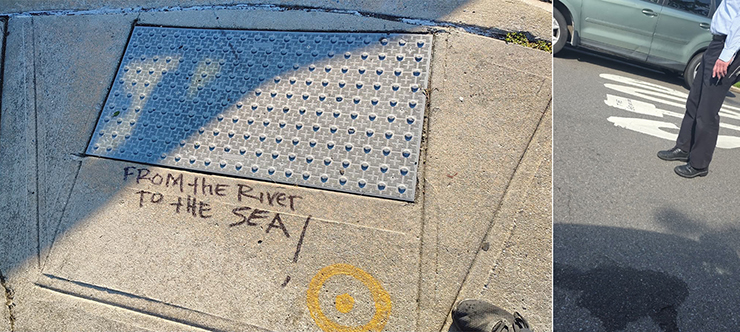
Residents of Kew Gardens and Richmond Hill awoke Friday, July 31, to a series of anti-Israel messages scrawled across sidewalks, roadway surfaces, and lampposts at several points throughout the neighborhood.
One of the most conspicuous inscriptions, “From the River to the Sea,” appeared in dark lettering near the northwest corner of 85th Avenue and 117th Street. Similar defacement was found nearby on painted roadway lines and along 84th Avenue between Lefferts Boulevard and 117th Street. The vandalism is believed to have been carried out sometime during the overnight hours.
Queens Shmira volunteers responded shortly after 9 a.m. after receiving a call from a resident on 85th Avenue. Working in coordination with the NYPD, they helped ensure that the affected locations were documented before cleanup began. Roughly 30 minutes later, additional reports prompted volunteers to canvass nearby blocks for further evidence.
The area is served by the NYPD’s 102nd Precinct, which covers Kew Gardens, Richmond Hill, Woodhaven, and surrounding communities. Residents who noticed the defacement, together with public-safety volunteers and responding officers, helped create a contemporaneous record of what had occurred.
That record may prove consequential. Incidents of this kind can disappear from view within minutes once a sidewalk is washed or a public surface is cleaned. Photographs, camera recordings, witness observations, and police reports may therefore become the principal means of reconstructing the sequence of events.
As of publication, no arrest has been announced, and no suspect has been publicly identified in connection with the July 31 incidents.
Investigators may compare the timing, location, handwriting, available video, and witness accounts to determine whether the various sites are related and whether the acts were committed by one person or by several individuals.
“From the River to the Sea” remains among the most contentious slogans associated with anti-Israel activism. The Anti-Defamation League considers the phrase anti-Semitic, arguing that it rejects Jewish self-determination by envisioning a Palestinian state extending from the Jordan River to the Mediterranean Sea, including the territory of Israel.
Its appearance, however, does not by itself establish that a criminal act meets the legal definition of a hate crime. Investigators must assess intent, the nature of the property targeted, evidence of bias, and the broader circumstances surrounding the offense.
When it is safe to do so, residents who encounter similar incidents should document the scene before anything is removed, note the precise location and approximate time of discovery and preserve relevant recordings from nearby homes or businesses. And they should notify police promptly. Many camera systems automatically overwrite stored material, sometimes within days.
Those who noticed suspicious activity overnight, or whose cameras cover 85th Avenue, 84th Avenue, 117th Street, Lefferts Boulevard, or adjacent blocks, may hold information of value even if their own property was untouched. No one should confront a person believed to be involved.
The rapid response by neighborhood residents, Queens Shmira, and the NYPD ensured that the evidence was preserved while still fresh. As the dispatcher who received the initial hotline call from a resident intent on removing the hateful message, I was struck by how easily an incident can disappear physically even while its significance remains. Proper documentation ensures that what happened is not erased along with the words themselves.
By Shabsie Saphirstein