Rabbi Shlomo Nisanov Explains Why He Welcomed the Mayor to Kehilat’s Pantry
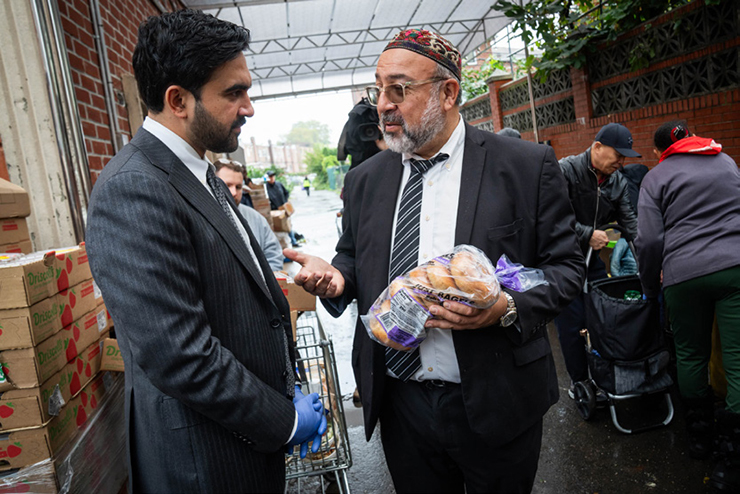
When Mayor Zohran Mamdani arrived at the Kehilat Sephardim Food Pantry at the corner of 153rd Street and 78th Road in Kew Gardens Hills on Monday, September 28, the visit raised an immediate question: Why had Rabbi Shlomo Nisanov agreed to receive a mayor whose statements about Israel and its soldiers have deeply angered many Orthodox and Bukharian Jews?
The Chol HaMoed Sukkos appearance marked Mamdani’s first visit to Kew Gardens Hills since taking office in January. Four days earlier, Israeli Prime Minister Benjamin Netanyahu had used his United Nations address to accuse Mamdani of spreading falsehoods about Israel and its soldiers. Mamdani responded by again describing Israel’s actions in Gaza as genocide. Against that backdrop, many residents found his reception inside a neighborhood synagogue painful.
The Queens Jewish Link received numerous objections to the visit. One community member called the visit a “bizayon to the community,” arguing that receiving Mamdani dishonored Israel and the IDF. Others maintained that preserving communication with City Hall did not require welcoming him inside Kehilat.
Rabbi Nisanov understood that receiving Mamdani would bring criticism. He explained that he does not make such decisions without first consulting his own daas Torah. Before agreeing to the visit, Rabbi Nisanov spoke with a prominent Queens rav and poseik, who advised that there was a chiyuv to receive the city’s sitting mayor and that refusing his request to attend the food distribution would constitute a chilul Hashem.
The rav distinguished between visiting the pantry and addressing the congregation. Mamdani was not asking to deliver remarks in the synagogue or participate in a religious service; he was asking to visit the food pantry and join its distribution to people in need. Mamdani had requested a visit several times before, Rabbi Nisanov said, but the logistics had not worked out. This time, Rabbi Nisanov followed the rav’s guidance and agreed.
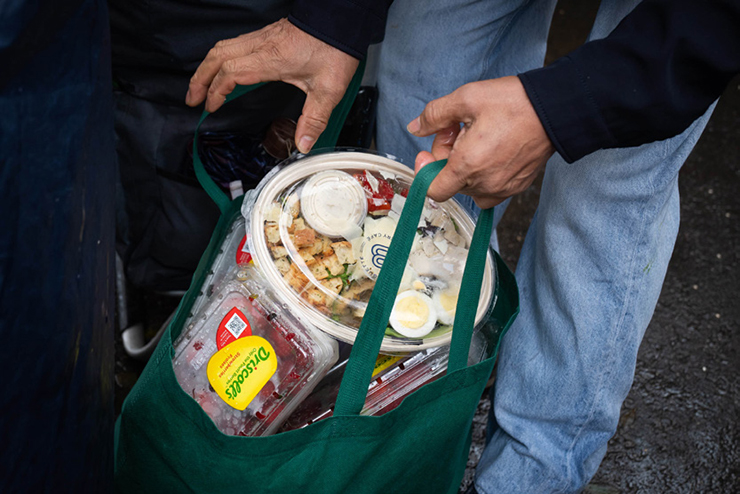
City Hall’s public schedule described the appearance simply as a “food distribution at a food pantry in Queens,” with no address to the congregation or synagogue program. Photographs from the visit show Mamdani handing prepared food and produce to recipients, speaking with them alongside Rabbi Nisanov, and meeting members of the pantry staff.
Rabbi Nisanov said the visit was neither a political endorsement nor a photo opportunity. Its purpose was the same as every distribution: providing supplemental food to individuals and families who need it.
During the visit, Rabbi Nisanov and Mamdani discussed the neighborhood’s history as a longstanding Orthodox community and the growth of the Bukharian Jewish population in Queens. Rabbi Nisanov’s mother, herself a neighborhood resident, directly asked Mamdani why many Jews perceive him as anti-Semitic. According to Rabbi Nisanov, the mayor responded, “If I were an anti-Semite, would I be here in your food pantry?”
In a statement afterward, Mamdani opened with “Moed tov! Суккот муборак!” – a Hebrew greeting followed by a Cyrillic holiday wish meaning “Happy Sukkos,” familiar to many Bukharian families from the former Soviet Union. He said he had joined Rabbi Nisanov to distribute free food in honor of Sukkos and thanked Rabbi Nisanov “for the reminder that community and service deepen our most joyful holidays.”
The Kehilat distribution was one of several Sukkos engagements Mamdani attended that week, followed by celebrations with Jewish New Yorkers over the next two days. Asked later about the mixed reception he received, Mamdani reflected on the Arbaah Minim – the four species, including the lulav and esrog – being brought together as a whole. “No matter which sukkah you’re in, you’re looking up at the same sky, the same moon,” he said. A mayor of 8.5 million people, he added, should expect at least 8.5 million opinions while serving residents regardless of what they think of him.
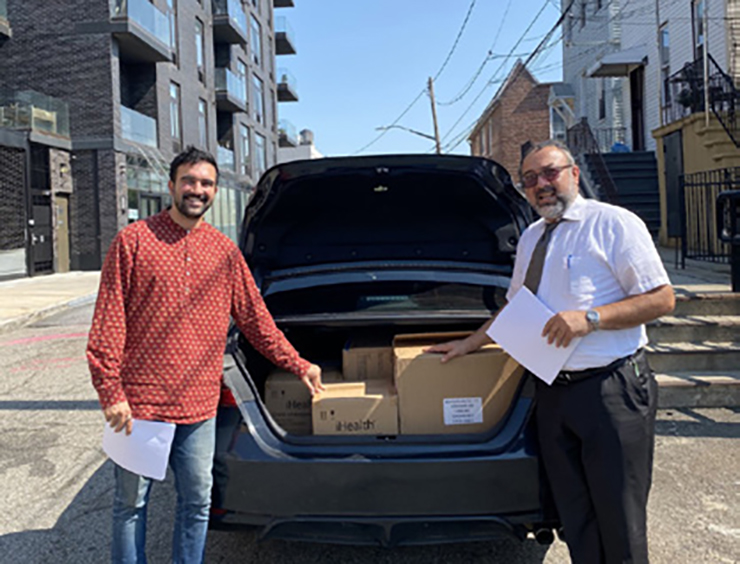
The September visit was not Mamdani’s first time at Kehilat or his first encounter with Rabbi Nisanov. On August 17, 2022, then-Assemblymember Mamdani spent a morning at the pantry and praised Rabbi Nisanov and the volunteers for feeding more than 200 people each weekday. Less than a month later, Rabbi Nisanov visited Mamdani’s Assembly district office in Astoria, Queens, and left with 1,000 Covid tests and 1,000 masks for pantry distribution.
Rabbi Nisanov supported Eric Adams rather than Mamdani in the mayoral election. He has nevertheless worked with officials across political lines when doing so could help the pantry or community.
Established around 1990 to help immigrants from the former Soviet Union, Kehilat’s pantry now distributes more than 25,000 food packages monthly, according to Rabbi Nisanov. He says it serves more than 6,000 people weekly and more than 21,000 monthly. The food is kosher, but recipients span religions, ethnicities, and backgrounds.
Long before an actual mayor walked through Kehilat’s doors, Rabbi Nisanov was known around Kew Gardens Hills as the unofficial “Mayor of Main Street.” A walk along Main Street with him can become a succession of interruptions as store owners, shoppers, friends, and relatives stop him. A supermarket owner offers bananas for the pantry; someone has a business proposal and someone else carries an invitation. Between encounters, his phone continues ringing.
For immigrants learning to navigate American government and institutions, Rabbi Nisanov became someone residents could approach when they needed to know where to go, whom to call, or how to get something done. That standing grew from the experience of Bukharian Jews who came to Queens after decades under Soviet rule and built synagogues, yeshivos, businesses, charitable institutions, and professional networks.
An exchange during Mamdani’s first pantry visit reflected that history. Rabbi Nisanov told him that people once said his father resembled Raj Kapoor, the legendary Indian actor and filmmaker whose movies became enormously popular throughout the Soviet Union. At the time, Mamdani referred to Rabbi Nisanov as Uzbek, reflecting his birth in what is now Uzbekistan. Rabbi Nisanov is a Bukharian Jew, part of a distinct, centuries-old Jewish community of Central Asia with its own religious traditions, culture, and Judeo-Persian heritage.
Rabbi Nisanov’s civic engagement extends beyond the pantry. In 2009, he joined a Bukharian Jewish delegation visiting the Jamaica Muslim Center during a Muslim-Jewish “Weekend of Twinning.” Some congregants were concerned for his safety, but Rabbi Nisanov went and identified areas in which Jews and Muslims could cooperate, including crime, unemployment, religious-school concerns, and food distribution. Following the October 7 attacks and rising tensions in New York, Rabbi Nisanov joined Jewish, Muslim, and Christian leaders at City Hall, where he said, “No one is born hating. You are taught to hate.”
Then-Assemblymember Rory Lancman helped Kehilat secure a $75,000 federal security grant in 2011 and remained a supporter of its food program. State Senator John Liu joined volunteers for a distribution in December 2022, while Assemblymember Sam Berger has volunteered alongside Rabbi Nisanov. The Queens District Attorney’s Office of Immigrant Affairs has partnered with Kehilat on kosher food distribution and immigrant services, and Assemblymember Jessica González-Rojas has spent time at the pantry with Rabbi Nisanov, volunteers, and young people.
Rabbi Nisanov has also served for years as an NYPD clergy liaison and is widely known across city agencies. In June 2023, Adams appointed him as one of the 37 original members of New York City’s first Jewish Advisory Council, established to provide City Hall with input on public safety, education, quality of life, and access to city services. “We have the ear of the mayor,” Rabbi Nisanov said at the time, “and that means a lot.”
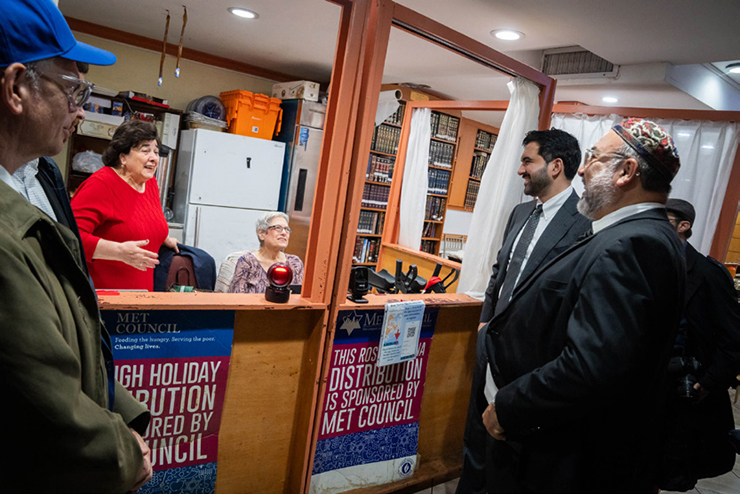
During the September 28 visit, Mamdani welcomed Rabbi Nisanov to his Jewish advisory committee, according to those present. The institutional status of that body remains unclear. The Queens Jewish Link asked the Mayor’s Press Office whether the Adams-era council still exists and whether Rabbi Nisanov formally serves under Mamdani. The Press Office has not responded.
The day after the Kehilat distribution, his administration unveiled the city’s first municipal strategy to combat anti-Semitism. The plan committed additional funding to community organizations, security for synagogues and nonprofits, Holocaust education, and public awareness.
In 2025, while helping bring Bukharian rabbanim together with Queens District Attorney Melinda Katz, Rabbi Nisanov summarized his approach: “We need to show up – consistently. We can’t be invisible.” The September visit put that approach to a difficult test.
Rabbi Nisanov’s explanation will not satisfy every critic. Mamdani did not address the congregation; he joined the food distribution, spoke with recipients, and left.
For the man once dubbed the “Mayor of Main Street,” there was a certain poetry in welcoming the actual mayor to Kehilat. Rabbi Nisanov has since moved on to bigger things: The mayor governs five boroughs, while the self-proclaimed “Intergalactic Rabbi” apparently has a somewhat larger constituency.
By Shabsie Saphirstein