What the U.S. Army Is Learning from Israel’s Combat Medics
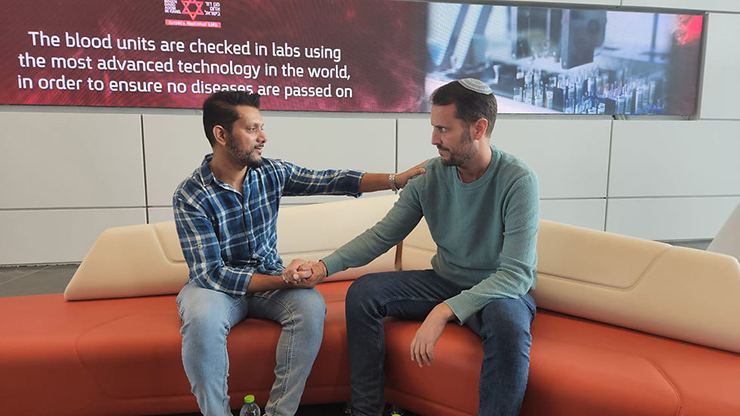
Israeli soldier Eytan Tesler survived a devastating battlefield injury in northern Gaza after receiving blood donated by a man he had never met. Weeks later, the two stood face-to-face at Magen David Adom’s Marcus National Blood Services Center, where Tesler could finally thank the stranger whose donation had helped save his life.
According to Magen David Adom, Tesler had suffered massive blood loss after being struck by a rocket-propelled grenade. IDF medics administered a whole-blood transfusion directly on the battlefield in Beit Hanoun before he could reach a hospital. His survival illustrates a transformation in Israeli combat medicine that has attracted the attention of the United States Army.
A 78-page U.S. Army assessment, Israeli Defense Force Medical Lessons Learned, examines how the Israel Defense Forces improved battlefield survival through faster treatment, blood transfusions near the front lines, and coordinated medical evacuation.
The IDF’s reported combat case-fatality rate—the proportion of combat casualties who died—fell from 14.8% during the 2006 Second Lebanon War to 7.1% in 2024, a relative reduction of approximately 52%. This does not mean the total number of soldiers killed declined by half. Meanwhile, the proportion of casualties classified as severely injured increased from 8% to 23%. Differences in battlefield conditions and casualty populations limit direct comparisons, but the assessment identifies significant advances in combat casualty care.
Prepared by the 68th Theater Medical Command of U.S. Army Europe and Africa, the study was completed in November 2025 and publicly released in April 2026. Its authors examined Israeli medical presentations and interviewed personnel ranging from frontline paramedics to senior military physicians.
Among their most consequential findings was a dramatic reduction in the time required to deliver advanced care.
During the 2006 Lebanon War, wounded soldiers generally waited 10 to 25 minutes before reaching an advanced life-support provider. Under the system described in the assessment, that interval fell to as little as zero to four minutes.
The IDF accomplished this partly by positioning physicians, paramedics, and specialized equipment closer to combat units, allowing wounded soldiers to receive treatment for severe bleeding and shock before evacuation.
A landmark American study of 4,596 U.S. battlefield fatalities in Iraq and Afghanistan helps explain why those minutes matter. Researchers found that 87.3% occurred before casualties reached a medical treatment facility. Among potentially survivable prehospital deaths, uncontrolled bleeding was the leading cause.
One of Israel’s most significant responses has been expanding access to whole blood directly on the battlefield. Whole blood supplies oxygen-carrying red cells, plasma containing clotting factors, and platelets that help control bleeding. For patients suffering catastrophic hemorrhage, it can help restore circulation and support clotting before hospital arrival.
The IDF had already pioneered battlefield use of freeze-dried plasma, which is easier to transport and store than conventional plasma. The introduction of specially screened low-titer group O whole blood expanded treatment options, making blood products available at battalion evacuation teams and, in certain circumstances, even closer to combat units.
Among casualties requiring transfusions for severe bleeding, the reported time to administer whole blood declined from approximately 20 minutes during the 2018–2023 period to five minutes in 2024. During ground operations, 368 wounded patients received blood products in the field, including 297 who received whole blood.
Achieving those results required trained personnel, refrigeration, and reliable supply networks linking civilian blood donors to frontline medical teams.
Between October 2023 and October 2024, Magen David Adom supplied approximately 4,700 units of low-titer group O whole blood to the IDF. Following the October 7 Hamas attacks, average daily blood collection surged from approximately 1,100 units to 4,000.
Israel’s national blood service helped sustain military supplies while meeting civilian medical needs. The IDF also installed refrigerators in additional evacuation vehicles, established blood distribution points, and improved emergency resupply procedures.
Heavily armored evacuation vehicles, including specially equipped Namer armored personnel carriers, enabled medical crews to retrieve casualties and deliver advanced care under enemy fire.
For Tesler, these advances had immediate consequences. The blood transfused by IDF medics in Beit Hanoun had been donated by Gershon Panker of Ramla during the opening days of the war.
When they eventually met, Tesler told him, “G-d works with people, and you are the man He chose.” He then added, “You saved my life. I thank you, Magen David Adom, and all the medical teams who treated me.”
Rapid evacuation provided another advantage. According to the Army, approximately 95% of Israeli military casualties were transported to civilian hospitals for advanced treatment, with a reported average evacuation time of 47 minutes. Among seriously injured patients evacuated by helicopter, the average was 62 minutes, with approximately 48% reaching a hospital within an hour of injury.
Military evacuation units worked closely with civilian trauma centers, allowing treatment begun near the battlefield to continue in hospitals equipped with specialized surgeons, blood banks, and emergency personnel.
For American planners, however, Israel’s geography presents an important limitation.
U.S. forces operating across the Pacific or under sophisticated enemy air defenses might face evacuation delays lasting hours. Short distances between Israeli combat zones and major hospitals cannot necessarily be replicated in a geographically dispersed conflict.
The Army therefore recommends adapting Israeli innovations rather than duplicating every procedure. Priorities include distributing blood products farther forward, strengthening supply chains, protecting evacuation capabilities, and preparing medical personnel to provide extended care when transportation is unavailable.
One of the assessment’s most revealing findings concerns the IDF Medical Corps’ willingness to revise established procedures as battlefield evidence emerged.
An Israeli analysis involving 112 critically injured patients who survived long enough to reach hospital care examined the relationship between early medical interventions and survival. Earlier administration of blood products was associated with improved outcomes, while the prehospital airway procedures studied did not demonstrate a comparable survival association.
The findings helped inform more selective use of certain airway and chest interventions, particularly when rapid evacuation allows definitive treatment to be performed in a hospital.
For American military planners, Israel’s experience demonstrates the value of continually reassessing treatment, logistics, and evacuation against actual battlefield outcomes.
Ruggedized digital tablets improved medical documentation by allowing information about injuries and treatment to accompany patients during evacuation. These records helped commanders evaluate outcomes and revise protocols. The Army recommends further development of secure electronic records, remote medical consultation, and potentially artificial intelligence to identify injury patterns and support medical decisions.
The assessment also examines psychological casualties. Following October 7, Israeli forces expanded commander training, early intervention, and access to mental-health professionals near operational units. The report describes encouraging preliminary findings while recommending stronger American systems for recognizing combat stress and supporting recovery.
The exchange of medical knowledge reflects a longstanding relationship between American and Israeli military physicians. Lessons developed by U.S. forces in Iraq and Afghanistan influenced trauma treatment internationally, including Israeli practices. American researchers are now examining how Israel adapted those lessons and developed additional capabilities.
The findings do not constitute an announcement that the U.S. Army has adopted Israel’s medical procedures. Rather, they offer recommendations based on Israeli operational experience while acknowledging vulnerabilities involving blood supplies, transportation, and the challenges of providing care when evacuation is delayed.
For Jewish communities, particularly families with relatives serving in the IDF, the findings carry significance beyond military strategy. The principle of pikuach nefesh, the obligation to preserve human life, gives the story particular resonance. The work of battlefield medics, medical researchers, hospital physicians, and civilian blood donors reflects a universal commitment to preventing deaths that better preparation and treatment might avert.
For Eytan Tesler, that meant recovering from his wounds and meeting the stranger whose blood helped save his life. For American soldiers who may one day face similar circumstances, the lessons learned in Israel could prove equally consequential.
Near the end of the report’s introductory assessment, its authors offer a warning: “The time for preparation is now.”