Before I discuss the remainder of my trip, I want to comment on the photograph that accompanied my article in last week’s Queens Jewish Link. It was not provided by me. If you look carefully at the photo, there is a red street sign that says “No Standing Anytime.” Clearly, this picture was taken in New York and not in Hungary, and it is not an accurate depiction of what you would have seen on the streets of Budapest. There are Chasidim in Budapest who appear to be in charge of the Beit Midrash shul where I davened. The kosher supervision authority over all kosher establishments in Budapest, to my knowledge, is the Beth Din Tzedek of the Chareidi Communities of Budapest. However, the majority of Jews on the streets in the Jewish Quarter are not Chasidim.
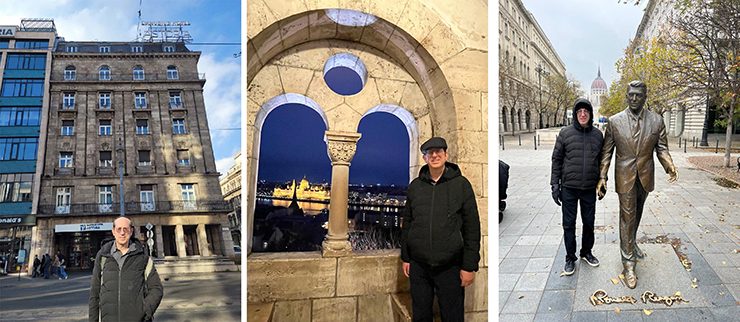
There were some unusual museums or memorials donated by people you would not have expected. In Raoul Wallenberg Memorial Park, there is the Holocaust Tree of Life Memorial with the names of various Hungarian Jews killed during the Holocaust. It was donated by an American who was a classmate of my aunt at Seward Park High School on the Lower East Side. At that time, he was known as Bernie Schwartz. He is more well known by his stage name, Tony Curtis.
An unusual museum is the Hospital in the Rock Nuclear Bunker Museum. It was originally set up as a hospital to be used during World War II, and later expanded to serve as a hospital in the event of a nuclear attack. The plan was that if there were an attack, survivors would be brought there for treatment.
A unique and somewhat disturbing museum is the House of Terror Museum, located in the former headquarters of the secret police during both German and Soviet control. It included a room used for torture and displayed some of the items used. In addition, there was a reconstructed basement where prisoners were housed in horrendous conditions, including a room so small that they could only stand. There were stories from survivors of the torture as well as German and USSR propaganda films. At the same time that the state was torturing its enemies, it was also putting out false propaganda to conceal what was happening. It is a powerful reminder of the importance of an independent media that is not merely a tool of the government.
The most unnerving part was the elevator ride. Two things I do not like are having to go in an elevator and having to be in a full elevator. While I was in a packed elevator moving downward at a snail’s pace, a video played describing the process used to hang someone. When it finished, the doors opened to the basement, which included a platform for hanging — complete with the noose, steps, and wooden backdrop.
Many of the Hungarians who worked at the facility during World War II as members of the Arrow Cross with the Germans continued under the Communist USSR. This is yet another example of how the far right and left can have much in common.
In last week’s column, I discussed what I learned at the Jewish museum regarding Hungary’s role in the Holocaust and how they emphasized the Hungarian Arrow Cross rather than Germany. I then went to two other museums that addressed the Holocaust: the Holocaust Memorial Center and the Hungarian National Museum. The Holocaust Museum pointed out that without Hungarian support, Germany — which had only a small operation in Hungary — would have been able to kill only 10,000 Jews instead of the nearly 600,000 who were murdered. The success of the operation was not merely due to the Arrow Cross; it also included Hungarians who were not members of the Arrow Cross and who had the option not to participate, yet willingly did.
The National Museum did mention the Holocaust, but it was a small part of the exhibit covering the World War II period and the entire museum as a whole. There was no mention of the number of Jews who were killed.
This is an example of how different entities can address the same events and yet reach different conclusions as to who was at fault. When information did not fit the desired narrative, it was left out. Some things never change.
At one of the museums, there was an exhibition about the Khazars. When I saw it, my reaction was: Who cares about them? They are gone. Then I had a chance to start looking at the Kuzari, written by Rabbi Yehuda HaLevi, which I brought to read during the long plane ride. The Kuzari is a discussion between the King of Khazaria and a rabbi in the Spanish Jewish community. There is a question as to whether the Khazars converted to Judaism and, if so, whether the conversion was sincere or simply to differentiate themselves from surrounding nations. Since I had not looked at the book first, I did not carefully review the exhibition. However, my recollection is that their conversion to Judaism was not mentioned at the exhibit, and what was shown was contrary to Jewish tradition.
Finally, what is a trip without a Jewish geography story? I was waiting to go into a restaurant when I began speaking with a group of people also waiting for a table. I found out that one of them has a sister and brother-in-law who daven in one of the shuls that I daven in. I ended up seeing her brother-in-law this Shabbos in shul and told him how I had met his sister-in-law.
The bottom line is that, especially in this climate, if you want to travel to Europe, you should consider Hungary as an alternative to the traditional countries.