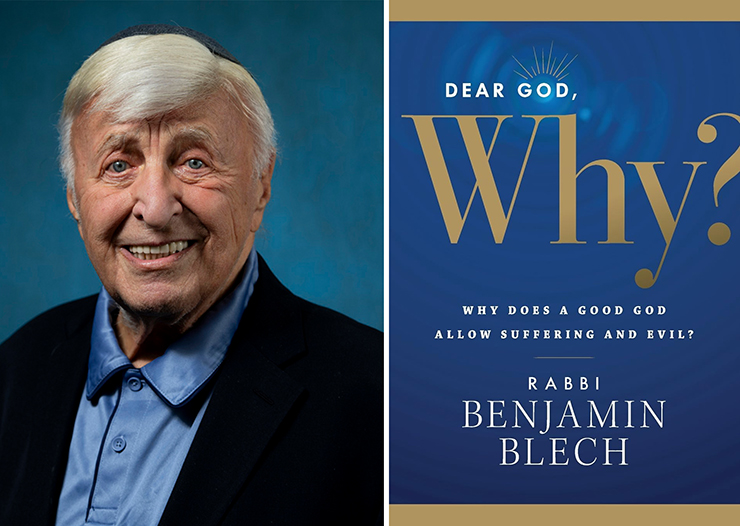
In his latest book, Dear G-d, Why?, the veteran professor offers a lifetime of wisdom on faith and resilience.
When Rabbi Benjamin Blech walks into his classroom at Yeshiva University, students rise. At 92, he is still teaching—still sharp, still funny, and still humbled by the idea that he might have one more thing to say. “I think I’m the oldest professor here,” he jokes. “I don’t know if that’s something to brag about.”
For more than six decades, Rabbi Blech has taught Torah, Talmud and Jewish thought to generations of students, serving as both a YU professor and a pulpit rabbi on Long Island. A tenth-generation rabbi, he has been ranked among the most influential Jews in America, honored as American Educator of the Year and celebrated by readers of his 20 books—several of them international bestsellers. His works range from The Sistine Secrets (translated into 16 languages and a bestseller in 26 countries) to acclaimed volumes on Jewish law, history and spirituality.
Rabbi Blech’s influence extends far beyond the classroom. Over the years, he’s appeared on the Oprah Winfrey Show and in global media, met with the Pope, served as a confidant to the Lubavitcher Rebbe, and lectured to audiences worldwide. Even Ernest Hemingway, after a long-ago conversation, told him, “Of all religions, Judaism makes the most sense—it’s a religion of life, not of death.”
His newest book, Dear G-d, Why?, may be his most personal yet. Not because it chronicles his doubts, but because it answers the question he’s been asked his entire life: Why does G-d allow suffering?
A Lifetime in Search of Meaning
Born in Switzerland in 1933, Rabbi Blech escaped Europe with his parents and siblings on the last ship to leave before the Nazi invasion—a journey that should have taken a week but stretched to more than two months as they evaded German U-boats across the Atlantic.
“I lost family in the Holocaust, but I was spared,” he says. “You can’t live through that without asking why—and I’ve spent my life trying to understand.”
That question became both his burden and his calling. For decades, he’s wrestled with it in classrooms and synagogues, and in the intimate moments that shape a rabbi’s life—at funerals, in hospital rooms, in conversations with those in pain. Dear G-d, Why? takes on that same question directly: Why do bad things happen to good people, and how can faith survive in a world that seems to betray it?
“When I came to America, I was old enough to understand what had happened to my family and to our people,” Rabbi Blech says. “The Holocaust shaped everything that followed. It gave me the drive to accomplish, to leave something meaningful behind, and to wrestle with the question that never goes away.”
A Response to an Earlier Generation—and to Our Own
Dear G-d, Why? is, in part, a response to Rabbi Harold Kushner’s 1981 bestseller When Bad Things Happen to Good People. Rabbi Blech agreed that Kushner captured the pain of the question—but his conclusion, that G-d is good but not all-powerful, was “nothing less than heresy.”
“The fact that he called what he wrote the Jewish approach, and that millions were reading it, upset me greatly,” he recalls. “I made myself a promise: if I ever had the chance and the audience, I would write the book that gave an authentic Jewish answer.”
For Rabbi Blech, that answer lies in trust, not denial. “Judaism doesn’t say G-d can’t stop evil—it says He has reasons we can’t always understand. We’re not asked to explain G-d; we’re asked to trust Him.”
That distinction, he says, is what sustains faith through tragedy. “If G-d were powerless, He wouldn’t be G-d. The challenge is to keep faith even when we don’t understand His ways.”
He’s seen the same question return in every generation. “My students used to ask about the Holocaust,” he says. “Now they ask about October 7, about antisemitism, about whether G-d still cares. The questions never change—only the headlines do.”
Faith in the Face of Fear
Even after a lifetime devoted to teaching faith, Rabbi Blech admits to fear. “This is the most afraid I’ve ever been in America,” he says from his Upper West Side home, where he and his wife, Elaine, have lived for over 25 years. “I used to say what happened in Germany could never happen here. I’m not so sure anymore.”
He pauses before adding, “The final straw came when I saw the hatred of Jews in our elite universities. I always saw America as the Golden Land. For the first time, I find myself thinking—yes, it could happen here.”
Yet he refuses despair. “I can’t leave,” he says simply. “I’m teaching Torah. That’s what’s keeping us alive.”
Fifteen years ago, doctors diagnosed Rabbi Blech with cardiac amyloidosis—a rare, fatal disease—and told him he had six months to live. Today, he remains an enigma to science. “The leading expert on the disease lectures about me,” he says, laughing. “He tells audiences there’s one man who’s lived for years—with no medical explanation—and he’s a rabbi. So maybe I have connections.”
“I believe I’m a miracle,” he adds. “If G-d kept me alive, it’s because there’s still something left to do—to teach, to write. This book is part of my mission.”
Wrestling—and Believing
Dear G-d, Why? is both philosophical and deeply human. Drawing on Jewish tradition, modern psychology, and decades of pastoral experience, Rabbi Blech doesn’t offer easy answers—only the courage to wrestle with G-d and still believe.
“People come to me and ask, ‘Why did this happen to me?’” he continues. “Sometimes there’s no answer. But that doesn’t mean there’s no meaning. The act of asking keeps you connected to G-d.”
That, he believes, is the heart of the matter. “In Judaism, it’s not wrong to question—it’s wrong to stop asking. To say ‘why’ is to say you still believe there’s a G-d who’s listening.”
One of the highlights of Rabbi Blech’s life is the satisfaction he gets from teaching at YU. “I go to school every day, and the students sit around me and drink in Torah. Teaching Torah is not just a blessing—it’s an obligation. This book is part of fulfilling that obligation. It’s my legacy.”
Rabbi Blech sees Dear G-d, Why? as the culmination of his life’s work—a synthesis of everything he has taught, written and lived. “Even when we don’t understand, even when we’re afraid, we can know that there is a G-d, and he is a good G-d.”