Much of the news these days is dominated by war, most notably Israel vs. Hamas, Israel vs. Hezbollah, and Ukraine vs. Russia. But there are many other conflicts. According to one report, over 65 global conflicts are now underway, including eight direct battles between nations, with 13 of them considered major wars. These are being fought by different armies in very different regions in order to achieve different objectives. But they have one common denominator: Human combatants are being phased out and steadily replaced by robots and other types of automation. And this trend is expected not only to continue but to accelerate.
The U.S. military is investing in new ways to prevent American casualties to whatever extent possible. These include making improvements to existing systems that we see frequently on news reports, such as drones and autonomous ground vehicles (AGVs). But new technology is also being developed, and the latest technological marvel is robot soldiers, which will be used in missions deemed too risky for people and in related situations.
At one time, robots were just clunky, unsteady humanoids, but not anymore. The latest ones come in many different sizes and shapes. Some are less than knee-high, others resemble dogs or other small animals, and a growing number look so much like people that it’s hard to believe they’re not human.
CBN News correspondent Caitlyn Burke says robots are ideal for dangerous missions such as clearing the enemy from a building, searching unfamiliar terrain, or going into unexplored areas where there is a heightened risk of ambush, booby traps, and related hazards. “These devices are already in America’s arsenal and part of the Pentagon’s initiative is to gain an advantage over both today’s opponents and those who may become opponents in the future,” Burke says.
Until a few years ago, very high-tech devices like these were found only in science fiction flicks, but these days they’re already being used increasingly by the military in more diverse tasks.
Send In The Robots
It’s becoming clear that the winners of future wars will not be the side that has the best military strategists, the bravest soldiers, or the most fighters; rather, victory will go to the one that has the best technology. “The U.S. must win the strategic competition for 21st-century technology,” Secretary of War Pete Hegseth said recently. And as technologies advance, a major goal is removing risk to human life wherever possible.
Countries are working hard to do just that—not for humanitarian reasons, but because this will help them on the battlefield. That’s why humanoid robots are being designed to move, work, and even resemble the people they’ll one day replace.
“Everything in our military is built to be used by humans or humanoids shaped like them, from the tactics they’ll use down to their weapons, their tools, and even their vehicles,” says Mike LeBlanc, co-founder of Foundation Future Industries, a firm developing humanoids geared for use in both heavy industrial purposes and military applications. “For example, humanoids will be able to get into Humvees and are going to be able to pick up an M4 rifle.” LeBlanc believes Foundation Future’s robots are going to be able to bring entire arsenals to life.
Historically, U.S. military spending on AI and unmanned systems was fragmented across various agency programs. That’s changed. Now the Department of War has transitioned “into dedicated, multibillion-dollar budget line items and centralized initiatives.”
Militaries around the world are aggressively increasing their spending on AI, autonomy, and battlefield automation, and the U.S. is no exception. In the current fiscal year, the Pentagon has requested $54.6 billion to $63 billion for autonomous warfare systems and $58.5 billion for AI-related investments as part of its defense strategy.
The U.S. military actively uses several categories of unmanned and robotic systems for ground, air, sea, and logistical operations. Already in use or well along in development are robotically controlled jet fighters, submarines, and drones that can not only fly very long distances but also carry very heavy payloads and strike targets with great precision.
Safety First
Other robots, already in use, are less dramatic but nevertheless very practical and extremely helpful in saving human lives and preventing injuries. Among them are:
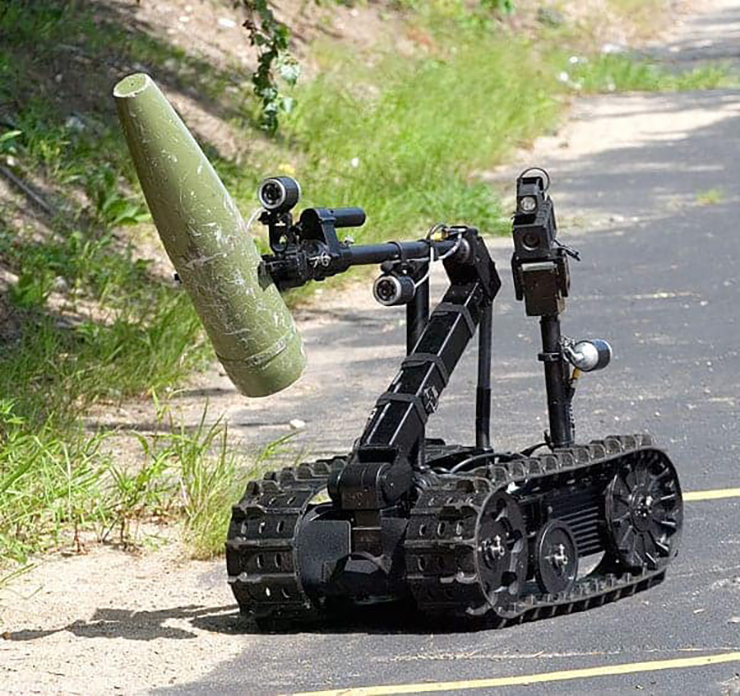
iRobot PackBot and QinetiQ TALON, used to inspect, handle, and neutralize roadside bombs and IEDs (improvised explosive devices) from a safe distance;
Robot mules and logistics vehicles like Hunter WOLF and THeMIS, which can transport heavy equipment or evacuate casualties across rough terrain close to the front lines; and
Combat and reconnaissance UGVs (unmanned ground vehicles) such as RIPSAW or robot dogs from companies like Ghost Robotics and Boston Dynamics, which are being used for surveillance, scouting, and hazardous inspections.
It’s interesting to note that the chief strategy advisor at Foundation Future is Eric Trump, who knows how to capitalize on the talent it has.
The military’s latest robot is called Alex, and it’s being tested for use in dangerous and physically demanding tasks such as clearing hazardous materials, reconnaissance, and firefights. One of the main objectives is keeping human soldiers safe and out of the direct line of fire.
Military robots are developed and manufactured by a number of companies. They range from startups to industry giants that are publicly traded; many are American, but several are foreign. They include Northrop Grumman, Lockheed Martin, Foundation Future, Boston Dynamics, and the Israeli firms Israel Aerospace and Elbit Systems.
Tough Competition
Every military in the world is getting into robotics and related automation. For example, unmanned jet aircraft for the military, controlled by AI, are now being readied for use, as are ultra-advanced robotic submarines, even more advanced drones, helicopters, and other crucial weaponry.
Meanwhile, other countries are also working hard at this endeavor, and China is of the most concern. Some of the robots they’ve put on display have amazing capabilities and are already being mass-produced. For example, one can race faster than Usain Bolt, widely regarded as the fastest (human) sprinter of all time. Others can lift exceptionally heavy loads, perform somersaults and other gymnastics, and perform very aggressive martial arts. And canine robots can be fitted with machine guns and climb up ladders.
One observer said that China is building the largest unmanned force on Earth, and whether this is correct or not, the implication is frightening. Moreover, these robots—even those seemingly intended for entertainment or commercial purposes—can easily be adapted for military purposes. Another observer said that military robots are advancing much faster than most of us realize.
Warfare is being transformed into a new era, one in which automation will assume the brunt of the fighting. The question is: Will this save human lives or take still more of them?
Gerald Harris is a financial and feature writer. Gerald can be reached at This email address is being protected from spambots. You need JavaScript enabled to view it.