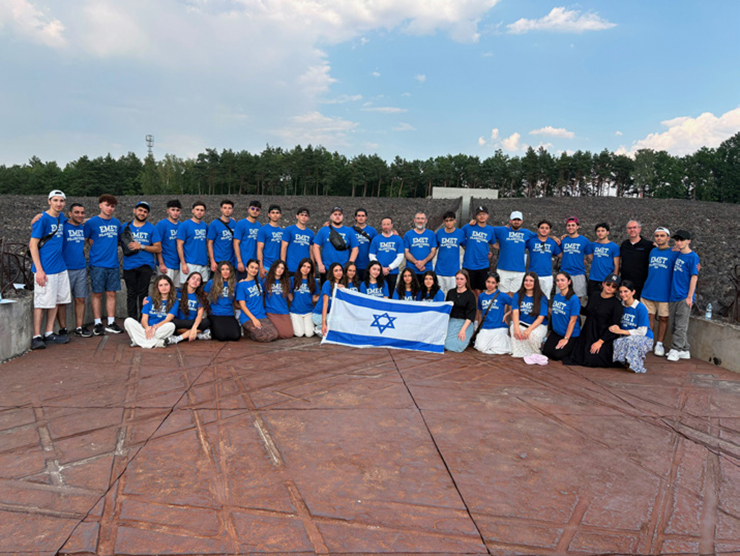
For 34 Emet students traveling through Poland and Vienna this summer, Jewish history was no longer something to study from a distance. They stood in places where vibrant Jewish communities once flourished, walked through sites of unimaginable loss, and heard stories of faith and resilience that made the past feel deeply personal.
The participants, all of whom completed the Emet Leaders Fellowship within the past two years, traveled with Rabbi Reuven Kigel, Emet Campus Director; Rabbi Mordechai Kraft, Emet Co-Founder and Educational Director; and Emet Mekarvos Alexandra Zarka and Sharona Malakov. Guided by Rabbi Tzvi Shiloni, the group visited Warsaw, Lublin, Leżajsk, Krakow, and other historic Jewish communities. They toured haunting sites, including the Warsaw Ghetto, Yeshivat Chachmei Lublin, Chelmno, Majdanek, Belzec, and Auschwitz-Birkenau, before continuing on to Vienna. Rabbi Kigel shared, “The goal of this trip was to come away empowered to live more meaningful Jewish lives.”
For Eden Yossefi, that message came into focus while standing at a train station. “One of the moments that touched me most was standing at a train station where, less than a century ago, thousands of Jews were taken away to concentration and death camps,” she recalled. “Rabbi Tzvi told us about a chasidic man who sang ‘Ani Maamin’ on one of those trains. It astounds me that people who were literally on a path to death could still find a way not to be brought down. They had every reason to feel victimized or angry at Hashem, yet many found a way to break through their fear and never give up hope. I’m grateful to be Jewish and to take that story home with me as an inspiration to strengthen my own emunah in Hashem.”
Ethan Khaimov was especially affected by visiting a field near Chelmno where hundreds of thousands of Jews were buried. “Seeing these places in person gave me a greater appreciation for being born Jewish and made me feel closer to Hashem,” he said. “It also made me think about the responsibility we have today not to remain silent in the face of anti-Semitism, but to stand up for ourselves and for one another. I’m leaving the trip with new friendships, a stronger connection to my Jewish identity, and a deeper understanding of why it is so important to learn from our history.”
For Allen Sholomov, the trip reinforced the idea that Jewish identity is expressed through the way a person lives. “This trip helped me remember that being Jewish was never just about rules, but about responsibility,” he said. “It’s about being respectful, having morals and values, thinking before you speak, and walking through the world with sympathy and empathy. What it really means to me is being a light unto the nations, one Jewish person at a time.”
The impact continued after he returned home. “Since I’ve been back, I haven’t complained as much. I’ve been a little gentler, more understanding, and I’ve tried to be a better son,” Allen said. “I’ve made it a point to be there more for my father, my mother, and my brother. After seeing everything we saw on this trip, I came home feeling much more grateful for the people and the life I have.”
Alongside the intensity of the historical sites, traveling together gave the students time to process what they were seeing, strengthen friendships, and experience the places where Jewish communities once lived, prayed, and built their lives. At the trip’s closing banquet in Vienna, students reflected on how they hoped to carry the experience forward. Commitments ranged from greater Shabbos observance and t’filah to baking challah and continuing their Torah learning.
“For me, that was really the purpose of the trip,” said Rabbi Kigel. “This experience was about asking what the history of the Holocaust means for us today and how it can inspire students to live more spiritual and intentional Jewish lives.”
After confronting both the destruction and the resilience of European Jewry, the students returned home carrying memories of the places they visited, stronger connections to one another, and a renewed sense of responsibility for Jewish continuity.