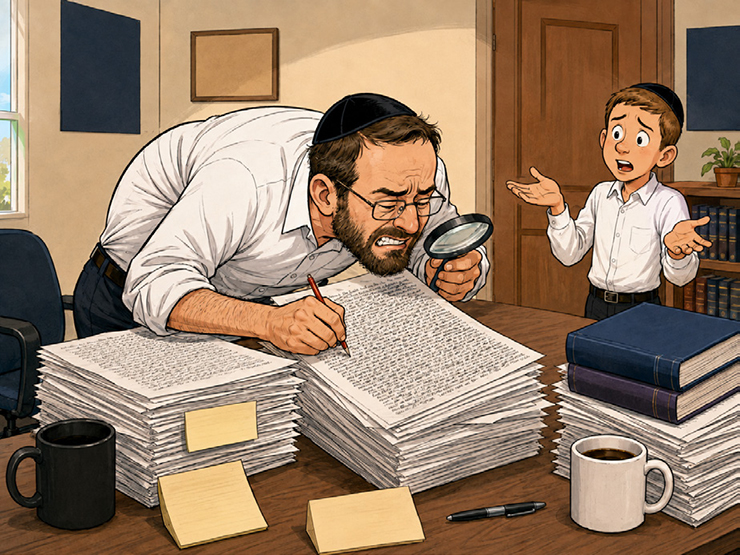
As a high school language-arts teacher, the worst part of my job is marking essays.
And yes, I know other teachers have to do it too. But if a history teacher notices that words in the essay are spelled wrong, he can just ignore it because it’s not his problem. A history teacher can say, “Does the essay make sense? I don’t know. But it has a lot of the words that I want to see, so we’re good.”
But as a Language Arts teacher, that is my problem. I can’t say, “We’ll learn how to spell those words eventually.” There are millions of words. And if any of those are spelled wrong or used incorrectly, that is my problem. I don’t know why language arts teachers teach vocabulary, because that just increases the number of words that the students can spell wrong.
So perhaps you’re thinking, “What if my classroom got computers? That would make it easier to mark things, right?”
That’s what I figured. I got laptops in the classroom a few years ago, and as far as the issues I was having marking essays, I cannot overstate what a difference the computers make, in that I have different issues now.
For example, for years, I was throwing out my back marking essays, hunched over, reading tiny scrawled words and then having to write even tinier scrawled words between those words, only to have the students say, “I can’t read what you wrote!”
You can’t read what I wrote? I at least spelled it right.
See, if something isn’t legible, you can often tell what it says by making out a couple of letters and getting the rest from context. But if the context doesn’t make sense either and there are some letters that shouldn’t be there…
“I can make out an I. What word did you mean to write?”
“Women.”
But yeah, not all my comments were clear. My students would say, “Mr. Schmutter, what did you mean when you wrote that this sentence is “awkward to read”?
“I meant that those were all the words I could fit in that space.”
But now that we have computers, I can write a whole long footnote explaining what’s wrong with it, with carefully-worded suggestions of how to make it better. And then those students can say, “I’m not reading a whole footnote. Are you kidding me? Mr. Schmutter, what does this say, in your own words?”
“Those were my own words.”
The thing is that footnotes are easily countable, so the kids get overwhelmed.
“How come that kid didn’t get as many footnotes? I think you like him better because he behaves and pays attention and puts in more work the first time around.”
But at least I don’t have to read handwriting anymore, right?
Well, there are still worksheets.
Also, they spend a lot of their computer time trying to choose the perfect font for their essay – often one that looks like handwriting. This is the most exciting thing for them about computers: That they get to choose a font. Even though when they were handwriting the essays, they could technically write it in any font in the universe, and they all chose messy and small.
I have a student who once chose all the fonts. 300-word essay, 300 fonts. Impossible to read. The first thing I did before reading it was hit CTRL A and turn it all into Times New Roman. He got the essay back and said, “You ruined all my hard work!”
This is all your hard work?
I knew. It was not an amazing essay. And I say this because now that I can read all the words they’re writing, I have come to the realization that I was maybe happier when I couldn’t.
I don’t know if students’ essays have gotten worse over the years, or if they were always this bad and I can just read it now. Or if they’re putting in less work because of the computers. They think, “Eh, Spellcheck will catch everything. I can sit back and play with the fonts, and the rest will write itself.”
I don’t know where to begin. I have to write comments like:
- These three words in your sentence are still spelled wrong, somehow,
- Also it’s missing punctuation. No period, at least?
- Also I’m not sure what’s going on in the sentence,
- And it doesn’t seem to have anything to do with the paragraph that it’s in,
- And I think the paragraph is in the wrong place in the essay,
- And also there’s nothing in the essay that tells me that you were interested in your topic.
And the student reads the comments and says, “So you want want me to correct the spelling, add punctuation, then delete the sentence, replace it with a new sentence somewhere else, move the paragraph somewhere else but not in the same place as the sentence, and then come up with new ideas for the topic and start over?”
“Pretty much.”
“If I have to rewrite the sentence, why did you tell me that the words I used were spelled wrong?”
“Welcome to my life! It’s in case you ever use them again.”
So what a typical student does at that point is fix the spelling, add a period, move the sentence and the paragraph to even worse places, and say, “There; I made 2/3 of the corrections. That’s at least a 67!”
I had one student last year who wrote an essay called, “What if oranges could talk?” The oranges did not say one word the entire essay. They did move around, though. Like the orange was hanging on a tree, and he saw a person coming at him with a knife, so the orange, quote, “ducked to avoid it.” So one of my questions was, “How does an orange duck?” Picture an orange. Now picture it ducking. What is the difference between the two pictures?
“I don’t know. That is all the thought I’m putting in here.”
And this harvesting scene happened when the orange was a few years old, by the way. Years. After a sentence about how, growing up, the orange used to play in the orchard with his friends, which I think leads the reader to assume that the orange was no longer attached to the tree.
But the essay didn’t have to make sense, because, “Eh, the spellcheck is going to catch it.”
But at least the essays get done faster, right? For the kids that know how to type.
Not really. Every day, the students have to get their computers from the safe upstairs in the principal’s office and wait for them to boot up and/or perform an update. And every single day someone deletes their entire essay by accident. Usually by saving a blank document over it at the beginning of class.
And it’s not like they show up with computers right when class starts. They’ll walk in without a computer and say, “What are we doing today?”
“We’re in middle of writing an essay that we’ve been writing for the past six days.”
Do you think a kid who forgets that he’s in middle of an essay is going to then remember what he’s written so far?
No. Yesterday the orange was off the tree, and today it’s back on. That kid who wrote about “What if oranges could duck?” toward the end of his story, there was an orange from a different orchard with the same name as one of the oranges at the beginning of the story.
“Eh, spellcheck is going to catch it.”
So I asked him about it. I said, “Clearly, you forgot what you’d written, but why didn’t you at least reread the story?” And he tried to pretend he did it on purpose. He said, “What? Two oranges could have the same name.”
This isn’t real life. Why don’t you change his given name for the sake of the story so your reader is less confused?
(Yes, I think it’s possible that the student I’m writing about is reading this article. But I can always claim that this is a different student who wrote about what if oranges can talk but don’t.)
I know this isn’t their first year using computers. When most of these kids were in elementary school, they had to type their essays too. I know this because my kids were in the same school. And I had to type the essays.
I think what throws them is that now it’s mesivta, and they don’t go home every night, so no one’s parents are typing it. Even a good parent who’s letting his kid come up with the words is at least prompting the writing choices and putting in punctuation the kid didn’t ask for. And the teacher isn’t really nitpicking on that. I’d rather read essays by the parents’, who are going to pay attention to my corrections and are the ones paying for this education anyway. Also, if you correct a kid, he graduates from your class, and the next year you have another kid who doesn’t know the thing you already taught the first kid. Whereas with parents, if you have your student’s younger brother the next year, the parents are back, with the knowledge you gave them before. It’s a much better system.
So I think we should assign the essays directly to the parents. They at least have their own computers.
Mordechai Schmutter is a weekly humor columnist for Hamodia, a monthly humor columnist, and has written six books, all published by Israel Book Shop. He also does freelance writing for hire. You can send any questions, comments, or ideas to This email address is being protected from spambots. You need JavaScript enabled to view it.