Before He Was Prime Minister: Philadelphia Magazine Revisits Bibi’s Teen Years
Israeli Prime Minister Benjamin “Bibi” Netanyahu grew up in West Jerusalem but spent his high...
 Queens Jewish Link
Connecting the Queens Jewish Community
Israeli Prime Minister Benjamin “Bibi” Netanyahu grew up in West Jerusalem but spent his high...

Imagine a teenager lying on a grassy field, gazing into the night sky. As he stares up at the stars, he thinks to himself, “Look at how enormous the universe is. The sky just expands endlessly... It must go on forever.” After sitting with that thought for a few moments, he becomes uncomfortable. “How can anything go on forever? Everything must stop eventually.” But after a few moments of relaxation, his thoughts intrude again. “But how can the universe stop? What exists on the other side when the universe ends? It must go on forever...” And this inner dialogue continues as he struggles to contemplate the infinite within his finite mind. This struggle is not a childish one; it is a challenge that confronts any finite being who tries to connect to the infinite.
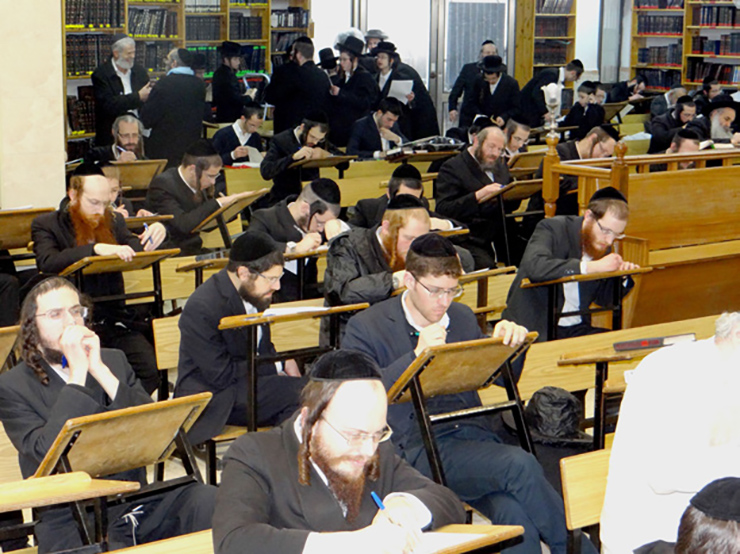
Lomdei Dirshu Take Test While City is Under Siege
A day before, it appeared that the second test in the Machzor Sheini of Daf HaYomi B’Halacha would be a routine Dirshu test despite it being a bit of a milestone. Lomdei Daf HaYomi B’Halacha were completing the laws of tzitzis and progressing to the laws of tefillin. The test in Eretz Yisroel was scheduled for this past Friday morning, 5 Iyar/May 6.
In our previous article, we began exploring the depth of S’firas HaOmer. Based on the Maharal and the Ramban, we explained that we are not counting down to Matan Torah, but rather we are building up towards it, ascending one day at a time. We do not wait for Shavuos to arrive; we actively bring it ourselves through the time and effort we invest as we count the Omer. After developing a general understanding of S’firas HaOmer, let us focus on a few specifics of the count itself. The 49 days of S’firas HaOmer parallels the 49-day process that the Jewish People went through upon leaving Egypt, before receiving the Torah. What is the meaning behind this process, and why is it specifically 49 days long?
We experience life through the medium of time. Each new moment brings with it new opportunities as we ascend through the journey of time. Amidst the constantly moving waves of time, the chagim (holidays) are specific points imbued with unique energy. Each holiday presents us with the opportunity to tap into and experience the theme inherent at that point in time.
Imagine leaving the exile of Mitzrayim with klal Yisrael. You have just witnessed the miracles of Y’tzias Mitzrayim (the Exodus from Egypt) and are now traveling toward Har Sinai, ready to receive the Torah. In between, however, lies an extraordinary event: K’rias Yam Suf – the Splitting of the Red Sea (or Sea of Reeds). One can ask, though, why K’rias Yam Suf was even necessary. Why couldn’t the Jews go straight from the spiritual high and miracles of Y’tzias Mitzrayim to the experience of Matan Torah (Receiving the Torah)? Why did they first have to pass through the sea? This question is strengthened by the commentators who point out that this journey through the Yam Suf appears to be pointless. After all, Chazal explain that klal Yisrael exited on the very same side of the Yam Suf that they entered (Arachin 15a)! If Hashem simply wanted to destroy the Egyptians, there were easier ways to accomplish this. What was the purpose of such a journey?
One night, four students stayed out late, completely disregarding the test they had the next day. Before school the next the morning, they hatched a brilliant plan to avoid taking the test. They covered themselves with grease and dirt and went to the principal’s office. They told him all about how their car had gotten a flat tire the previous night on their way home from a wedding, and how they had to spend the whole night pushing it home.