
When Dahlia Abraham-Klein attended Yeshiva Dov Revel in the 1980s, her curriculum focused heavily on Ashkenazi history and the Holocaust, with little attention given to her family’s history in Central Asia. Forest Hills was just beginning to experience the massive influx of Bukharian Jews who would transform the Jewish landscape of Queens, and her family was among the first to settle in the neighborhood.
“They started the Sephardic Jewish Congregation on 67th Drive, which is now under Rabbi Sholem Ber Hecht. Wherever they went, they built a community,” she said.
A few blocks away, the Cohanim family fled from the Islamic Revolution in Iran, sending their daughters to the Bais Yaakov of Queens. Many years later, Ellie Cohanim met Abraham-Klein at the Great Neck Synagogue, and they bonded over their memories of growing up Mizrachi in Ashkenazi schools. “We were the other and there was no interest,” she said.
Taking matters into her own hands, Abraham-Klein wrote books on her family’s experience that connected Persian, Bukharian, and Afghan Jews through trade, migration, and marriage. She began with books on food: Silk Road Vegetarian, which adapted her family’s recipes for a new audience. But she yearned to publish her family’s stories, which publishers were reluctant to print, as they did not expect a sizable readership interested in Central Asian Jewry.
“After I learned the ropes of publishing, I did not need a publisher. The printing expenses are nothing to talk about, the books are printed on demand. I don’t need to convince publishers,” she said.
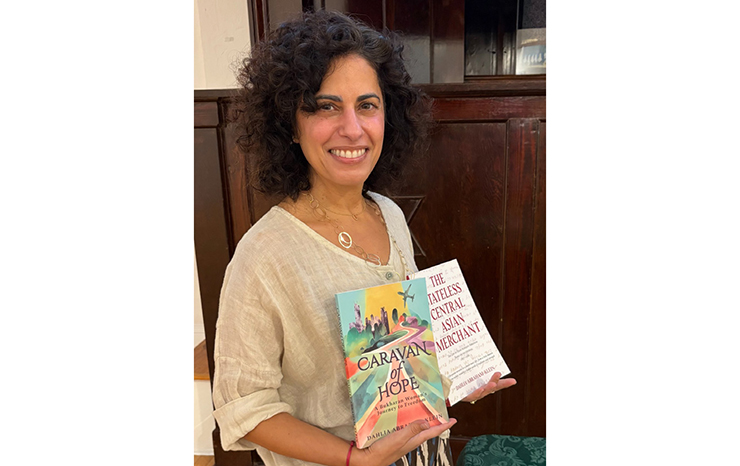
In 2023, she published Caravan of Hope, the story of her mother’s life. “She was born in prison. Her father was an Afghan merchant. He came with diamonds to marry my grandmother. Somebody informed on him,” she said. He avoided arrest thanks to Turkmen smugglers who brought him back to Afghanistan. The Soviet authorities instead came for his pregnant wife and imprisoned her. She was already a member of a suspect class, as she descended from Bukharian Jewish merchants whose wealth was confiscated following the Russian Revolution.
“She was a Yagudaev and she was educated. The prison warden respected her, and they helped her write letters to get her released.” She was also smuggled out of Uzbekistan, with a newborn strapped to her chest. “My grandfather was regarded as an Afghan national and they liked him. He traded with them, was honorable, and he understood Russian.”
When Israeli independence was restored in 1948, most Afghan Jews made aliyah as a religious duty. “My mother was among the first to leave Afghanistan. They thought that they were moving to a religious country. There was a pig slaughterhouse across the street from them in Tel Aviv.”
After marrying her father, Zina Abraham moved to Bombay, where he had a business, and in 1956 they immigrated to Queens. Her grandfather, Haim Aghajan Abraham, also settled here, living to the age of 102. After his death in 1999, Dahlia found his journal and sought to learn its contents. The book was not intended for anyone; rather, it was an exercise for its author.
“He started writing his journal at 90 years old. He needed companionship and to jog his memory. It was 100 pages long. That he could recall this much says something about that generation,” she said. Written in Judeo-Persian, it was translated in Israel and then published in English by Abraham-Klein.
“Our family originally came from Mashhad, which borders on the cities of Merv and Herat. When the Qajar army came to Herat in 1850, some went back to Mashhad and my family went to Merv. It had the Trans-Caspian Railway that benefited the region. My grandfather was born in Merv. Then his family went to Samarkand. They had an uncle in Samarkand.”
In this short description, she noted how today’s seemingly insular Mashhadi and Bukharian communities were connected in the 19th century by persecution, trade, and marriage, and they often moved from place to place. The deeply researched book offers insights into these Jewish communities and the societies in which they lived, such as Iran, Uzbekistan, Afghanistan, and India.
“The story of Central Asian Jews is not about victimhood. It is about resilience, forging ahead, and empowerment. We were merchants, constantly moving. Moving was our survival, and trade formed kinship. In America it flipped, and now they marry only among their own.”
Always a small community, Afghan Jews assimilated into the larger Sephardic population in Israel, and in America many of her family members either married Ashkenazim or out of the faith, which explains how she became a Klein. Her parents did not teach her Judeo-Persian because they prioritized English. Alongside books, Abraham-Klein relies on social media to tell the history and culture of Afghan Jews.
“I started to post on Instagram. With encouragement, these stories need to be told. People respond to videos and social media. I have Muslims following me, Indians, Pashtuns, those who say that they’re B’nei Yisrael. That’s really the way to get the word out. Explain our stories in short form.”
Cohanim felt the same urge, connecting Abraham-Klein to organizations and events where she spoke about Caravan of Hope and The Stateless Central Asian Merchant. In the latter, Queens College professor Manashe Khaimov wrote the introduction.
“Haim’s ability to thrive across multiple cultures and continents – even as far as Southeast Asia – illustrates the core paradox of his identity,” he wrote. “Though he was stateless, he was never rootless. His sense of self was guided by an unwavering Jewish identity that guided every aspect of his life.”
Khaimov also maintains a lively presence on social media in his role as the founder and CEO of SAMI: Sephardic American Mizrachi Initiative, which promotes the culture of Central Asian Jews on college campuses, among young professionals, and with kosher trips to Uzbekistan. He teaches a class on Bukharian Jews at Queens College.
Abraham-Klein said that the purpose of her books is not simply to preserve stories but to show pride in Jewish resiliency, which she finds lacking in America. “Jewish pride is missing in America. It has to be part of the curriculum. If you know your Jewish history, my family survived because they were religious.”
By Sergey Kadinsky