
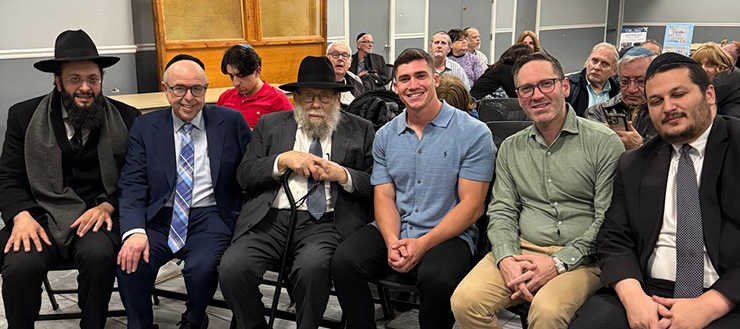
Imagine what it was like to be among the first IDF soldiers to march into Gaza after October 7. On Wednesday night, November 26, the community gathered at the Young Israel of Queens Valley to hear an incredibly inspiring firsthand account of that experience from Yosef Green, an IDF soldier who bravely fought on behalf of Eretz Yisrael and klal Yisrael for the past two years, and his wife, Batsheva, who courageously held down the home front. The program, hosted by Chazaq and the Queens Jewish Link, left everyone awestruck and grateful for the courage of this young couple.
First, Robby Aboff, Event Coordinator of Chazaq, greeted the large crowd and welcomed everyone. Next, Rabbi Yaniv Meirov, CEO of Chazaq and Rabbi of Congregation Charm Circle, led the recitation of T’hilim.
Rabbi Peretz Steinberg, Rabbi Emeritus of the Young Israel of Queens Valley, then spoke. He shared that when he taught at the Young Israel of Kew Gardens Hills, he had four girls in his class. All four eventually became shomrei Shabbos. One of them was the grandmother of Yosef Green, Anita Serle, who used to walk from her apartment on Aguilar Avenue to shul every Shabbos. He described her as a woman of exceptional midos and expressed how meaningful it was to see her grandson, who fought on behalf of klal Yisrael, speaking that night.
Following this, Mr. Yaakov Serle, publisher of the Queens Jewish Link and great-uncle of the speaker, shared that he was honored to have the organization Boots for Israel present and thanked everyone for attending. He noted that as soon as the war began, his great-nephew was drafted. Newly married and fighting for all of us, he said he marveled at Yosef’s bravery.
Next, Batsheva Green spoke about her experience. She reflected that she and her husband had witnessed many miracles over the past two years. They met when they were 18, when Yosef was enrolled in a Hesder program combining Torah learning with IDF service. They married at 19. Yosef served in the North for a year and a half, and they were eagerly awaiting his return home just before Sukkos.
She had baked a cake to celebrate his homecoming. But a few days later, October 7 happened and everything changed. She moved back in with her parents. She recalled her husband entering the house with his phone just as the first siren sounded, describing the moment as surreal. He left immediately for his base, and for the first few days there was no communication. Families were not allowed to visit. Friends and relatives sent duffel bags of supplies for the soldiers, and delivering these bags gave her a way to enter the base and briefly see her husband. The uncertainty during that time, she said, was agonizing. Three weeks later, there was an official visiting day, the last before the soldiers went into combat. “It was terrifying,” she said.
During the month before Yosef entered Gaza, she struggled emotionally. At a certain point, she told herself that if her husband knew she was depressed, it would make things harder for him. She explained that she had to continue with life because that was what he was fighting for. With Hashem’s help, she began sending him positive, uplifting letters. She also described the tremendous achdus during that time. She received phone calls, emails, flowers, and cookies from people she knew and from strangers. So many people said they were davening for her husband. “We felt that virtual hug,” she said. “It gave us chizuk.”
Yosef then told his story. He described the many miracles he experienced. Born in Boca Raton, Florida, his family made aliyah in 2009. An avid athlete, he played for Team Israel’s baseball team and had been offered a position that would have exempted him from army service. It was a difficult decision, but he chose yeshivah and combat instead. “I would never take back that decision,” he said.
On October 7, he was in shul about to begin a hakafah when the rabbi told him that his commander was trying to reach him. He rushed home, retrieved his phone, and was instructed to report to the base immediately. His former gear was gone. He received random equipment and a gun that, to his dismay, did not work. As a frontline machine gunner, having no functioning weapon was alarming but unavoidable.
On October 8, the unit was flown by helicopter to the northern border, where they remained for a week and a half. Then they were told that they would be entering Gaza in three to four weeks. By that time, Yosef finally received a reliable gun. His unit was assigned to be the first to enter Gaza on foot. The trek was a grueling seven-and-a-half-kilometer walk through deep sand. They entered and began taking significant territory.
After the first ceasefire, with some hostages released, things became even more difficult. A month and a half into the war, exhaustion was severe. They barely slept. Days were filled with intense fighting. Soldiers broke down.
One night, while guarding a house, Yosef stood by a window and spoke to Hashem. “Hashem, thank You for keeping us alive. We need some strength.” Army jeeps sometimes brought food, water, and snack boxes. After that t’filah, Yosef opened a box using a small red flashlight since there was no electricity or running water. Inside, he found a package labeled, “For the protection of Yosef Dov ben Rinat Rachel.” It was a box of his mother’s home-baked cookies. Later, he learned that a 23-year-old student in the Mir Yeshivah, who was learning in his merit, had invited his mother to a siyum. She brought cookies, labeled the leftovers with his name, and sent them to the army. They eventually reached him in Gaza. “To this day,” Yosef said, “I am still learning with that guy.”
He shared another miracle from Jabalya on the first night of Chanukah. This area served as a Hamas headquarters. The soldiers had to move single file through narrow walkways where tanks could not pass. Yosef, the frontline machine gunner, and his commander entered a house from the left side. They spotted the foot of a terrorist hiding behind a couch with a machine gun ready. Yosef’s friend shot him, saving Yosef’s life. The house contained a massive store of weapons. Yosef later lit his neir Chanukah in a tuna can supplied by the army. This was his Chanukah miracle.
Another miracle occurred during a 48-hour mission guarding tunnels. Yosef rode in the back of a Hummer-style vehicle with ten soldiers. After five minutes, a powerful explosion flipped the vehicle. All were covered in blood. Three soldiers did not make it out. The machine gunner died instantly, and the commander was critically injured. The backpacks hanging off the sides absorbed much of the shrapnel, which saved Yosef and the other ten soldiers.
After four and a half months, Yosef was released from Gaza in time for the birth of his daughter. Two months later, he seriously injured his hand while trying to separate frozen hamburgers and needed surgery. A month and a half afterward, he received notice that his unit was being deployed to Lebanon. Because of his injury, he was unable to join them. This was around Sukkos, during which there were many casualties, including Rav Shaul Moyal, father of ten from Samaria. “I was supposed to be there, but I wasn’t,” he said. “Hashem kept me safe. He gave me another chance.”
Yosef explained that what kept him going most was a personal promise never to remove his tzitzis and never to miss davening. He davened three times a day regardless of circumstances. He put on t’filin in Gaza and recited Sh’ma before going into battle.
He added that he and his unit entered thousands of homes, and in 99 percent of them there was some connection to Hamas. There were pictures of leaders on the walls, rocket launchers, or guns. Gaza’s civilians elected Hamas as their leaders. He said the media’s portrayal of innocent civilians is false. Terrorists operated in schools. Before the IDF launched an attack, they issued warnings, and soldiers helped elderly Palestinians down the stairs and out of harm’s way. This was the opposite of Hamas, which commits massacres. Hamas is not an army; it is a terrorist group. “As Jews, we value life.”
Now released from the army, Yosef coaches baseball for boys under 18 and works in real estate.
When asked how he felt about global anti-Israel and anti-Semitic sentiment, he replied, “Who cares what other people think? We have am Yisrael.” He described seeing stickers in Eretz Yisrael commemorating fallen soldiers, young men who gave their lives shortly after high school. “We value life. We are here to help others.”
Several audience members thanked him for his heroic service. Yosef responded, “We felt your help and your support.”
He showed a video of a young boy with Down syndrome who had been given his name to daven for. Every day, the boy davened for him. When Yosef returned from the war, he visited the child. The video showed the boy hugging him tightly and crying, a powerful and beautiful expression of the pure love and caring that Hashem wants from us all.
Thank you to the Queens Jewish Link and Chazaq for hosting this remarkable program. We are honored that Yosef visited, and we are grateful for his heroic service. May Hashem bless him and his family with good health, and may am Yisrael merit true and lasting peace with no more war.
By Susie Garber