

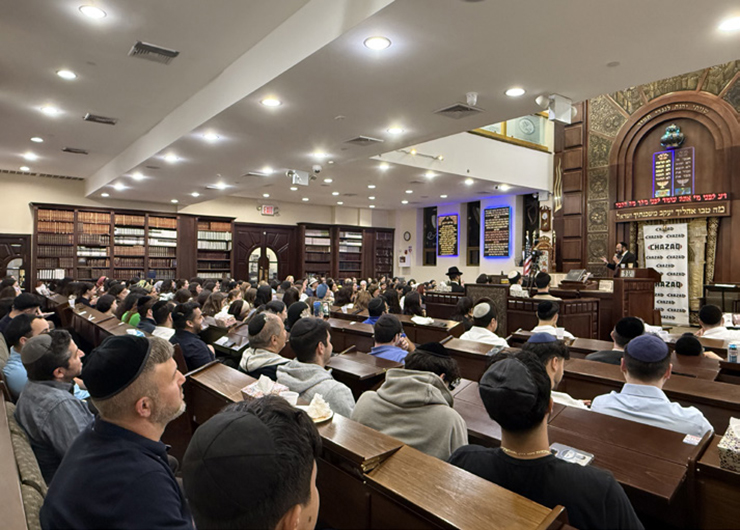
On Thursday evening, July 20, Rabbi Joey Haber, well-known speaker, and Rabbi Yitzchak Aminov, of Kol Yisrael, spoke at the Bukharian Jewish Congregation of Jamaica Estates on the topic of jealousy. The shiur, titled “Why Not Me? The Poison of Jealousy,” was hosted by Chazaq, Kol Yisrael, and Milana’s Jewish Kiruv Movement.
Rabbi Aminov spoke first. He said that the Ramchal calls jealousy a painful midah, one that we are born with and can see even in little children. Each mitzvah corresponds to a certain body part, and Sefer Chareidim says that this quality of jealousy is found in the Ten Commandments, with the mitzvah of “Do not covet” connected to the heart.
King Shlomo says jealousy is connected to the bones and that the bones rot when a person is jealous. Rav Wolbe teaches that this means that when you hear that someone did something better than you or achieved something you wish to achieve, the psychology of a person is such that his own performance begins to diminish in his eyes. Jealousy eats up what you have. Theodore Roosevelt said, “Comparison is the thief of joy.”
When we are busy focusing on someone else’s grass, we neglect our own lawn, and the idea of the bones rotting means that we stop believing in the good that we ourselves possess. The Ramchal teaches that no one is in your league, because everyone was created with his or her own mission, tools, and strengths, and Hashem has a different plan for each person.
We should therefore notice the good that Hashem gifted us with. Every morning, ask yourself: What has Hashem given me today that someone else would love to have? The more we notice our own blessings, the less attractive someone else’s blessings become.
Rabbi Haber spoke next and began by noting the human tendency to keep waiting for something else. Whatever you’re hoping to get through today, you’ll eventually get there, but then you’ll simply be waiting for something else. How, then, do we stop ourselves from constantly waiting and asking the question, “Why not me?”
Avraham Avinu hosted guests who were really angels, although he thought they were nomads. Why did Hashem make them look like nomads? Rabbi Haber explained that this was a way to teach us how important it is to treat others kindly. We look at someone and judge him or her, but we should never judge that person, because the nomad standing before us could really be an angel.
Avraham did not judge his guests, and he treated them very well, even though they appeared to be nomads. Yet a lot of us are not as guilty of judging others as we are of judging ourselves. We look at ourselves as not so great, even though we should be cognizant of the fact that we were created by the greatest Creator. Because we know our own faults and weaknesses, we focus on our mistakes and think that we’re not good enough, while looking at other people we barely know anything about and fantasizing that their lives are this or that. We must put ourselves in the right frame of mind.
The pasuk in B’reishis states that Avraham was old and Hashem blessed him with everything. Ba’kol, according to the Rambam, is a midah: the ability to look at my life and say, “I have everything.” Avraham experienced ten tests, and after the last test, his wife Sarah was dead. Was this really “everything”? He had a very tested life, but “everything” means that I view both the good and the bad in my life as my everything. “This is everything I need to have for me to be me. I need the good and the challenges. I need the bad. That’s my everything.”
If Avraham had not gone through all those tests, he would not have become Avraham Avinu, because those tests were part of what made him who he was. In the same way, what is in my life is everything I need, and the problems are part of my everything. Even what I’m missing is part of my everything. When you look at your life this way, you understand that Hashem gave you an “everything,” and all of it together is exactly what you need.
Problems begin when we start comparing ourselves to others, especially because nothing is really what it looks like from the outside. When you view a video of Disneyland, it looks like the happiest place on earth, but the video doesn’t tell you that there are two-and-a-half-hour lines. Your neighbor’s house is not necessarily what you imagine it to be either. Instead of looking at someone else’s lawn, look at your own lawn and water it, recognizing that you are gaining from the challenges you have.
Ask yourself what Hashem wants from you through the challenge you are experiencing and recognize that this challenge is part of your everything. Your job is to say that what you have is perfect for you.
At the end of Avraham’s life, he gave gifts to his children and then gave everything to Yitzchak, passing on to Yitzchak this midah that what I have is everything. Later, Yaakov gave Eisav gifts. Eisav said, “I have a lot,” while Yaakov said, “I have all. I have the blessing of my father and grandfather.” That attitude is the way you water your own grass.
This is what I need, because there is a blessing and a purpose in it. If I didn’t have this challenge, something would be missing from the person I am supposed to become. There is no other attitude to have; otherwise, you will just keep waiting and waiting for something else. If you can develop this attitude, then you have the most incredible blessing, because the challenge itself makes you change, helps you grow closer to Hashem, and shapes who you are supposed to be.
Happiness is not a destination. Happiness is the decision that I will be content today, right now, where I am.
In Birkas HaMazon, we ask Hashem to have mercy on us and bless us as our forefathers were blessed with ba’kol, mi’kol, kol, with kol referring to Yaakov. That is the blessing that is complete.
This shiur can be viewed on www.TorahAnytime.com.