

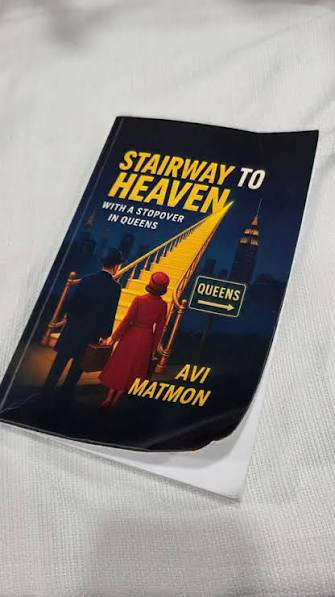
Rabbi Avi Matmon, a member of the Queens community, traces his spiritual journey to Yiddishkeit in his recently published memoir, Stairway to Heaven: With a Stopover in Queens. Throughout the book, he weaves his personal story together with powerful quotes, Torah teachings, and ideas that influenced his own growth. He shared that his goal in writing the memoir is to inspire others to draw closer to Hashem and the mitzvos.
The book’s opening line immediately draws the reader in: “Even though I died twice in this book, I am still here to write about it.” Rabbi Matmon describes how he contemplated the secular definition of success – money, a car, a house – and came to realize that he was searching for something much more. “…I felt I wanted something greater… something money couldn’t buy.” He writes, “My soul was searching for something – hungry for it.”
Rabbi Matmon draws on ideas from the Rambam, numerous other Torah sources, and the teachings of Rav Avigdor Miller about Shabbos and t’filah. He discusses the famous question raised by the Torah’s description of the creation of man, when G-d says, “Let us create man.” Who is this “us”? Rabbi Matmon explains that G-d is teaching us that each person has a task and a mission. Each of us is here, in a sense, to create ourselves.
Rabbi Matmon writes that he hopes to help the reader understand how to achieve freedom of mind and contentment, and the book succeeds in conveying that message. Along the way, he shares his parents’ experience adjusting to life in America as immigrants, as well as the remarkable story surrounding his own birth. His parents endured 12 miscarriages before he was born. They received a brachah from the Lubavitcher Rebbe that they would have a child, conditional upon their keeping Shabbos. He also recalls visits to his grandparents’ home in Israel.
He relates stories from the Gemara and the Chofetz Chaim illustrating the importance of keeping one’s promises. He also explores the power of prayer and the power of speech. Speech, he notes, is a Divine gift given only to mankind. “We are the power of the voice, kol Yaakov.”
Rabbi Matmon also writes about the power of reciting Nishmas Kol Chai and singing t’filos at the Shabbos table. He describes Nishmas Kol Chai as the “crown jewel,” an extraordinarily beautiful and meaningful t’filah.
One particularly interesting discussion concerns the role of emotion and association in t’filah. Rabbi Matmon explains that when Esther needed to pray, she made use of a powerful tool that G-d gave us: association. She deliberately walked through the corridors of the palace and stared at the windows, evoking within herself a feeling of despair that would put her in the emotional state necessary to cry out to G-d.
He continues: “Prayer is meant to touch many emotions. Each paragraph has deep-seated ideas that our Sages have revealed to us through our holy books. Plus, reciting prayers over the years provides personalized experiences that can produce even more feeling and connection. We have to learn how to reveal and unfold them from within ourselves through each prayer.”
Rabbi Matmon teaches that, just as Esther used association to evoke feelings of despair and brokenness, a person can use association to awaken many different emotions in avodah she’ba’lev. He writes, “I personally use association to capitalize on the feeling of appreciation. One prayer can convey sadness while the other, excitement; one could transmit joy while the other, excitement; one could sprout out excitement while the other, remorse. By the end of the prayer service, we will have shared many of our emotions with G-d. … A person can achieve a closeness that one could never have imagined, where we would be able to notice His presence. A person would then come out of the Morning Prayer as a new person. One that is happier and more satisfied with life.”
Rabbi Matmon also shares the famous observation by Mark Twain: “The Egyptian, the Babylonian, and the Persian rose, filled the planet with sound and splendor, then faded to dream-stuff and passed away; the Greek and the Roman followed and made a vast noise, and they are gone; other peoples have sprung up and held their torch high for a time, but it burned out, and they sit in twilight now, or have vanished. The Jew saw them all, beat them all, and is now what he always was, exhibiting no decadence, no infirmities of age, no weakening of his parts, no slowing of his energies, no dulling of his alert and aggressive mind. All things are mortal but the Jew; all other forces pass but he remains. What is the secret of his immortality?”
Rabbi Matmon goes on to share what he sees as the answer to Twain’s question: Torah study. As Stairway to Heaven: With a Stopover in Queens traces Rabbi Matmon’s personal journey, it also offers the reader numerous lessons about faith, prayer, personal growth, and the search for a more meaningful life. It is a fascinating read.
The community wishes Rabbi Matmon good health and much success in all his endeavors.
By Susie Garber