

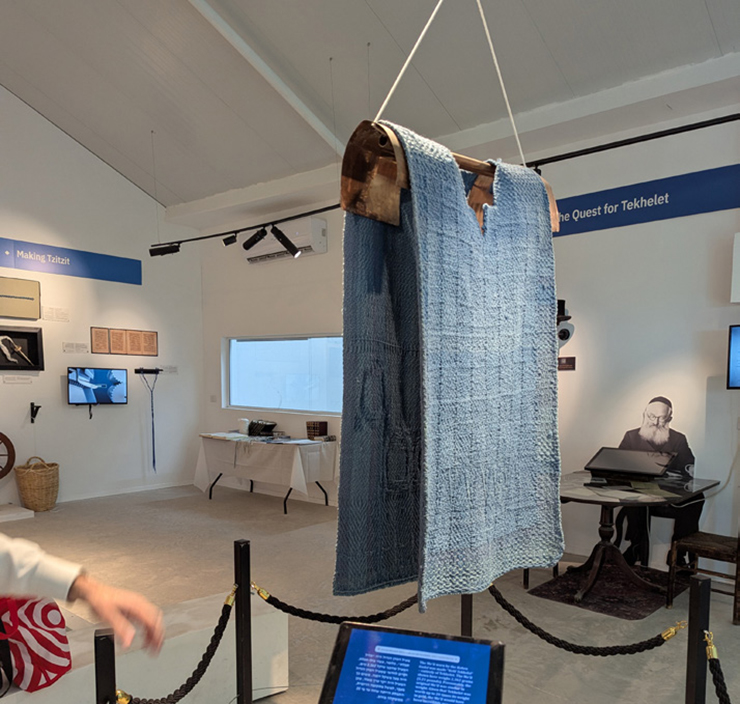
A visit to the Ptil Tekhelet Education Center in Kfar Adumim, Israel, offers a fascinating look at the history, science, and halachic discussion surrounding t’cheiles. During our tour, the guide explained how t’cheiles was produced in ancient times, how knowledge of the dye was eventually lost, and how researchers came to identify what many believe is the original source of the biblical blue dye. He also demonstrated the dyeing process and showed us some of the equipment used today.
Our guide began by noting that t’cheiles is mentioned 49 times in Tanach. Its first appearance is in connection with the construction of the Mishkan, where t’cheiles was used in its coverings and other materials. The Kohen Gadol also wore t’cheiles on four of his garments. Later, in Megillas Esther, the color appears in the description of the bigdei malchus, the royal garments, reflecting how rare and prized these colors were in the ancient world.
One of the most remarkable qualities of authentic t’cheiles is the durability of its color. Fabrics discovered at Masada and in the Bar Kochba caves were dyed from the same type of sea creature and have retained their color over the centuries. The chilazon lives in the Mediterranean Sea, and the guide showed us a tank containing these extraordinary snails. Considering their historical significance, it was surprising to see just how tiny they were.
Although the chilazon is native to the Mediterranean, the snails used today for producing t’cheiles are generally obtained from other areas, including parts of Europe, so that the Mediterranean population will not be depleted. Archaeologists have uncovered approximately 60 ancient sites connected with the production of this dye, providing further evidence of how widespread and valuable the industry once was.
One important site is Tel Shiqmona, which served as a major center of dye production using the murex snail during the period of the Bayis Rishon. Tosafos indicates that t’cheiles was known throughout the ancient world, while the Gemara famously describes the chilazon as having a body resembling the sea and a form resembling a fish and says that it rises once in 70 years.
The science behind the dye is equally fascinating. The snail remains in the water while its shell continues to grow with it, and a gland known as the hypobranchial gland produces the substance from which the dye is made. When first extracted, the liquid appears yellow, but as it oxidizes it turns a deep purple. Under the proper conditions, it can then be transformed into the distinctive blue associated with t’cheiles. Approximately 20 snails are required to produce enough dye for one pair of tzitzis. Of the roughly 1,700 species of snails found around the world, three inhabit the Mediterranean, although other species are also capable of producing a similar blue dye.
Because fabrics colored with these dyes were extremely valuable, they became closely associated with wealth and royalty. The guide explained that following the period of the Second Beis HaMikdash, Roman restrictions were one of the factors that led Jews to stop wearing t’cheiles. The Romans sought to reserve these rare and costly colors for emperors and members of the ruling class, and laws prohibited ordinary people from wearing or selling certain dyed fabrics.

These restrictions became especially severe under Emperor Justinian, who decreed that anyone using fabrics dyed from the snail could lose both his possessions and his life. The guide showed us a Roman coin bearing the image of an eagle, with crushed snail shells depicted beneath it. The presence of the shells on Roman coins reflected the importance of the dye industry and Rome’s desire to assert control over this highly valuable commodity.
There were also imitation dyes in circulation. The guide showed us an example of a false dye known during the time of the Gemara that was produced from a plant rather than from the chilazon. By the seventh century, however, the knowledge and infrastructure necessary to produce genuine t’cheiles had largely disappeared. Rabbi Isaac HaLevi Herzog believed that the manufacturing centers were destroyed during the Muslim conquest of Eretz Yisrael around 638 CE. By the era of the great Geonim and Rishonim, including the Rambam, t’cheiles was no longer available and was spoken of as something that had been lost.
Centuries later, attempts were made to rediscover it. In 1889, Rabbi Gershon Henoch Leiner, the Radzyner Rebbe, concluded that the chilazon was a squid known as the cuttlefish and began producing thousands of t’cheiles strings based on that identification. Rabbi Herzog later examined the question extensively in his 1913 dissertation and rejected the cuttlefish identification, instead pointing to the Murex trunculus as the likely source.
One difficulty remained: The dye produced by the murex appeared purple rather than blue. That question was addressed in the early 1980s, when Otto Eisner discovered that exposing the dye to direct sunlight during the production process causes it to turn a brilliant indigo blue. This discovery helped strengthen the case for identifying the murex as the source of t’cheiles.
The halachic discussion, however, is more complicated. Rabbi Yosef Dov HaLevi Soloveitchik discussed the Radzyner Rebbe’s t’cheiles and rejected it, although two different explanations of his reasoning have been recorded. According to one version, because the squid had been known to rabbanim throughout the generations and had never been identified as the chilazon, that longstanding absence of identification effectively constituted a negative tradition. According to the second version, identifying the chilazon requires a positive mesorah, which would mean that the restoration of t’cheiles must wait until Messianic times.
The distinction between those two approaches has important ramifications for the contemporary use of t’cheiles produced from the Murex trunculus. Similarly, the Midrash’s statement that t’cheiles was nignaz, or hidden away, has been interpreted in different ways. T’cheiles such as Rabbi Yechiel Michel Tucazinsky understood the term to mean, that t’cheiles became rare or inaccessible, rather than that it disappeared completely or that its future use was prohibited (“Topics in Perek HaTekhelet, Daf Yomi Menachot, Perek 4”).
The center also displays examples of the different opinions regarding how the t’cheiles strings are incorporated into tzitzis, allowing visitors to see how the various interpretations are applied in practice. We were also shown the machinery used in the modern production process, which helped bring together the historical, scientific, and practical aspects of what we had learned.
The visit was a fascinating educational experience and provided a deeper appreciation of a mitzvah whose history stretches back thousands of years. Our guide also mentioned that a website is available listing g’dolim who wear t’cheiles today.
By Susie Garber