
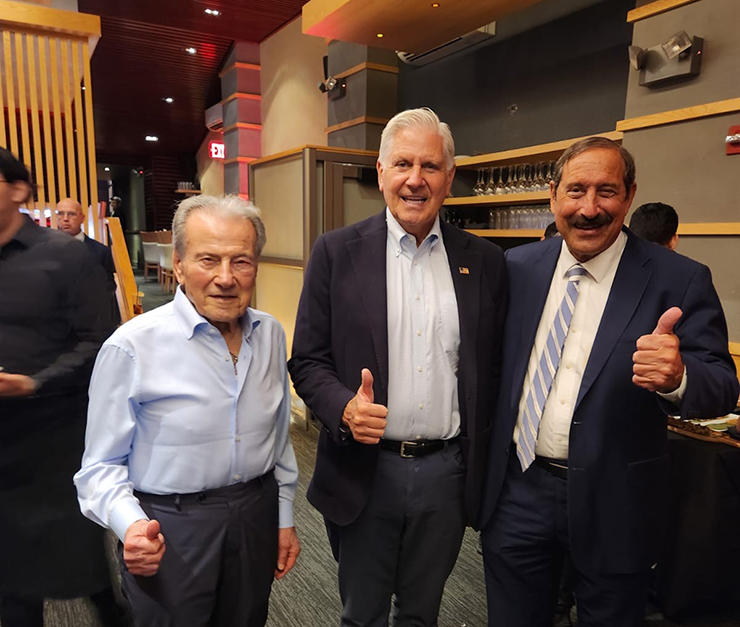
On Sunday, July 12, Dr. Joseph Frager hosted a tribute at Sen Sakana, the kosher Japanese-Peruvian restaurant in Midtown Manhattan owned by Jerry Wartski and managed by his son, Allan. The gathering honored Wartski, a 96-year-old Holocaust survivor, longtime Israel advocate, and honorary president of the Israel Justice Organization (IJO). It also gave Nassau County Executive Bruce Blakeman, the Republican and Conservative nominee for governor, an opportunity to explain why he entered the race while continuing to serve in county government.
Born in Osjaków, Poland, in 1930, Wartski was nine when Nazi Germany invaded. During one Nazi selection, he stood on loose bricks to make himself appear taller and old enough for forced labor. The split-second decision saved his life, as children and elderly Jews were separated for deportation and murder.
Wartski was later deported to Auschwitz-Birkenau, where his mother was murdered in the gas chambers. He survived starvation, forced labor, and a death march, while his father died during the final months of the war. Wartski was ultimately liberated in Germany. He arrived in the United States in 1949 and built a successful career in Manhattan real estate.
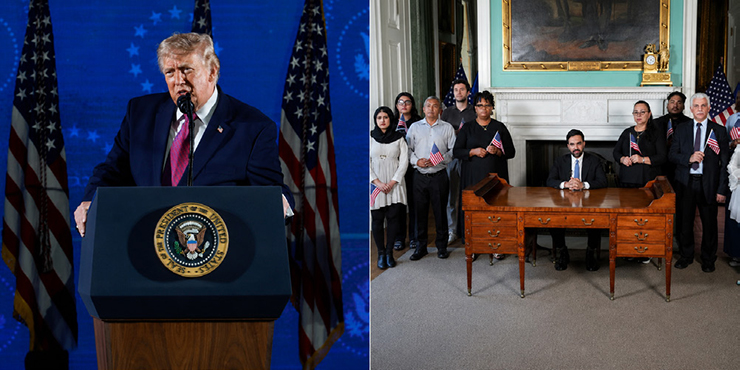
After decades of rarely discussing his wartime experiences, Wartski began speaking publicly as the survivor generation dwindled and antisemitism again became more visible. In a 2024 Trump campaign advertisement, he displayed the prisoner number tattooed on his arm, rejected comparisons between Trump and Adolf Hitler, and called Trump a mensch. After attending Trump’s rally at Madison Square Garden, Wartski also condemned comparisons between that gathering and the Nazi rally held at an earlier Madison Square Garden in 1939.
Frager, a New York gastroenterologist for more than four decades and IJO chairman, introduced communal leaders. Blakeman began by noting his three-decade friendship with Frager, quipping, “The only negative thing about him is every time I go to shul and I’m about to get into my zone, he says, ‘So, what do the polls say?’”
Blakeman addressed the question he hears constantly: Why leave a comfortable position in Nassau County to run statewide?
“I wanted nothing to do with running for governor,” he said. “I was happy being County Executive. My county is larger than eight states.”
Blakeman said his thinking began to change after his decisive reelection in Nassau County. He recalled receiving a congratulatory call from Trump at about 1 a.m.; according to Blakeman, Trump had expected bad news from Nassau and expressed surprise upon learning the size of the victory. Calls from business, religious, and political leaders urging him to run followed the next day.
His wife, Segal, suggested that he travel around New York and hear directly from residents before deciding.
Blakeman recalled traveling the state and hearing a consistent theme.
“I found that people were miserable,” he said. “Every corner of the state, people were miserable under Kathy Hochul.”
Referring to his “24/7” campaign schedule, he added, “I told my rabbi, ‘I meant 24/6.’ He said, ‘Don’t worry, we’ll give you a waiver on this one.’”
Blakeman repeatedly returned to what he called Hochul’s “unholy alliance” with New York City Mayor Zohran Mamdani. He noted that the two had endorsed each other and argued that their partnership placed the state’s economy, public safety, and religious life at the center of the race.
Blakeman cited a ranking placing New York 50th in economic outlook.
“It’s a national embarrassment,” he said.
He argued that high taxes and heavy regulation are driving businesses and middle-class residents out of the state. He claimed New York utility rates are 70 percent above the national average and that only 30 percent of a typical bill reflects the energy itself. From snow-covered solar panels to the cost of offshore wind, he argued that New Yorkers are paying a premium for unreliable energy.
Blakeman called for natural-gas development in New York’s Southern Tier, arguing that increasing the supply would lower energy costs.
On public safety, Blakeman criticized cashless bail and the HALT Act, calling Hochul the nation’s most “pro-criminal governor” before turning his criticism to Mamdani.
“He talks about collectivism,” Blakeman said. “That’s not socialism. That’s communism.”
Turning to antisemitism, Blakeman picked up on an earlier warning that the political climate carried echoes of the 1930s.
“I tell my Christian friends, the Jews are the appetizer,” he warned. “You’re the main course.”
Blakeman cited the cancellation of a Puerto Rican heritage breakfast involving Christian clergy, which he said he later sponsored himself, and noted Mamdani’s absence from the installation of New York’s new archbishop.
“It’s not just the Jews,” Blakeman said. “He has a bias against Christians.”
Blakeman contrasted Hochul’s record with his administration in Nassau County, saying the county had hired more than 900 law-enforcement professionals, received seven bond-rating upgrades, and recorded four consecutive budget surpluses without raising property taxes.
“People in Nassau County are happy,” he said. “But people in this state want opportunity.”
Blakeman also accused progressive officials of weakening traditional family life, objecting to policies allowing biological males into girls’ locker rooms and bathrooms and to bureaucratic language replacing the words mother and father.
“The Ten Commandments say, ‘Honor thy father and mother,’ not gestating and non-gestating parents,” he said.
Blakeman cited a poll by co/efficient for the Coalition to Protect Nassau Taxpayers showing him trailing Hochul by six points, 47 percent to 41 percent, with 12 percent undecided.
“If I’m six points behind now, we’re going to win this thing,” he told the gathering.
He noted that his campaign had submitted more than 66,000 signatures to seek an independent Vote Affordable ballot line, exceeding the 45,000 required. Blakeman said the additional line would give voters who would not consider voting on the Republican or Conservative lines another way to support his candidacy.
He said he hoped to assemble a coalition of Republicans, conservatives, independents, religious voters, business owners, and “common-sense Democrats.” Blakeman planned to meet afterward with Brooklyn Democrats who, according to him, were troubled by their party’s direction.
“We never thought we would say this, but you’re our last hope,” he recalled them telling him. “You’re the guy who could save the Democratic Party.”
“This battle is not for us,” Blakeman said in closing. “It’s for our children and our grandchildren. What kind of world are we going to leave them?”
“Todah rabbah,” Blakeman concluded. “May Hashem bless you all, and may Hashem bless the United States of America.”
By Shabsie Saphirstein