
Politicians and influencers are quick to reference Jews and Israel,
but far less eager to listen to them
This summer began with a viral chant coined during the NBA playoffs, when a Knicks fan appeared in a crowd chanting the words, “My mayor’s Muslim, my bagel’s Jewish, my Christian Dior...” The last line was later modified to reflect the reality of the final score between New York’s victorious hometown basketball team and the San Antonio Spurs.
The fan who made those words famous is a Muslim, MD Ahnaf Hossain, 23, of Jamaica. He spoke of the Jewish delicacy as a reflection of the city’s diversity. Not a bad thing, considering the recent uptick in anti-Semitic incidents and reduction in political representation, with candidates hostile toward Israel winning Democratic primaries at the state and federal levels. Hossain’s chant earned him thousands of followers, a spot in front of City Hall during the ticker-tape parade, and a meeting with Mayor Zohran Mamdani.
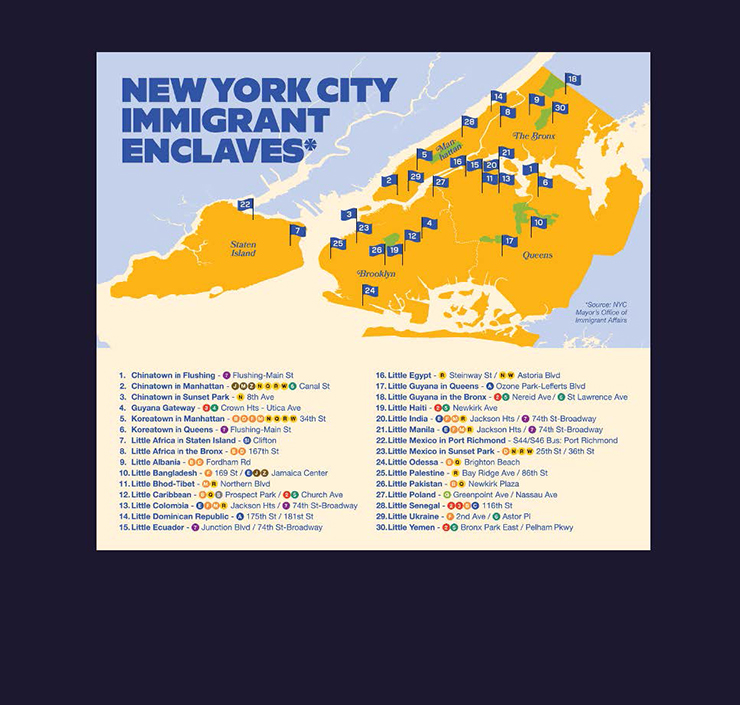
Concerning viral news stories, two weeks ago I stopped at a public library to pick up the NYC Neighborhood Passport, a scavenger-hunt booklet published by the mayor’s office to celebrate the city’s role as a host of this year’s World Cup. The map inside this keepsake identified 30 immigrant neighborhoods, such as Little Egypt, Little India, and Little Tibet in Queens. Some places of origin received multiple mentions: Guyana, Korea, three Chinatowns, and one Little Palestine in Bay Ridge.
On the list of partner organizations, the “Museum of Jewish Heritage – A Living Memorial to the Holocaust” stood out as the only Jewish institution among the many museums, community centers, and advocacy groups.
On July 2, I tweeted my disappointment with the map, suggesting that if it had a place for Israel, it would be Main Street in Kew Gardens Hills. I received a handful of likes and a comment that white ethnicities were represented by Little Albania, Poland, and Ukraine.
A week later, writer Avital Chizhik-Goldschmidt tweeted this map, and it went viral. It generated conversations about whether descendants of older immigrant groups, such as the Irish and Italians, deserved a place on the map. What about US-born African Americans and Puerto Ricans, non-immigrants who left a huge cultural imprint on the city? Concerning Jews, did we want to appear on a map published by a mayor who pretends that Israel does not exist? It would be foolish to label the Satmar community of Williamsburg as Little Hungary. Should we settle for Little Odessa and Little Uzbekistan as stand-ins for recent Jewish immigrants?
Historically, Jewish ghettos in the Old World were nicknamed Little Jerusalem. It would be a fitting name for Borough Park, whose Jewish population is reminiscent of the holy city’s chareidi communities. Would the label be acceptable to anti-Zionists who cannot separate the concept of the Jewish homeland from the Jewish state?
Last week, Mamdani agreed to add Little Italy to the map, which resulted in laughter on social media, as this district is merely a couple of blocks catering to tourists rather than a thriving community of immigrants and their descendants. By this metric, the Lower East Side would be the likely candidate for the Jewish label. But if Mamdani won’t call it Little Jerusalem, what would it be? The placement of the city’s Jewish communities on the map could play the same role as the bagel in Hossain’s lyrics: a recognition that we are an inseparable part of the city’s identity. More preferable would be a mayor who takes our concerns about anti-Semitism seriously.
Then there are the self-described allies who feel important enough to dictate terms to Israel. Former Chicago Mayor Rahm Emanuel delivered a speech that ignored current reality, urging Israel to return to the two-state solution, with recognition of the Jewish state by all Arab countries as the reward.
“I flew here from Chicago to tell you directly where things need to head if we are going to maintain the historic alliance that binds our two democracies,” he told an audience last Wednesday in Tel Aviv. “Without question, the alliance is at a crossroads. It cannot stand or survive as it has been. To maintain the strength of our ties, we need significant changes and a new direction.”
Emanuel spoke of his personal connections to Israel as the son of a veteran of the 1948 war, a staffer for President Clinton during his administration’s attempts to negotiate peace, and President Obama’s chief of staff during the Iranian nuclear talks. He spoke of Founding Prime Minister David Ben-Gurion’s dream of Israel being an equal among nations rather than a heavily militarized pariah.
His toughest words were aimed at the nationalist elements within Israeli society, equating them with the terrorists who seek the destruction of the country. “The pursuit of a so-called greater Israel is as self-destructive and fanatical as the chant ‘from the river to the sea.’ Your government has been complicit in the horrors now being inflicted on innocent families in the West Bank.”
There are, unfortunately, too many examples of Israeli soldiers and civilians recording themselves committing destructive acts. These include anti-Arab graffiti, property theft, the burning of farms, and heaping verbal abuse on non-Jewish individuals.
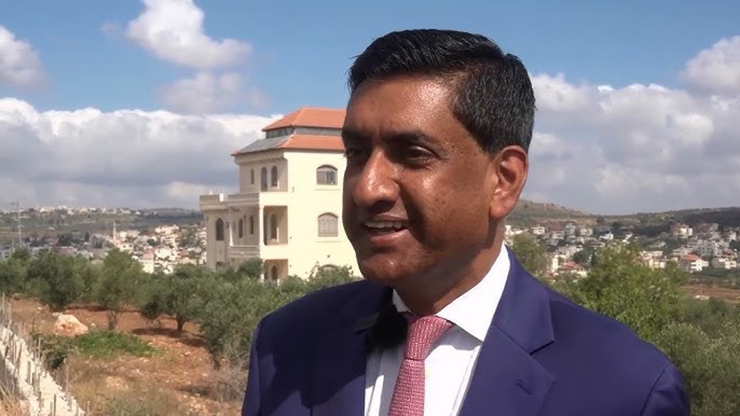
California Rep. Ro Khanna was already hostile toward Israel ahead of his unannounced visit last week.
“I see these young men brandishing M4s, circling, circling our vans, cursing us out in Hebrew and Arabic, which I didn’t understand, and filming us, laughing at us, wiping our windows while doing that, blockading us,” Khanna said to CNN.
After contacting the American Embassy, which spoke with the Israeli army, Khanna’s tour group was allowed to proceed. In another interview with NBC, he described the armed civilians as “hoodlums,” complaining that the army took the side of the armed settlers rather than the distinguished American visitor.
Khanna was offered the opportunity to meet former hostages and Druze activists and to receive a briefing on Israeli humanitarian aid entering Gaza. Instead, he kept the Israeli government out of the loop and had an anti-government organization serve as his tour guide.
When his car was stopped by armed Jewish civilians, he recorded his gotcha moment of settlers menacing a member of Congress. His description of the long-suffering Palestinians was also predetermined to fit his narrative, never mind the mansion behind Khanna in one of his videos that illustrated the unspoken reality of wealthy Palestinians.
During his trip, Khanna told NBC that he was seriously considering a presidential run in 2028.
“They’re using us as props,” Israeli journalist Haviv Rettig Gur told The Free Press. “None of this answers the questions that Israelis are actually asking. None of this answers the questions Palestinians are actually asking, and all of this is explicitly geared toward questions that Democrats are asking back home. It literally feels that they’re treating us as a dramatic backdrop to create the moral authority for their gamesmanship.”
On the opposite side of the political spectrum, 21-year-old social media influencer Braden Peters, known online as Clavicular, also visited Israel to take in the party scene in Tel Aviv.
When Israeli Channel 13 reporter Bar Shem-Ur asked Peters whether he would apologize for appearing in a Miami nightclub last January alongside other anti-Semitic influencers who were giving Nazi salutes to the music of Kanye West, the visitor stormed off the set.
“How much I’ve done for this country’s reputation, because it is in shambles,” he said. “I don’t have to be in Israel... I’m here to do a good thing for the country.”
Peters felt that he was doing a favor for Israel without holding himself accountable for associating with Nick Fuentes and Kanye West.
Emanuel also feels that he can salvage what is left of the US-Israel relationship by serving up tough love and asserting his own relevance in the Democratic Party.
Khanna’s visit provided a distraction from his disastrous support of disgraced Senate candidate Graham Platner and an opportunity to raise the possibility of his own presidential bid.
In these circumstances, Israel has as much cultural value as the bagel in Hossain’s lyrics or the missing flag on the mayor’s map of neighborhoods. Jews are a backdrop, a token when useful, but denied a true voice of representation that reflects our values, aspirations, and concerns.
By Sergey Kadinsky