
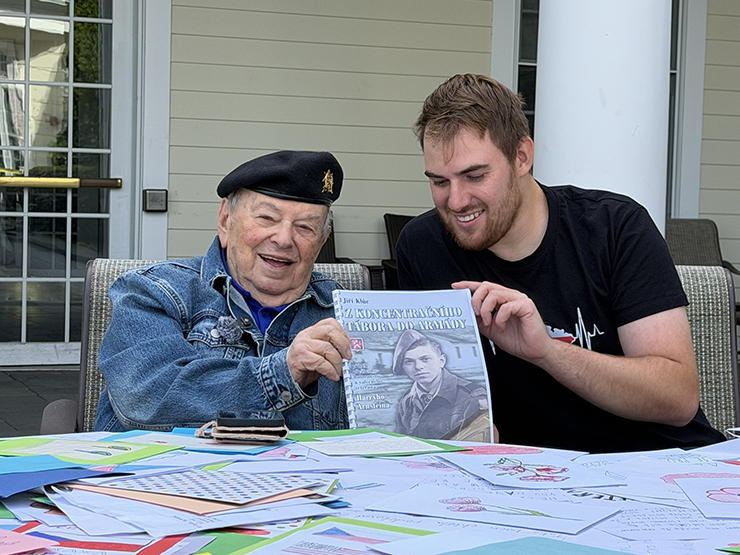
Harry Arnstein survived a concentration camp and served in three armies: the British, Czechoslovak, and American. On Saturday, October 10, 2026, the 99-year-old Holocaust survivor and World War II veteran received an unexpected tribute in Roslyn, Long Island: more than 400 thank-you letters from schoolchildren in the Czech Republic and Slovakia.
“I never expected anything of this nature. I’m really taken aback,” he said, describing the messages as an “outpouring of love.”
For Arnstein, who holds both Czech and US citizenship, the letters offered a connection to the homeland he left decades ago – and recognition from a generation learning about his experiences for the first time.
As a Jewish child in Czechoslovakia, he fled with his family to Yugoslavia to escape the Nazis. They were subsequently captured and interned in Ferramonti, a concentration camp in Fascist Italy. He spent approximately two years there before regaining his freedom in 1943.
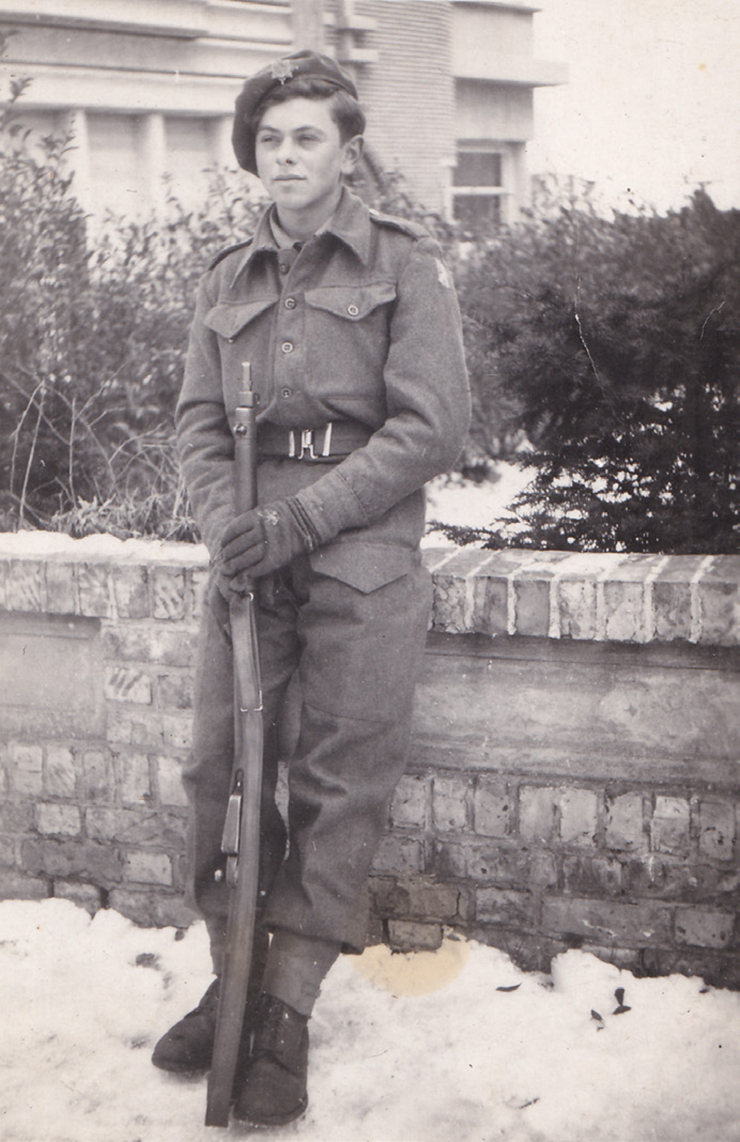
At just 16, he began serving as an interpreter for British forces in Italy. He later became an armored vehicle driver in the Czechoslovak Armored Brigade, participating in the siege of Dunkirk from October 1944 to May 1945.
The teenager who had been imprisoned was now serving in the fight against Nazi Germany.
After the war, Arnstein fled communism in Czechoslovakia and immigrated to the United States. During the Korean War, he served in a photographic unit of the American military while stationed in the United States.
“I lived under Hitler and I ran. And Mussolini put me in a pen as a prisoner. And then I ran again from [communism] and Stalin,” he recalled.
Yet his life remained largely unknown in his native country.
Czech historian Jiri Kluc discovered Arnstein while researching Holocaust survivors and military veterans. He was struck by his extraordinary experiences and the lack of awareness back home that this veteran was still alive.
“He fought for our freedom, he is still a Czech citizen, and yet people in his native country did not even know he was still alive,” Kluc said.
Over the past year, Kluc traveled to New York several times to document his life. He spent long hours listening to Arnstein’s recollections, examining his photographs, and researching archival records.
Kluc, the founder of Witnesses of War, a nonprofit educational platform, has interviewed more than 800 witnesses to history. His work with Arnstein developed into a memoir and an effort to share his story with schoolchildren and the wider public in his homeland.
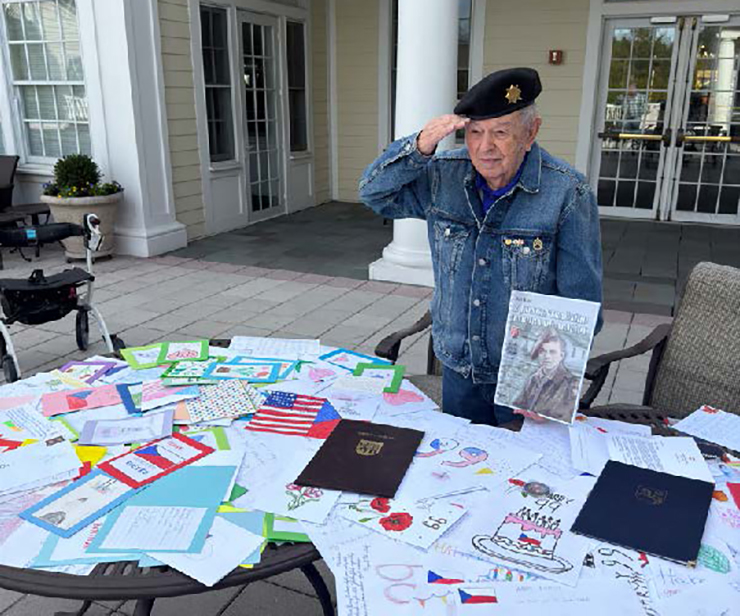
Teachers in the Czech Republic and Slovakia incorporated Arnstein’s experiences into their lessons. Students aged 10 to 15 then wrote letters thanking him and reflecting on what they had learned. One described his story as a reminder that “freedom is not free.”
In total, 424 letters were brought to Roslyn. Spread across tables in front of Arnstein, they showed him that children thousands of miles away now knew his name and understood something of what he had endured.
“When I was younger, nobody paid much attention to me,” he said.
The presentation also included recognition letters from the mayors of three Czech cities connected to Arnstein’s life: Brno, where he was born; Ostrava, where he spent his childhood; and Nymburk, where his family came from.
He also received an acknowledgment from the US Embassy in the Czech Republic and a memoir written by Kluc based on his recollections and archival research.
For Arnstein, these connections carry particular meaning because returning to his homeland is now difficult.
“I wish I could go back to the old country again, but I’m not up to travel at this point,” he said.
Instead, a part of his homeland came to him – in hundreds of handwritten messages from children who are helping carry his story into another generation.
Story and photos by Jiri Kluc