
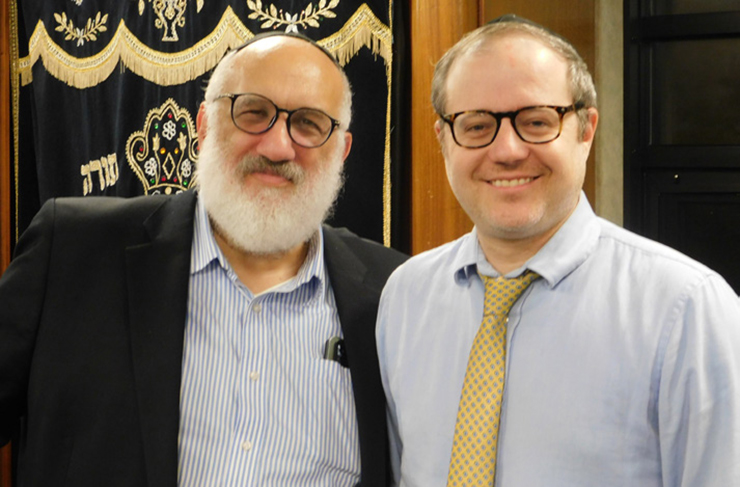
He was the rabbi at the Young Israel of Forest Hills; now he is a candidate for the Israeli Knesset (Parliament). Rabbi Yehuda Oppenheimer came back to his shul on October 11 to discuss the political party in which he holds the #8 slot.
Rabbi Yehuda and Lani Oppenheimer led the Young Israel of Forest Hills from 2009 to 2017. They now live in Afula, Israel. Rabbi Oppenheimer is a frequent columnist for the Queens Jewish Link and The Jewish Press.
His political party, HaTzibbur HaChareidi (the “Chareidi Public”), seeks to accommodate the chareidi population in the Israeli Army, education, and workplace.
There are 1,452,350 chareidim out of an estimated 7.2 million to 7.8 million Jews living in Israel, 14.3% of the total population. With a growth rate of 4.0% to 4.2% per year, they are the fastest-growing population in Israel, according to Israel’s Central Bureau of Statistics.
Chareidim are known for emphasizing Torah study, large families, and a reluctance to take part in Israeli society. Rabbi Oppenheimer unpacked the historical and religious reasons why this is so.
Israel’s early years had secular Socialists in power for many years. They wanted to create a “New Jew,” a proud Jew, “one who stands up for himself,” leaving behind Yiddish, the Galut (Diaspora) mentality, and “including Torah for many of them.”
“The army was seen very much as the institution that was going to be sort of the melting pot.” “You have to remember why the chareidim were very suspicious of the Army and other cultural institutions,” said Rabbi Oppenheimer.
The chareidim see themselves as having been in Israel before the secular European Zionists came. Students of the Vilna Gaon and the Baal Shem Tov came a hundred years before the State of Israel was formed. Chareidim viewed the Zionists as trying to change everything and destroy Torah.

The Chazon Ish and Prime Minister David Ben-Gurion came to an agreement that full-time Torah students wouldn’t have to go into the Army. At the time, it meant 400 men or fewer were exempt.
Prime Minister Ben-Gurion did not think the Torah world would grow, but the chareidim rebuilt after the devastation of the Holocaust to where now “yeshivos are bursting at the seams… It’s an unbelievable, huge success,” said Rabbi Oppenheimer.
When Menachem Begin became Prime Minister in 1977, he made a deal with the religious parties in his coalition: Anybody learning full-time in yeshivos could be exempt from the Israeli Army.
“The chareidi world was afraid of the Army being a place in which so many were lost to becoming [or staying] religious or certainly chareidi Jews.” Leaders in the chareidi world now say no chareidi man should go into the Israeli Army, whether he is learning or not. Basically, it “became that you are exempt if you are chareidi,” said Rabbi Oppenheimer.
“It’s normal to have [chareidi] families with 12, 15 kids.” The secular have many fewer kids. Chareidim are becoming part of the majority in Israeli society. The rest of society can’t be the only ones working, paying taxes, policing, and fighting the wars.
Israelis hate more than anything else being “a freier,” someone being taken advantage of. Chareidim are not working, paying taxes, or fighting in the Army, but also are not appreciative of the Israelis doing that. “Sometimes we hear, you didn’t give us enough, and you didn’t give us that.”
Now, “some of the really ugly stuff going on now where chareidim are blocking roads, calling police ‘Nazis,’ or telling Israeli soldiers ‘you should have died in a tank…’ The bottom line of all this is that, for the most part, [the chareidim have] become one of the most hated groups,” and not just among the secular but among the Religious Zionists as well, said Rabbi Oppenheimer.
A lot of the chareidim are not working or are underemployed. Forty-five percent of chareidi children are living under the poverty line. Some 3,500 chareidim have left Judaism “because they are so disgusted.”
“That is the context” in which Rabbi Oppenheimer and his political party “saw that this is a situation that just can’t go on.”
Judy Silberberg read a report about how Israelis who are working are in poverty. Rabbi Oppenheimer said it could be because they’re not getting an education. His political party believes that “every child should get a basic education, learn math, learn English, learn some things.”
Even people with advanced education, because of AI and advanced technology, have a hard time getting a good job now. It’s also not fair for married women to work while having large families to take care of while their husbands learn Torah all day, said Rabbi Oppenheimer. Those who learn full-time should learn, but those spending very little or no time learning should not be exempt.
Go into the Army chareidi and come out of the Army chareidi. “Being in the Army should not affect your religious level.”
The Israeli Army can create frameworks for the chareidi population, such as Mehadrin kosher food, time to daven, learn Torah, classes, a proper Shabbos, no girls on the army base with the young guys, and no girls being forced to be put into a tank with guys.
Chareidi police, including Border Police, and Army units are already operating. Sheirut La’am, where they do national service helping communities and working behind the lines in supply for the Army, is also an option for the chareidim.
His political party, HaTzibbur HaChareidi, wants to help new immigrants. Too often, immigrants leave Israel because “they couldn’t find a community that they felt comfortable in, that meets their needs.”
Four of the top candidates in his political party are Americans who made aliyah, and two of the top four candidates are women.
Rabbi Oppenheimer didn’t come to fundraise or ask for votes, but to start a conversation about his political party among Americans who know people living in Israel. He believes that many chareidim are glad to be living in Israel and see that the current situation is unsustainable.