

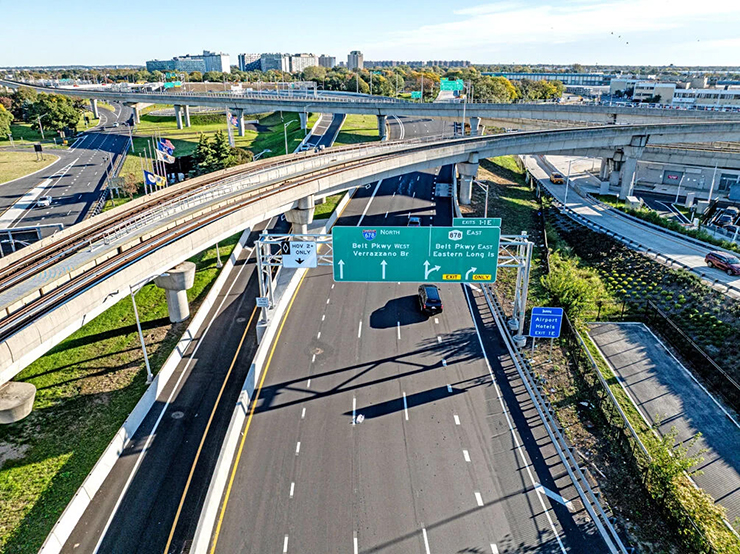
After years of construction and traffic delays, drivers traveling to JFK Airport have new lanes available on the Van Wyck Expressway.
The new high-occupancy vehicle lanes opened October 23 along a 4.3-mile stretch between the Kew Gardens Interchange and JFK, marking a major milestone in the state’s $1.4 billion Van Wyck Expressway Capacity and Access Improvements project.
The lanes are open to buses, taxis, for-hire vehicles, and private vehicles carrying at least two people, including the driver. Drivers must use designated entry points and follow posted restrictions.
The improvements are intended to ease one of Queens’ most persistent traffic bottlenecks, particularly for vehicles traveling to and from the airport. The Van Wyck is also heavily used by commuters, delivery vehicles, airport employees, and local residents, making congestion a daily problem well beyond airport traffic.
Construction began in 2020 and was carried out in three major phases.
The first involved work on nine highway overpasses to accommodate the additional lanes. The second included reconstruction and improvements to four railroad bridges near Jamaica Station, along with work on portions of the expressway’s service roads.
The final phase added the new lanes, improved entrance and exit ramps, and included additional bridge repairs and replacements. According to the New York State Department of Transportation, 23 bridges were rehabilitated or replaced over the course of the project.
The redesigned ramps are intended to reduce dangerous merging and prevent backups from spilling onto the expressway’s through lanes.
The project also included a $135 million sewer improvement developed with the New York City Department of Environmental Protection. The double-barrel sewer segment is designed to help address flooding problems in southeast Queens, where drainage has long been a concern for residents.
Although the new highway lanes are operating, construction is not entirely finished.
NYSDOT expects rehabilitation work on nearby service roads to continue through the end of 2026. Residents and motorists in Briarwood, Kew Gardens, Richmond Hill, and Jamaica may therefore continue to encounter local construction activity, detours, and traffic disruptions.
How much time the new lanes will save drivers will depend on traffic conditions, the time of day, and the approaches used to enter or exit the expressway. Congestion on surrounding streets and at the Kew Gardens Interchange may still affect travel times.
The opening brings the long-running highway project closer to completion, although drivers in the surrounding neighborhoods will still have to contend with construction until the remaining service-road work is finished.
By Shabsie Saphirstein