

This past Motza’ei Shabbos, families gathered in the gymnasium of The Queens Cheder in Jamaica Estates, where an evening of inspiration was about to unfold. Behind the head table hung a banner featuring the Cheder’s emblem and imagery of the campus, grounding the event in the legacy of what had been built—and what continues to grow.
Rabbi Osher Plutchok opened the evening with heartfelt hakaras ha’tov to Rabbi Naftali Rosenbaum, Mr. Reuven Yusufov, Mr. Nissan Yusupov, and the Cheder’s leadership, praising their steadfast commitment to preserving and building upon the vision of Rabbi Meir Chaim Gutfreund zt”l, noting how “He lifted every child.”
He then transported the crowd into a little-known chapter of Jewish history—the era of the Cantonists, young Jewish boys torn from their families by the Czar’s army. He recounted the story of a rav who sold the silver crowns of the Sifrei Torah to ransom an orphaned child. That child grew up to become a towering talmid chacham, ultimately serving as the rav of his city.
Rabbi Plutchok then connected the story to the Cheder’s mission: “Every child is a future. Every child is a world. When you save a child, you save generations.”
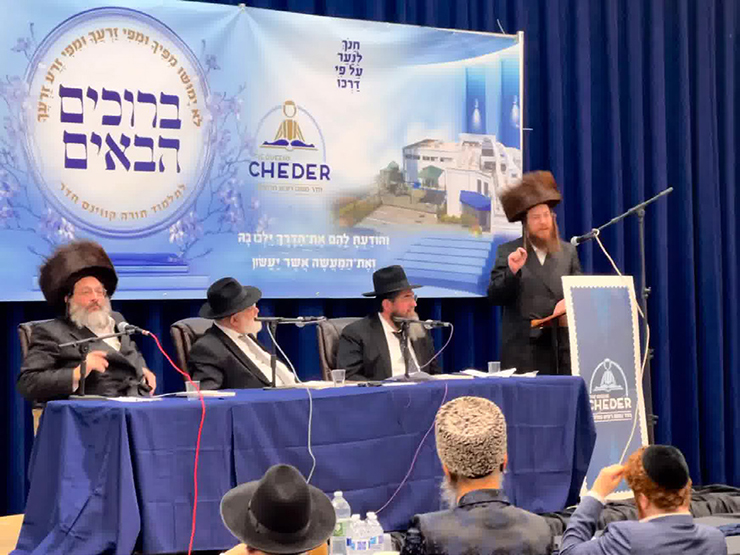
“My father believed every child was his mission,” Rav Mordechai Gutfreund, son of the Cheder’s legendary founder, remarked. “It is very difficult to stand here,” he said, “in the place where my father should be.”
He spoke about Yaakov Avinu, boundary-making, and the sanctity of environment. Children, he explained, absorb holiness naturally when the atmosphere around them is infused with stability and love.
“The Cheder,” Rav Gutfreund said, “is a Kodesh HaKodashim for children. My father built it that way. He saw greatness in every child—even before the child saw it in themselves.”
Naftali Rosenbaum, speaking on behalf of the administration, offered a heartfelt glimpse into Rabbi Gutfreund’s quiet greatness. He recalled how years earlier, when asked to speak publicly for the first time, he panicked. Rabbi Gutfreund took him aside, helped him craft the speech, instilled confidence, and lifted him up.
“That,” Rav Naftali said, “was who he was. He didn’t build buildings; he built people.”
He acknowledged the Rebbetzin with deep respect and gratitude—her behind-the-scenes mesirus nefesh indispensable to the Cheder’s heartbeat.
The Chinuch Panel: Torah, Real Life, and the Art of Raising Children
The room shifted once more as the evening’s centerpiece began: the chinuch panel.
Three distinguished mechanchim took their seats: Rabbi Menachem Shmeltzer, Menahel of the Brooklyn Cheder; Rabbi Moshe Weinberger, Rav of Agudath Yisroel of Flatbush; Rabbi Yosef David Ungar, veteran mechanech with a gift for transforming complex issues into practical guidance.
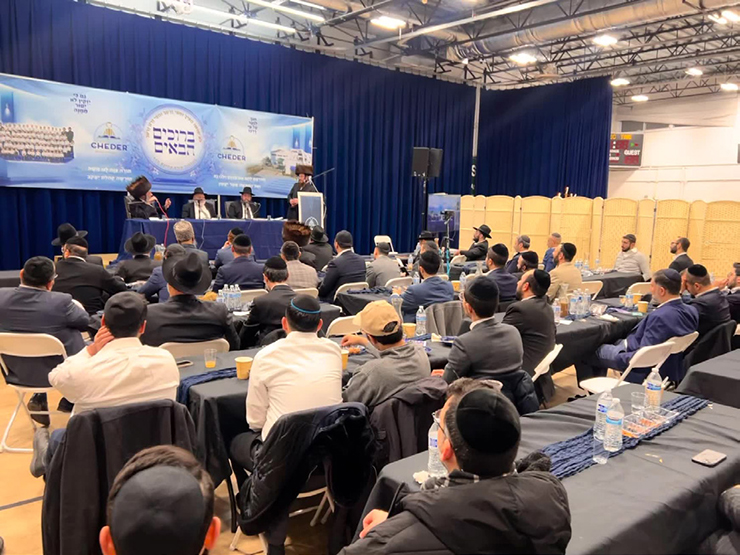
Anonymous questions were read aloud.
“How do I give attention to each child in a busy home?”
Rabbi Weinberger responded first: “Don’t measure attention in hours; measure it in presence. Even five minutes of full attention can last a lifetime.”
Rabbi Shmeltzer added: “Children don’t compare quantity. They compare tone.”
Rabbi Ungar, with his trademark humor, chimed in: “You want to know attention? Say your child’s name with affection. That’s chinuch.”
“How do we make Shabbos meaningful rather than stressful?”
Rabbi Shmeltzer explained that Shabbos must begin emotionally on Thursday, not at candlelighting. “Build the anticipation,” he said. “Let children feel that Shabbos is the highlight of their week.”
Rabbi Weinberger added: “A child knocking over a grape juice cup isn’t the problem. A child feeling unwelcome at the table is.”
Rabbi Ungar shared a story of a boy who dreaded Shabbos because the father was “checking everything—tzitzis, hair, shoes.” “Check their smile,” he said. “Everything else will follow.”
“My child refuses to wear a yarmulke during play.”
Rabbi Weinberger smiled: “Sometimes it’s not rebellion; it’s gravity. Make sure it fits.”
Rabbi Shmeltzer: “Clip it before you correct it.”
Rabbi Ungar: “Don’t make mitzvos a battle. Build identity with warmth.”
“Should I allow karate or sports leagues?”
Rabbi Weinberger explained it brilliantly: “If the environment strengthens midos and builds character, it’s chinuch. If it confuses values, step back.”
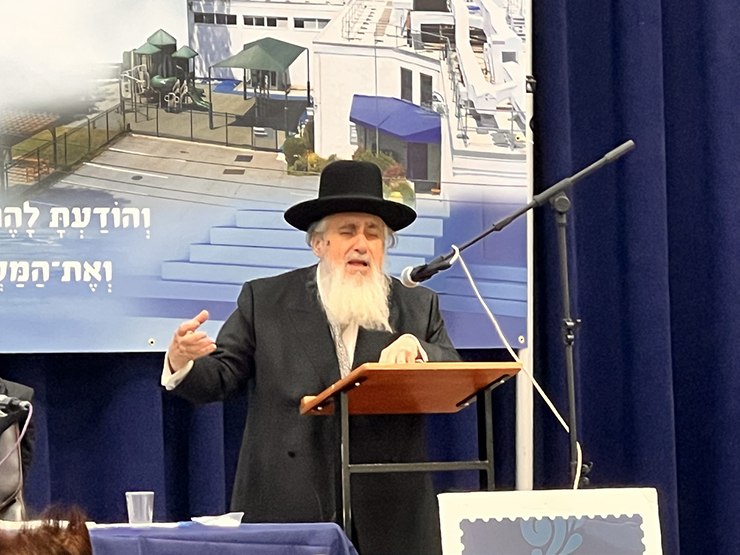
Rabbi Ungar added with a grin: “Hashem created karate for the kids who need to burn energy so they can sit in class.”
“When should I call the school—and when is it too much?”
Rabbi Shmeltzer’s answer hit home: “If you call every day, the school can’t help you. If you never call, the school can’t help you either.” Partnership, he stressed, is essential.
Rabbi Weinberger added: “School and home must be one team.”
Rabbi Ungar closed the topic with humor that held truth: “I told one parent, ‘Your son is fine. You are the one who needs recess.’”
HaRav Eliezer Ginsburg, in the evening’s keynote address, spoke of Yaakov naming a place “Sukkos,” of Rav Chaim Volozhiner, and of lessons learned in unexpected moments.
Rav Ginsburg then delivered a powerful line: “Our children are not ours. They are given to us. What we give them—our patience, our joy, our presence—that is what we give back to Hashem.”
He urged parents to greet children warmly, limit distraction, and fill their homes with the message: You matter.
The Queens Cheder succeeded once again in giving the community not only guidance, but heart.