
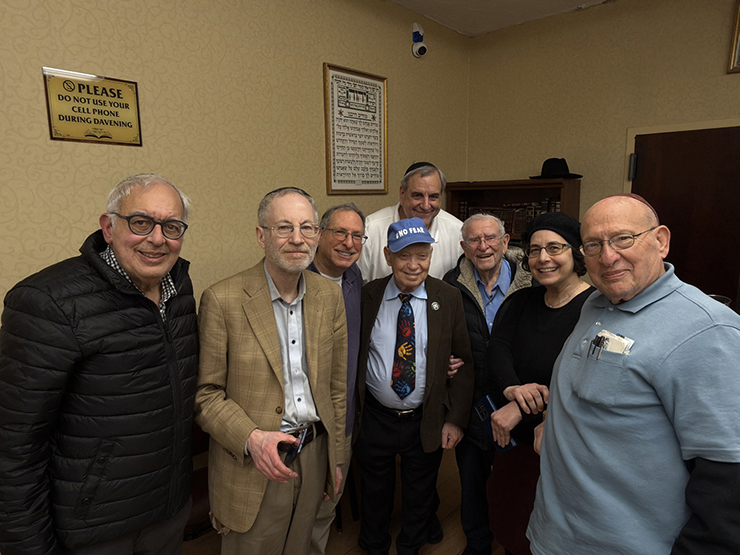
The room grew quiet as Sami Steigmann stepped forward in the lower-level beis midrash of the Young Israel of Hillcrest. Moving slowly but confidently between the rows of chairs, the 86-year-old Holocaust survivor greeted attendees, shook hands, and made eye contact with nearly everyone in the room. Before long, the more than 50 participants gathered that evening were leaning forward in their seats. For them, this was living history unfolding only a few feet away.
Sami’s appearance in Queens carried special meaning. Only weeks earlier, the Harlem resident had been honored at the Queens Jewish Link’s Networking Expo for his tireless work in Holocaust education. His return to the borough brought his message back to a community deeply committed to preserving Jewish memory.
Sami’s life spans some of the darkest chapters of Jewish history – and the resilience that followed. Born in 1939 in Czernovitz, Bukovina, then part of Romania, he was still an infant when Romanian authorities deported his family to the Transnistria region during World War II. From 1941 to 1944, they were imprisoned in a labor camp in Mogilev-Podolsky.
Too young to work, Sami became a victim of Nazi medical experimentation. Although he has no memory of the procedures themselves, their effects have followed him throughout his life, leaving him with chronic pain that he still endures every day.
Years later, he applied to the Claims Conference, seeking recognition as a victim of Nazi experimentation. When confirmation arrived, it carried profound meaning.
“Money could never compensate for what happened,” he told the audience, pausing as he scanned the room. “But it meant that the world acknowledged what they did.”
Life in the camp was defined by hunger and cold. At one desperate moment, Sami’s father traded his winter coat for a loaf of bread to keep the family alive. In another remarkable act of courage, a German farm woman delivering food to guards noticed the starving child – his stomach swollen and his body weakened by hunger. Risking her life, she secretly fed him milk until his strength returned.
Sami never learned her name. But years later, while visiting Yad Vashem in Israel, he saw the memorial dedicated to the unknown Righteous Among the Nations and felt certain she was among them. “That woman saved my life,” he said quietly.
After the war, the family returned to Romania, where life remained difficult. Sami described growing up in conditions young people today can barely imagine: homes without running water, daily trips to a well to carry water for bathing, outhouses instead of indoor plumbing, and soccer games played with balls made from rags because real ones were impossible to obtain.
Yet, despite these hardships, his parents created a loving home. His father Nathan had grown up an orphan in Vienna and developed the street instincts that helped his family survive both during and after the war. His mother, Reghina, was never allowed to attend school but possessed extraordinary warmth and kindness.
One of Sami’s most powerful memories came years later when his family immigrated to Israel in 1961. Arriving as a young immigrant, he noticed something that left an indelible impression. “When I saw a Jewish policeman for the first time,” he said with a smile, “I realized I was home.” Growing up in communist Romania, Jews had always lived under the authority of others. Seeing a Jewish officer representing a Jewish state symbolized something entirely new: security, dignity, and independence.
Sami later served in the Israeli Air Force, from 1962 to 1965, working on a team responsible for testing and repairing instrumentation on Mirage fighter jets that would later play a role in Israel’s Six-Day War.
In 1968, with little money and no knowledge of English, he came alone to the United States. His life in America would include both opportunity and hardship. At different times, he lived under the poverty line, spent time in a shelter, and endured painful family estrangement.
Rather than becoming bitter, Sami found purpose through volunteering.
“I volunteered for 18 different organizations,” he explained. “When you give something of yourself, you actually help yourself.”
For decades, however, Sami rarely spoke publicly about his experiences during the Holocaust. Like many survivors, silence was common.
That changed in 2003 during a special gathering at the United States Holocaust Memorial Museum in Washington, DC. For two days, the museum closed its doors to the public and welcomed survivors, their families, and the soldiers who liberated them. More than 8,000 people attended.
At his table sat a man who had been born in the same city and deported to the same camp during the same years.

“He was taken when he was eight months old,” Sami recalled. “I was taken when I was a year and a half.”
For the first time in his life, he felt he truly belonged – both to the generation that survived the camps and to those who had endured the war as children.
Within a few years, he began speaking publicly.
His first audience was a group of sixth graders. Unsure whether his story was meaningful – after all, he had few personal memories of the camps – he simply shared what he knew.
Soon afterward, the students sent him thank-you letters. One letter changed everything.
“Your story was overwhelming,” the student wrote. “I promise I will tell it to my children.”
Since then, Sami has spoken to more than 300,000 people, reaching audiences across the United States and beyond.
Despite the gravity of his subject, Sami’s message ultimately centers on hope and responsibility.
“The Holocaust happened because too many people stood by and did nothing,” he told the audience. “Don’t be a bystander. Be an upstander.”
At one point in the evening, Sami reflected on a familiar line from the Haggadah recited each year at the Pesach Seder: “In every generation they rise up against us to destroy us; but the Holy One, blessed be He, saves us from their hands.” For Sami, the words are not just liturgy; they are lived history.
By Shabsie Saphirstein