

A single memorial candle burned in a quiet room in Jamaica Hills last week — a steady, unyielding light reflecting across the faces of those gathered to remember.
Inside the Margaret Tietz Nursing and Rehabilitation Center, residents, survivors, rabbonim, and community leaders joined together for the annual Yom HaShoah commemoration. While printed programs were distributed to the capacity crowd, the atmosphere was one of solemn, personal reflection rather than formal ceremony. This year, the gathering carried a particular sense of urgency.
Rabbi Zavel Pearlman, the facility’s on-site chaplain, opened the program with a message that directly addressed the current global climate. In previous years, he noted, Yom HaShoah served primarily as a historical reminder; today, it feels more like a contemporary warning. He observed that the hatred that defined Europe in the 1930s is becoming increasingly visible again in the form of public rallies and open hostility toward the Jewish people. “It’s the oldest hatred in the world,” he said, warning that the line between history and the present is no longer as distant as many once believed.
Yet, the Rabbi emphasized that Yom HaShoah is defined not only by destruction but by gevurah — heroism. He pointed to the Warsaw Ghetto Uprising as a pinnacle of Jewish resistance, where those with almost no resources stood against a professional army for weeks. However, he stressed that heroism was equally present in smaller, quieter acts: the sharing of a final piece of bread, the risks taken by children for their elders, and the simple will to endure. “Every survivor,” he said, “is a hero.”
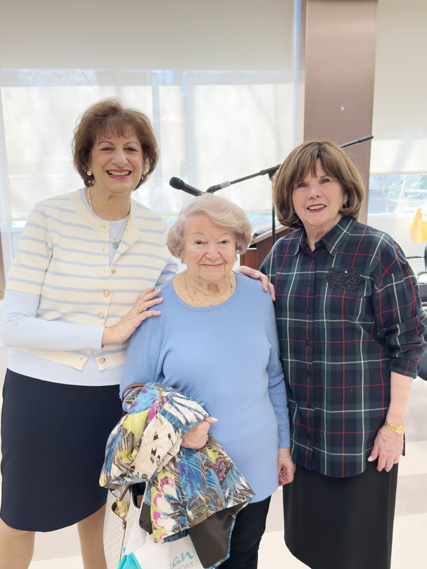
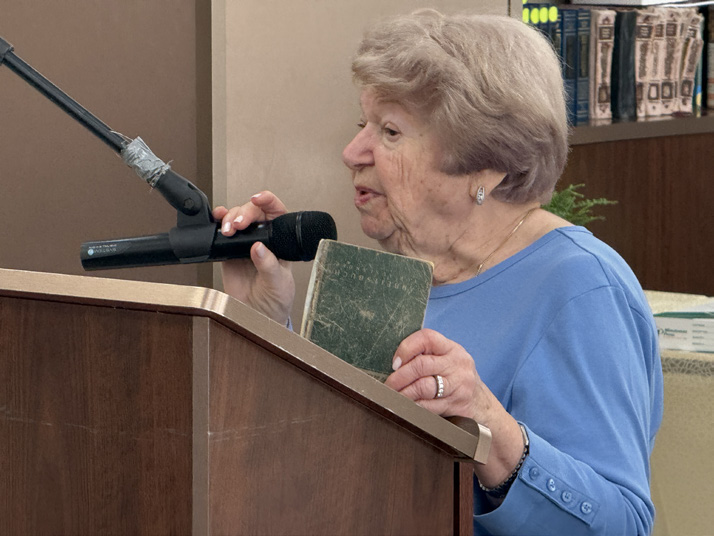
That truth was personified by the afternoon’s keynote speaker, Lucy Pisarz. A resident of Fresh Meadows, Pisarz spoke without notes, providing a direct and harrowing account of a childhood spent hidden in plain sight.
Born on May 1, 1937, in a small Polish village, Pisarz lost her father early in the war when he was taken to a forced labor camp. He never returned, and to this day, his final resting place remains unknown. Raised by her grandmother and a Polish caretaker, Pisarz spoke only Polish as a child and was unaware of her Jewish identity.
A local priest, a friend of the family, provided the warning that allowed them to escape the initial deportations. He supplied false identity papers, giving the family new names and a chance at life. They moved from town to town under constant risk of discovery until they were eventually caught and placed in a ghetto. Under the cover of night, Pisarz and her mother used their assumed identities to escape. Upon returning to their village, they found it emptied of Jews and her grandmother deceased. They eventually reached Krakow in 1942, a time when civilians were being gathered for forced labor in Germany.
Using their assumed Catholic identities, Pisarz’s mother was selected to work as a cook in the household of a Gestapo officer. It was there that Pisarz spent the remainder of the war. She learned German, was treated as a member of the household, and was protected by the officer, whom she called “Opa.” It is a complex reality to reconcile — finding safety and protection within the home of a man tied to a regime of genocide.
When Russian soldiers arrived to liberate the area in 1945, the transition was fraught with danger. The officer who had sheltered them was targeted by the soldiers as a representative of the Nazi system. In an act of childhood bravery, Pisarz stepped between the soldiers and the man she knew as her grandfather, telling them they would have to kill her as well. The soldiers spared him.
Liberation brought its own set of challenges. Pisarz emerged as a child raised Catholic, wearing a cross and knowing only the customs of the church. In displaced persons camps, she struggled to find her place among other Jewish children who had endured the horrors of the ghettos and death camps. Her survival had depended on forgetting her roots; now, she had to reclaim them. “They took off the cross,” she recalled. “They told me, you’re going to learn Hebrew.”
Pisarz and her mother remained in Europe for five years, moving through various camps while waiting for the opportunity to immigrate. In 1950, they finally arrived in the United States. Having never attended formal school during the war, Pisarz threw herself into her studies, learning English and working tirelessly to catch up with her peers. She eventually built a successful 35-year career at Metropolitan Life, a testament to her resilience and the opportunities found in her new home.
In America, she met her husband, also a survivor who had endured Buchenwald and a death march. Together, they built the very thing the Nazis tried to erase: a family. Today, she is the mother of two and the grandmother of seven.
For decades, Pisarz did not speak publicly about her past, citing the heavy emotional toll. It was only recently, following a high-profile interview in Queens, that she began to share her account more widely. Now, she speaks in schools to ensure that younger generations understand the reality of the Holocaust.
Rabbi Yossi Blesofsky, Director of Chabad of Northeast Queens, spoke about the necessity of Jewish identity in the face of rising antisemitism. He noted that even distant communities, such as those in Australia, have felt the impact of recent events, referencing the surge of incidents in places like Bondi Beach. He recalled the Lubavitcher Rebbe’s chilling response when asked if another Holocaust could happen: “Tomorrow morning.”
His message, however, was one of strength. He pointed to the resilience of klal Yisrael and the ongoing defense of the State of Israel as sources of inspiration. “Our protection comes from Hashem — and from being better, kinder, more united Jews,” he said, emphasizing that a strong Jewish identity remains the most potent response to hatred.
Linda Spiegel, Director of Public Affairs at Margaret Tietz, reminded the audience of the facility’s unique heritage. Founded by survivors, it was established to ensure that those who lived through the unimaginable could spend their later years with dignity and a full Jewish life, including a kosher kitchen and a permanent shul. “Everyone who works here needs to know its story,” she said.
The ceremony concluded with the lighting of six candles, each representing a million Jews murdered in the Holocaust. Pisarz lit the first candle in memory of the children and infants whose lives were cut short. Other candles were lit by leaders and survivors including Rabbi Mayer Waxman of the Queens Jewish Community Council, survivor Evelyn Friedman, and Rabbi Daniel Pollack, representing Congresswoman Grace Meng.
The room rose for a moving rendition of Ani Maamin, the declaration of faith sung by Jews even on the way to the death camps. As residents slowly departed the shul, many stopped to kindle their own memorial flames, a quiet act of defiance against a world that once tried to extinguish their light.
In Fresh Meadows and Jamaica Hills, that light continues to burn. Lucy Pisarz is that flame.
By Shabsie Saphirstein