

For more than a century, Regina Puterman carried memories that few could ever imagine. She witnessed the destruction of her family, survived one of history’s darkest chapters, and endured decades of personal heartbreak. In her final years, she quietly carried the profound pain of believing she had been forgotten. Yet, in her final days—and especially at her funeral—the Jewish community answered that loneliness with an extraordinary act of unity.
On the morning of June 25, an urgent message spread rapidly through Jewish WhatsApp groups and social media. A 102-year-old Holocaust survivor had passed away. She had no immediate family, and there was concern that there might not even be a minyan at her funeral. The request was simple: “Help ensure a Holocaust survivor has a proper Jewish funeral.”
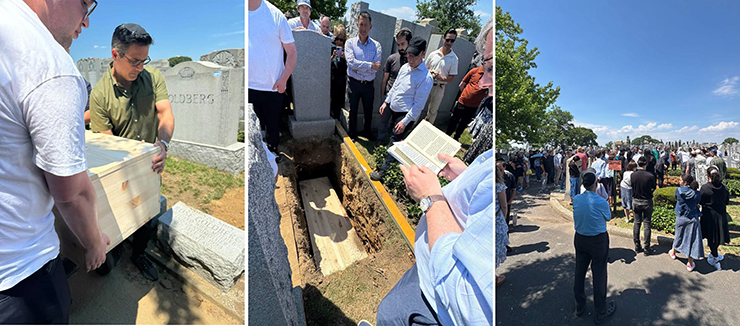
Within hours, Jews from every background answered the call. People from the Bukharian, Ashkenazic, Sephardic, Chasidic, and Modern Orthodox communities answered the call, leaving work, rearranging schedules, and traveling to Mount Lebanon Cemetery in Glendale. In a borough where Jewish communities often worship separately and maintain distinct traditions, Regina’s funeral became a rare moment when those differences faded. Most had never met Regina Puterman, yet each understood that no Holocaust survivor should make a final journey alone. By the time the funeral began, more than 50 people had gathered around her grave, transforming what might have been a lonely burial into a remarkable display of chesed shel emes and Jewish unity.
The extraordinary turnout becomes even more meaningful when one understands the life Regina Puterman lived before that final afternoon in Queens.
Regina was born on April 1, 1924, in the town of Wojnilov, then part of Poland—now located in western Ukraine. Her childhood came to an abrupt end with the Nazi occupation. According to Holocaust remembrance advocate Jonny Daniels, who documented Regina’s story through a series of conversations during the final months of her life, her parents and sister were murdered during the Holocaust, leaving her as the sole survivor of her immediate family. While millions of European Jews were murdered in ghettos and extermination camps, Regina survived through years of hiding, first on a farm and later inside a factory. She endured constant hunger, relentless fear, bombings, and the ever-present knowledge that discovery meant certain death.
When the war finally ended, Regina emerged alive, but the world she had known no longer existed. Like so many survivors, Regina undertook the daunting task of rebuilding a life after losing almost everything. She married another Holocaust survivor, and together they settled in France. Together, they hoped to rebuild the family that the Holocaust had stolen from them. Eventually, they immigrated to the United States in the hope that fertility treatments would allow them to become parents. That dream never became reality. Regina was unable to have children, her first husband later died of cancer, and after remarrying, she eventually lost her second husband as well. The loneliness that had begun during the Holocaust followed her throughout much of her life.
In recent years, Regina developed a friendship with Daniels, founder of the From the Depths Foundation, an international organization dedicated to Holocaust remembrance, education, and preserving the stories of survivors. Daniels and I studied together in the beis medrash at Yeshivas Midrash Shmuel in Shaarei Chesed, where it was already evident that his passion for preserving Jewish history and helping others would shape his life’s work. Today, that commitment is reflected in his efforts to locate aging Holocaust survivors, preserve their testimonies, restore neglected Jewish cemeteries, and ensure that those living in isolation are treated with dignity during their final years.
During one conversation, Regina quietly confided that she felt forgotten. Daniels later described the conversation as one of the most heartbreaking he had experienced. Regina spoke of feeling forgotten after her parents and sister were murdered, after surviving while so many members of her family and community perished, after being unable to have children, and as she became one of the dwindling generation of Holocaust survivors still alive.
Determined to show Regina that she had not been forgotten, Daniels invited her to participate in the Holy Survivor Torah Project, an initiative that enables Holocaust survivors to write a letter in a Sefer Torah dedicated to their generation. For Regina, whose own family had been nearly erased from history, participating in the writing of the Torah became a profound affirmation that her life—and the lives of those she lost—would forever remain part of Jewish eternity.
Only days after writing her letter in the Holy Survivor Torah, Regina passed away on June 24, at the age of 102. Daniels publicly shared Regina’s story in the days surrounding her passing as part of his ongoing efforts to preserve the memories of Holocaust survivors.
There is a profound irony in the final chapter of Regina Puterman’s life. Only days before her passing, Regina confided to Daniels that she felt forgotten. Yet Daniels’ decision to share her story introduced her to thousands who otherwise never would have known her name. Through the Holy Survivor Torah Project, Regina became permanently connected to the eternal story of the Jewish people.
Regina left behind no children or grandchildren to carry on her family’s name. Instead, she leaves behind something just as enduring: a testimony to the resilience of the Jewish spirit and a reminder that klal Yisrael truly is one family. The Nazis sought to erase Regina, her family, and millions of other Jews from history and memory. They failed. As long as their stories continue to be told, their memories remain woven into the living fabric of the Jewish people. Regina’s life will continue to inspire, and the compassion shown by those who gathered at her graveside reminded us that every Holocaust survivor remains part of the collective heart of klal Yisrael.
May Regina Puterman’s memory forever be a blessing, may her neshamah have an aliyah, and may we continue to honor the dwindling generation of Holocaust survivors by preserving their stories and carrying their memories forward for generations to come.
By Shabsie Saphirstein