
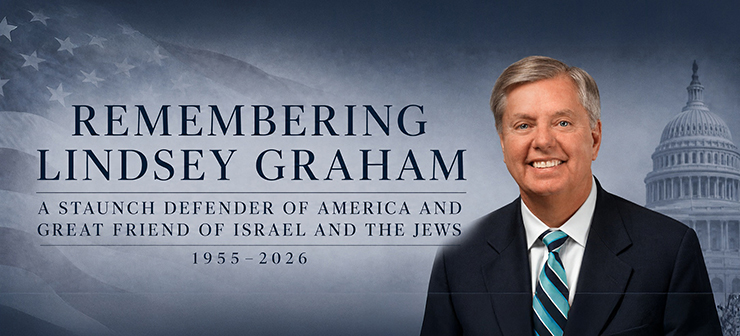
He was loud on television and relentless off it. To understand what America and the Jewish community lost, look past the microphone
In the final weeks of his life, Senator Lindsey Graham was laying the groundwork for what he hoped would become a historic agreement establishing formal relations between Saudi Arabia and Israel.
He had discussed the effort with President Donald J. Trump, Jared Kushner, Steve Witkoff, Israeli officials, and senior Saudi representatives. Graham understood the obstacles: An agreement would require bipartisan support in Congress, difficult decisions in Jerusalem, and a willingness in Riyadh to proceed despite the unresolved Palestinian question. Another trip to Saudi Arabia and Israel was being planned, with Graham hoping that intensive negotiations could begin after the Israeli election and the American midterms.
On the final night of his life, Graham spoke with Trump after returning from Ukraine. He briefed the president on the trip and on the sweeping Russia sanctions legislation he hoped to move through the Senate. A person who spoke with Graham shortly afterward told Axios that the senator complained of feeling unwell. When urged to seek immediate medical attention, Graham reportedly said he would go the next morning, after his scheduled appearance on Meet the Press.
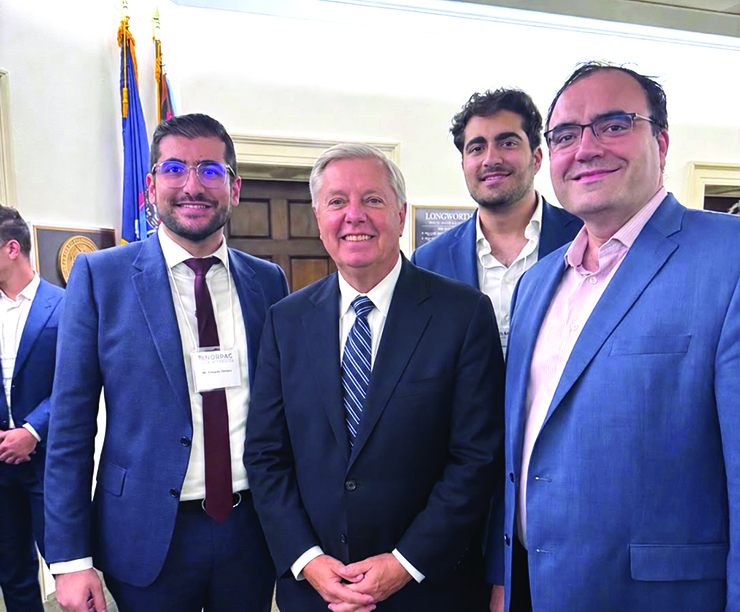
With the humor of a man who still regarded history as a list of assignments waiting to be completed, Graham joked, “I can’t die now. I still need to do the Russia sanctions, get Iran sorted out, and do Israeli-Saudi normalization.”
Several hours later, on July 11, Lindsey Graham was gone.
The public will remember the Senate floor speeches, the television appearances, and the forceful warnings delivered in committee rooms. To understand why his death has struck so deeply within the Jewish community, however, one must look beyond the microphone to the work he repeated for decades: intelligence briefings, hurried flights, Orthodox advocates, grieving families, and appropriations bills.
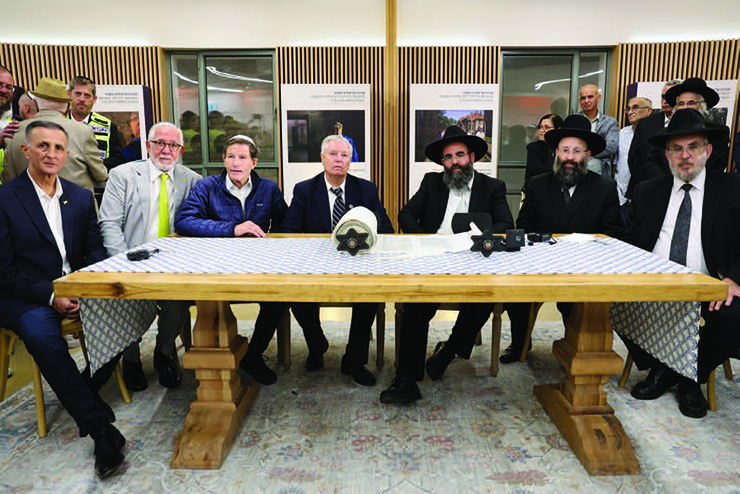
There was always another report from Israel, another warning concerning Iran, another family afraid that the world was forgetting its loved one, and another Jewish organization seeking time on a schedule that had none to spare.
Orthodox advocates came to explain why a technical provision could affect the security of a synagogue, the future of a yeshivah, or the right of parents to educate their children according to their faith. Graham listened, and the advocates did not have to begin by proving that their concerns mattered.
Nathan Diament, executive director of the Orthodox Union Advocacy Center, first met Graham in the late 1990s. For nearly three decades, through changing administrations and Graham’s own political transformations, Diament found him attentive to the same fundamental concerns: Israel, religious liberty, school choice, support for families, and the rapid growth of anti-Semitism.
Following Graham’s death, the Orthodox Union noted that its advocacy leaders had met with him regularly and worked closely with him on major policy initiatives, including enactment of the Taylor Force Act. They remembered his insight, his humor, and his love for Israel and the Jewish people.
The relationship reached well beyond foreign policy. Graham repeatedly introduced resolutions recognizing Religious Education Week and honoring the schools, houses of worship, and organizations that provide religious instruction. His 2025 resolution was supported by Agudath Israel of America and the Coalition for Jewish Values.

Supporting materials noted that more than 13,000 South Carolina public-school students, with parental permission, left campus each week to attend off-site religious classes. Graham did not see the preservation of a church in South Carolina and a yeshivah in New York as competing concerns; both reflected the right of families to pass their beliefs to another generation.
A Southern Baptist senator from South Carolina and Orthodox rabbis from New York approached faith differently. What they shared was a belief that America remained stronger when religious conviction was protected rather than pushed to the margins.
That belief also brought Graham into rooms where the political divisions ran deep. At the Orthodox Union Advocacy Center’s inaugural attorneys conference in 2025, Graham appeared alongside Democratic Representative Dan Goldman for a discussion about anti-Semitism.
Despite their partisan differences, Graham argued that Jew-hatred had to be confronted not only for the sake of Jews, but for the moral fabric of America. Anti-Semitism, in his view, was a warning that the foundations of the wider society were beginning to erode.
His understanding of responsibility had been formed long before he entered Congress. Graham grew up in Central, South Carolina, where his parents operated a bar, restaurant, and pool hall. The family lived in a room behind the business.
While Graham was in college, both parents died within approximately 15 months of one another. At 22, Graham became the legal guardian of his 13-year-old sister, Darline. He finished college, attended law school, raised his sister, and served for 33 years in the Air Force, Air National Guard, and Air Force Reserve, retiring as a colonel.
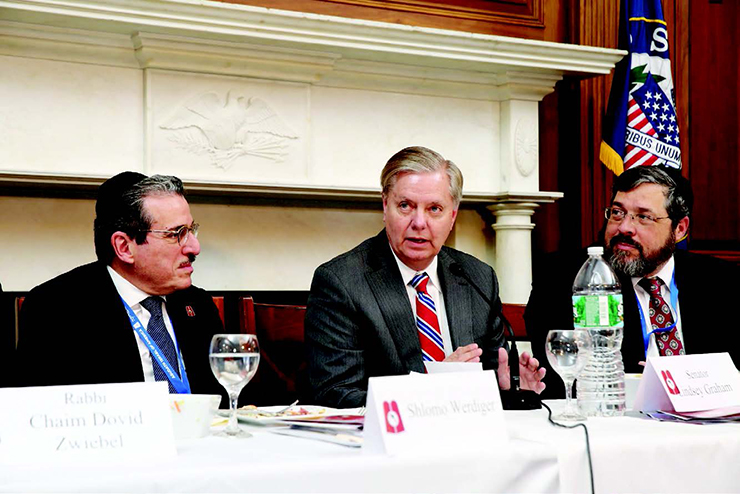
That early lesson in obligation shaped how he received those who later came to him for help. More than 100 Orthodox rabbis and lay leaders arrived on Capitol Hill. They had come to advocate for increased security funding for Jewish day schools, yeshivos, and synagogues.
The danger was already starkly disproportionate. Of the 282 grants awarded nationally through the federal Nonprofit Security Grant Program in 2016, 247 went to Jewish institutions. Even that funding, communal advocates warned, did not come close to meeting the need.
During the September 2016 Orthodox Union mission, Graham announced that he was introducing legislation to defer certain American assistance to the Palestinian Authority until it ended laws providing financial rewards to terrorists and their families.
The leaders had arrived seeking protection for the buildings where Jewish children learned and Jewish families prayed. Graham used the same gathering to announce a campaign against the system rewarding those who murdered Jews.
That campaign became the Taylor Force Act.

Taylor Force was a West Point graduate and United States Army veteran who had served in Iraq and Afghanistan. In March 2016, while visiting Israel through a Vanderbilt University program, Force was murdered by a Palestinian terrorist in a stabbing attack in Jaffa.
The Palestinian Authority praised the killer as a martyr and provided his family with a monthly stipend. When Graham met Taylor’s parents, Stuart and Robbi Force, condolences were followed by a mechanism for accountability.
Graham worked for more than two years alongside the Force family, pro-Israel organizations, and lawmakers from both parties to condition American economic assistance upon the Palestinian Authority ending payments to terrorists and their families. The legislation faced delays, resistance, and negotiations, but Graham continued pressing until it became law in March 2018.
Washington treated the Taylor Force Act as a foreign-assistance measure. For the Force family and much of the Jewish community, its meaning was more elemental: American taxpayers would no longer be asked to support a system that glorified and rewarded the man who had murdered their son.
For years, Graham traveled with Senators John McCain and Joe Lieberman – the “Three Amigos” – representing a political friendship that has become increasingly rare.
Through Lieberman, an observant Jew, Graham became an unlikely student of Jewish life.
At Lieberman’s memorial service in 2024, Graham recalled that his friend always knew exactly when sundown would arrive on Friday, regardless of where they were. Graham joked that he had become especially good at recognizing when Shabbos ended so their work could resume.
He then looked toward the Orthodox Jews in the room and quipped about their “too many rules.” The humor worked because it came from familiarity rather than distance. Graham had lived beside those rules in airports, hotel rooms, motorcades, and foreign capitals. He had watched the demands of political power yield to religious observance.
At the same memorial, Graham recalled visiting the Western Wall with McCain and Lieberman during the 2008 presidential campaign. Photographers surged around them so aggressively that Graham was pinned against the ancient stones and injured his knee.
“They crushed me against the wall, and I began to wail,” Graham joked. Lieberman reached through the crowd and pulled his friend back onto his feet.
Fifteen years after that visit, the country he had walked through with his friends was in mourning. Less than three weeks after the October 7 massacre, Graham assembled a bipartisan delegation of five Republican and five Democratic senators and flew to Israel.
“If I had a bigger plane, we probably would have brought the entire Senate,” Graham said in Tel Aviv. “To our friends in Israel, we stand with you without apology, unequivocal.”
A statement of support could have been issued from Washington. But Graham wanted Israelis to see American senators standing before them. He wanted solidarity to occupy physical space.
William Daroff, CEO of the Conference of Presidents of Major American Jewish Organizations, repeatedly witnessed that habit. Daroff recalled arriving for meetings with Israeli prime ministers or other senior officials and seeing Graham emerge from the same offices. It happened so frequently that the encounters became evidence of how continuously Graham involved himself in the relationship.
He traveled to Israel when the alliance was celebrated and when it was strained. He appeared after massacres, during wars, and at moments when support for Israel had become politically costly.
For Graham, an alliance revealed its value when remaining present became difficult.
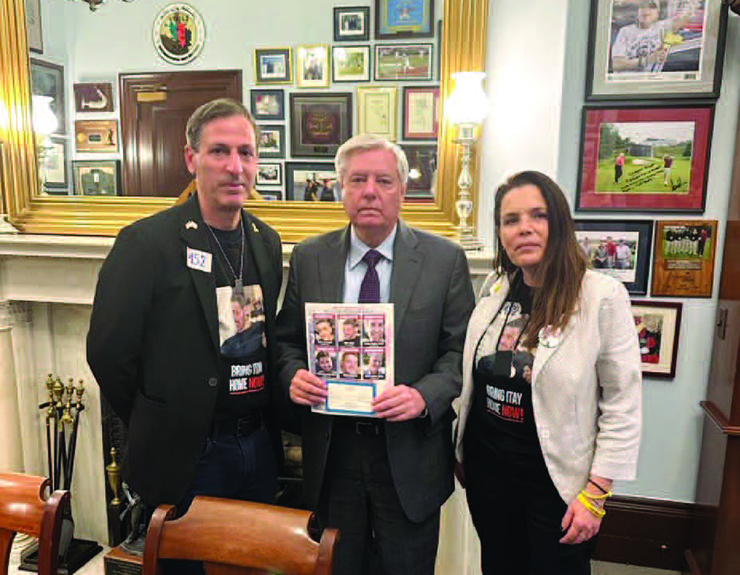
The hostage families soon became part of his work. They carried photographs into meetings and repeated the names of the missing so that Washington could not allow living human beings to disappear into the language of negotiations and diplomatic process.
The American Jewish Committee recalled that over the 843 days the hostages were held in Gaza, Graham frequently met their families and elevated their voices. He frequently met with families such as Ruby and Hagit Chen, whose son, 19-year-old soldier Itay Chen, was kidnapped on October 7.
Graham understood the danger that came after the immediate horror. A kidnapped person could become a photograph, the photograph a number, and the number another item pushed lower on the international agenda. He helped keep the hostages and their families before those who possessed the power to act.
Yet the advocacy that drew attention rested on work that drew none. Away from the cameras, it turned to columns of figures.
As chairman of the Senate State and Foreign Operations Appropriations Subcommittee, Graham helped craft the fiscal year 2020 bill providing $3.3 billion in Foreign Military Financing for Israel, along with funds made available for construction of the new American embassy compound in Jerusalem.
This was where support became measurable. A speech might reassure an ally for an evening; an appropriations bill could sustain military readiness, diplomatic commitments, and strategic cooperation for another year.
Graham’s support was not confined to preserving the existing relationship. During his final months, he began considering how the alliance could evolve.
After meeting Prime Minister Benjamin Netanyahu in January 2026, Graham said the Israeli leader had presented him with a vision for deeper joint American-Israeli weapons development. Netanyahu argued that Israel was creating technology capable of changing the future of warfare and that partnership with the United States could strengthen the security of both countries.
Graham emerged persuaded. He called the potential venture a “21st-century Manhattan Project” and promised to carry the proposal back to Washington.
Yet support did not require automatic agreement. Netanyahu disclosed after Graham’s death that when the prime minister discussed eventually phasing out traditional American military assistance, Graham objected forcefully.
The senator believed Israeli security and American security were inseparable. He could embrace a new technological partnership while fighting to preserve traditional assistance; to Graham, both expressed the same belief that the alliance was not charity flowing in one direction, but security shared between nations confronting common enemies.
Graham remained an internationalist inside a Republican Party increasingly skeptical of foreign commitments. His most difficult late-career argument was not always with Democrats or foreign adversaries, but with members of his own political coalition who believed America could protect itself by withdrawing from the burdens of the world.
Graham considered that a dangerous illusion.
He was not a man without controversy. His rhetoric could be severe, and his foreign-policy prescriptions frequently called for the use or threat of overwhelming force. His political evolution from one of Donald Trump’s harshest Republican critics into one of the president’s closest congressional allies remained one of the most disputed chapters of his career.
Some heard moral clarity in Graham’s warnings. Others heard an alarming willingness to escalate conflicts whose consequences would be borne far from Washington.
Yet Graham never regarded history as a classroom exercise. He believed disasters followed when democratic nations ignored warnings, allowed aggressors to gather strength, or waited until an ally was already on the verge of destruction.
That conviction could make him impatient, combative, and overly certain. It also made him extraordinarily difficult to move when an ally needed him to remain standing.
Graham died two days after his 71st birthday. Preliminary findings indicated that he suffered an aortic dissection related to the hardening of his arteries, with a final determination pending further testing.
The Jewish community has known many political supporters. Far fewer became friends whose loyalty was tested across decades, whose concern did not have to be awakened by an election, and whose involvement became so dependable that few imagined the day it would suddenly end.
Lindsey Graham kept showing up. Only now, as the meetings continue and his chair remains empty, does the full weight of that presence become clear.
May his memory be a blessing.
By Shabsie Saphirstein