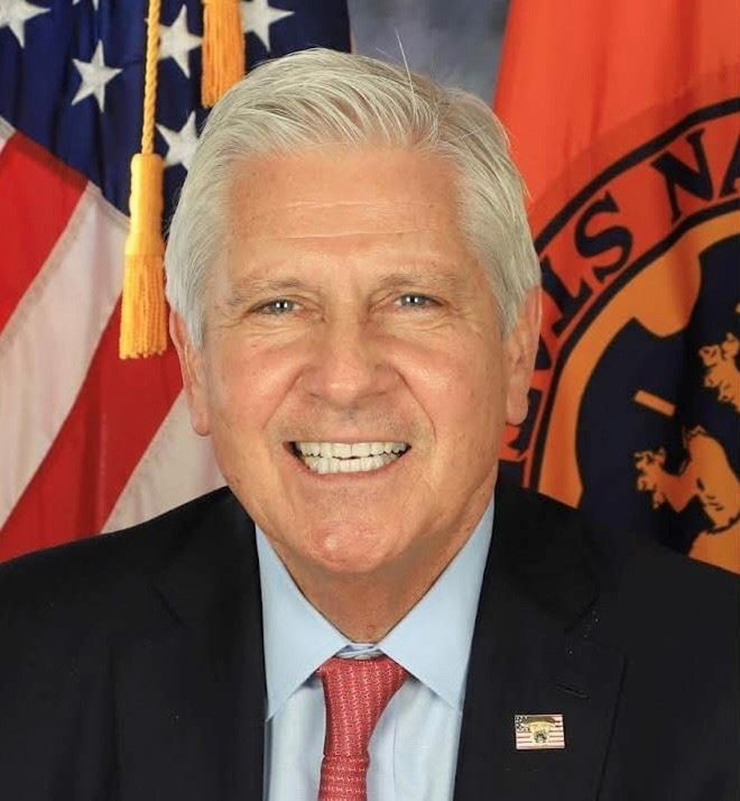

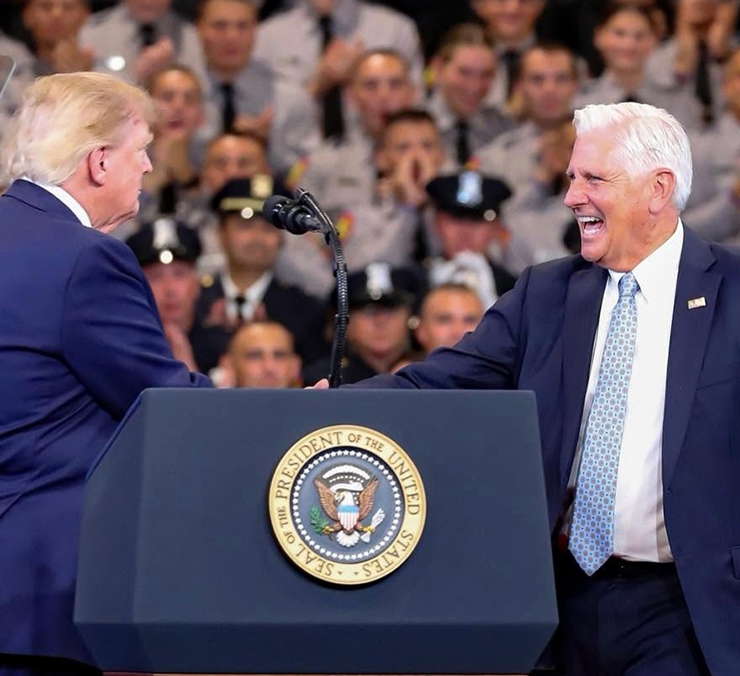
Four weeks before New York marks 25 years since September 11, 2001, President Donald Trump arrived in Nassau County on Friday, August 14, to present new national crime figures from a county ranked first in America for public safety. Ground Zero is not a term New Yorkers use lightly, and nothing in politics compares with the sacred ground in Lower Manhattan. Yet in the 2026 contest over New York’s direction, Nassau County has emerged as a political ground zero. This year’s 9/11 commemoration will also include a seventh moment of silence for those lost to 9/11-related illness and injury.
I attended on behalf of Queens Shmira, alongside Queens Jewish Link co-publisher Yaakov Serle. Whatever one’s politics, the President was coming directly to our community to address law enforcement and public safety, issues central to those of us protecting Jewish institutions and neighborhoods.
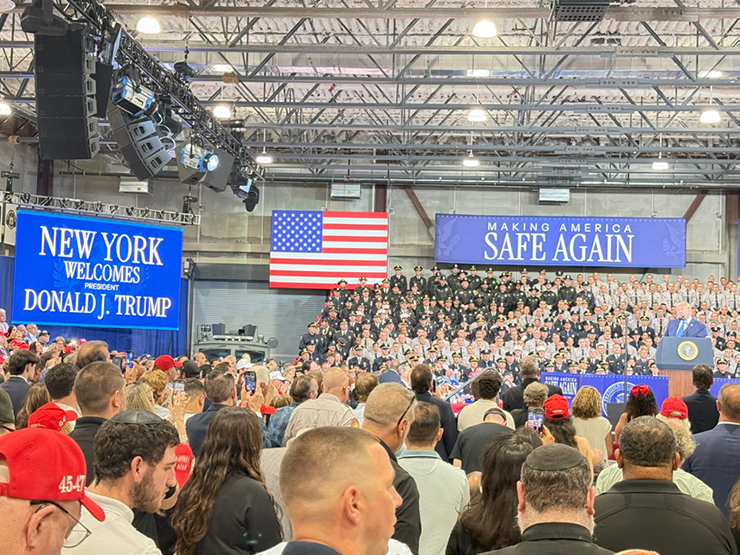
With Shabbos only hours away, Secret Service agents, elected officials, media crews and hundreds of law-enforcement officers converged on the David S. Mack Center for Training and Intelligence. The 500-seat auditorium was packed, with uniformed officers filling the risers and flanking center stage. By my estimate, total attendance hovered around 1,000.
Rabbi Elie Weinstock, Senior Rabbi of the Jewish Center of Atlantic Beach, Nassau County Police Department chaplain and spiritual adviser to its Shomrim Society, delivered the invocation. With Rosh HaShanah approaching, he invoked the shofar as a “piercing clarion call” and urged those assembled to “wake up, be better, do more, serve more, care more,” while praying for the police, County Executive Bruce Blakeman, Commissioner Patrick Ryder, President Trump and national unity. Victims’ advocate Madeline Brame then led the Pledge of Allegiance, followed by Nicole Thumbart performing the national anthem.
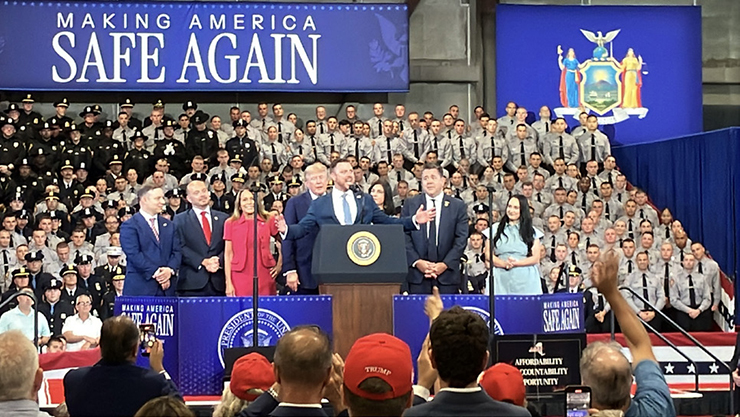
The Jewish presence was impossible to miss. Nassau is home to one of the country’s largest suburban Jewish populations, and yarmulkes, sheitels and Magen David necklaces were visible throughout the crowd. Ronen and Orna Neutra of Plainview were recognized by Blakeman as he remembered their son, Omer, who was killed on October 7. Among those attending were Yeshiva of South Shore Rosh HaYeshivah and Dean Rabbi Mordechai Kamenetzky, radio personality Sid Rosenberg, victims’ advocate Jasmine Robles and White House Press Secretary Karoline Leavitt.
Speakers before Trump each approached public safety from a different perspective. Anthony D’Esposito, a former NYPD detective and congressman now serving as Inspector General of the U.S. Department of Labor, called keeping people safe government’s first responsibility. Jeanine Driscoll, the Republican candidate in the 4th Congressional District and mother of a son entering the NYPD, spoke about law-enforcement families. Mike LiPetri, challenging Rep. Tom Suozzi in the 3rd Congressional District, listed combating antisemitism and protecting Jewish residents among his priorities. Rep. Andrew Garbarino, chairman of the House Homeland Security Committee, tied the gathering to the approaching 25th anniversary of 9/11 and his work to protect the World Trade Center Health Program.
Blakeman followed with the afternoon’s defining local declaration: “Welcome to the safest county in America.” He praised Nassau’s cooperation with federal immigration authorities, saying the county had removed approximately 2,000 migrants with criminal records while avoiding enforcement actions at churches, schools, day-care centers and hospitals. That figure was Blakeman’s own account, but immigration enforcement was clearly one of the central policy divides presented from the stage.
FBI Director Kash Patel, who said Garden City had been his home for three decades, credited local law enforcement with giving his immigrant family the security to build a life there. Attorney General Todd Blanche, also a longtime Nassau resident, vowed to continue federal prosecutions “until every community in this country is as safe as Nassau County.” The Associated Press reported that their participation departed from the traditional distance their offices have generally kept from partisan campaigning.
Then came Trump.
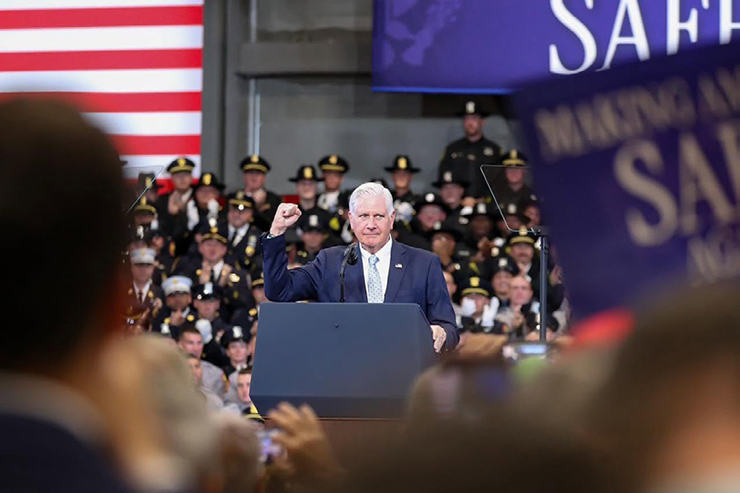
“I love Long Island,” he began. Over the next hour, a formal crime address gave way to personal stories, endorsements, political attacks, jokes and impromptu exchanges. When it ended, “Y.M.C.A.” filled the building and Trump delivered his signature dance.
The larger significance, however, lay in why he chose Nassau County.
The FBI report released that day showed violent crime nationally falling 9.3 percent in 2025, with murder and non-negligent manslaughter down 18.1 percent, robbery 18.5 percent, rape 7.6 percent and aggravated assault 7.2 percent. The homicide rate fell to 4.1 per 100,000 residents, matching 1955 and 1956 for the lowest level in roughly seven decades.
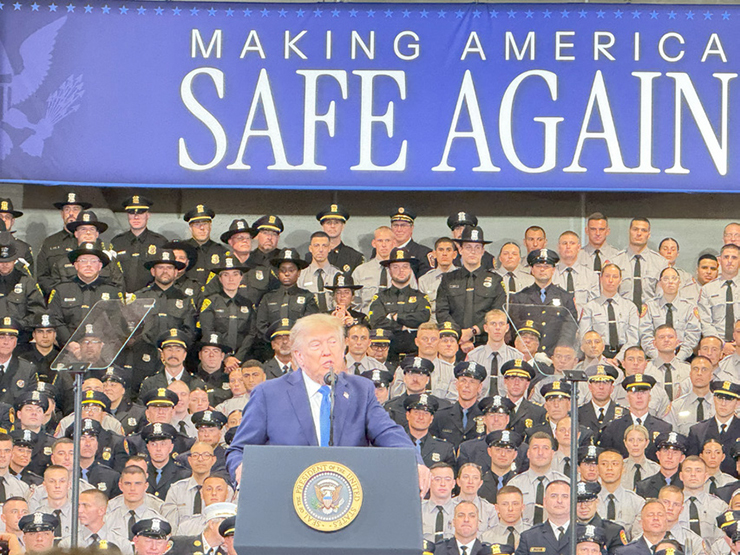
Those figures are historic, but they do not establish a single cause. Violent crime had already been declining nationally since 2022, and researchers caution that the decrease has occurred across jurisdictions with differing policing, political and economic conditions. Trump credited his immigration and law-enforcement policies, but the data alone cannot assign the decline to one administration or policy.
Nassau’s ranking was equally significant. U.S. News & World Report placed Nassau No. 1 in the nation for public safety, awarding it a perfect score of 100 in a measure considering crime, injuries and public-safety capacity. Nassau also ranked first in 2020 and 2021 under then-County Executive Laura Curran. Trump emphasized that ranking.
The afternoon was also unmistakably political. Trump repeatedly praised Blakeman, his endorsed Republican candidate for governor, saying, “I’m sure of this one.” Republicans view Nassau as a model for a statewide public-safety message, while Democrats point to declining crime across New York and argue that state investments have also contributed to improved safety.
When Trump summoned congressional allies and candidates to the front, the event briefly became a New York Republican convention in miniature. Rep. Nick LaLota tied public safety to affordability; Nicole Malliotakis called for voters to “change the tide” across New York; LiPetri framed the choice as “common sense over chaos”; and Driscoll thanked Trump for “lighting this room on fire.” Trump also endorsed Saritha Komatireddy, the Republican challenging Attorney General Letitia James, who recently toured Kew Gardens Hills.
The political stakes explain why Nassau matters beyond its borders. Trump narrowly carried the county in 2024, flipping it Republican in a presidential election for the first time in more than two decades. Republicans are targeting the two Democratic-held House seats centered there, Suozzi’s and Rep. Laura Gillen’s, while Blakeman attempts to become New York’s first Republican governor since George Pataki left office.
Blakeman’s place in the Jewish community adds another layer. Elected in 2021 as Nassau’s first Jewish county executive, he belongs to the Orthodox Jewish Center of Atlantic Beach. The approaching 9/11 anniversary is also personal for him: his nephew, New York State Court Officer Thomas “Tommy” Jurgens, was killed while responding to the World Trade Center.
The emotional center of Trump’s remarks came from a family in mourning. He recognized Migdalia Martinez and retired NYPD Detective Sgt. Jesus Freytes, whose 12-year-old son, Jacob Freytes, was killed by stray gunfire in the Bronx in July. Trump stepped away from the podium and embraced Martinez as she wept.
Trump also recognized Madeline Brame, whose son Hason Correa was murdered; crime survivor Jasmine Robles; and former NYPD Officer Ethan Curreri, who had previously arrested José Ibarra, later convicted of murdering nursing student Laken Riley. Trump compressed the chronology in his telling: Ibarra’s New York arrest and Riley’s murder were separated by months, not days.
That contrast reinforced Nassau’s emerging political importance. The county is suburban yet inseparable from New York City; home to a substantial Jewish community and a powerful law-enforcement culture; politically competitive; the battleground for two consequential House races; and the base from which a Republican county executive is trying to capture Albany.
From the press riser, with uniformed officers framing the stage and yarmulkes and Magen David necklaces visible throughout the room, the event’s scale was easier to gauge than its long-term effect. The auditorium was small enough to watch the President’s expressions and hear unscripted exchanges — a level of access rare for a presidential appearance, and one that put national politics directly inside a community that spends much of its time thinking about security.
What Friday established most clearly was a strategy. Republicans intend to run New York’s 2026 races on public safety, and they intend to run them from Nassau County: the two House seats they are targeting sit there, their candidate for governor runs the county, and the crime numbers they plan to cite carry the county’s name.
Come September 11, Ground Zero will mean what it has always meant — Lower Manhattan, the victims, the first responders and the families marking 25 years. In the 2026 campaign, though, Nassau County has become the ground both parties are now fighting over.
By Shabsie Saphirstein