
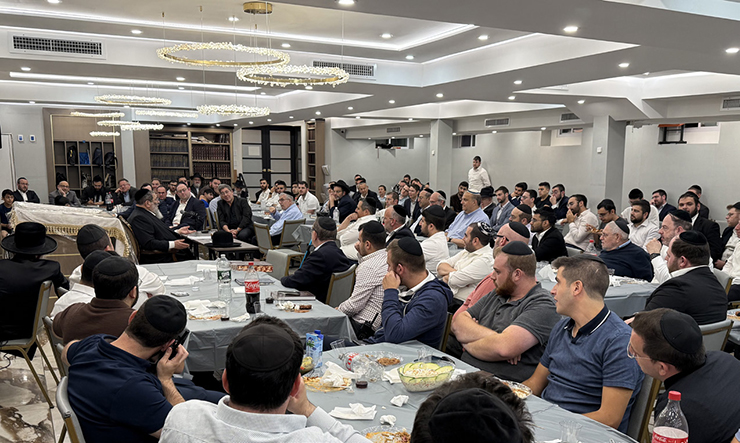
Did Jewish families really celebrate Shabbos every week? That was the question a Catholic woman from Topeka, Kansas, asked HaRav Yaakov Bender shlita during a flight home from Los Angeles. Her astonishment became one of several stories the Rosh HaYeshivah shared during the Kew Gardens Hills Rosh Chodesh Yarchei Kallah on September 17, illustrating the joy of Jewish life and the values children absorb at home.
The gathering at Beis Yosef D’Ulem brought together learning groups from across Queens. Reb Nechemia Hoch introduced Rav Bender, Rosh HaYeshivah of Yeshiva Darchei Torah in Far Rockaway and a master mechanech whose guidance is sought by parents and educators worldwide. His lecture, delivered ahead of Yom Kippur, remains especially relevant as families prepare for Sukkos.
Rav Bender recalled Rabbi Scheinman, an American who learned in the Mir and survived its wartime journey to Shanghai. As children in Washington, D.C., he and his siblings sometimes played on the White House lawn. One day, a stranger asked about their tzitzis, encouraged them to preserve their traditions, and introduced himself as President Calvin Coolidge.
Years later, their father, Peretz Scheinman, was killed in an automobile accident, leaving a wife and nine children. Many observant immigrants lost jobs because they refused to work on Shabbos, and their children often heard how difficult it was to be Jewish. Despite their hardships, the Scheinman children heard how wonderful it was to be a Jew. All nine remained observant.
Rav Bender asked parents to consider what their own children hear. Is it the happiness of Shabbos, Yom Tov, and Torah learning, or mainly the work and inconvenience involved? The atmosphere parents create can influence children long after particular conversations are forgotten.
Technology presents another challenge. Rav Bender spoke about children who stay up on devices and struggle to get up for shul, and about the damage caused by inappropriate online material. Even harmless distractions consume hours better spent with family.
At a Lakewood gathering alongside HaRav Shmuel Kamenetsky shlita, Rav Bender noticed many attendees on their phones. He asked how many called their mothers every day. Only five hands went up.
Rav Bender recalled calling his widowed mother every evening, conversations that remain precious decades after her passing. He also urged husbands to call their wives during the day just to see how things are going. With phones constantly within reach, there should be time for the people who matter most.
That attention should extend to children. One boy brought home parshah sheets, eager to share what he had learned, only to hear his father complain about another package of papers. Parents may feel overwhelmed, but a child’s enthusiasm for Torah deserves encouragement.
On that flight from Los Angeles, the woman from Kansas described visiting Jewish neighbors and watching the mother light candles, the father leave for shul in his finest clothing, and the family gather for a festive meal. Learning that this happened every Friday night astonished her.
“Rabbi, do you know how lucky you are?” she asked. Her own family enjoyed something comparable perhaps twice a year, and she kept accepting her neighbors’ invitations.
Rav Bender wondered why Jewish families sometimes rush to end Shabbos when they could enjoy more time with spouses, children, and grandchildren. Acknowledging the considerable work involved, particularly for mothers, he encouraged parents to ensure that children also experience the happiness of these occasions.
Another story showed how a small kindness can become a lifelong memory. On a camp trip to Niagara Falls, one boy discovered that the identification needed to cross into Canada was missing and had to leave the bus. Rather than abandon his friend, another camper stepped off with him.
That camper was Rav Bender’s son. When he married, the incident was recounted repeatedly at the Sheva Brachos. The attractions were forgotten, but the kindness had become part of the family’s history.
The Rosh HaYeshivah connected that lesson to the avnei miluim, the twelve stones of the Choshen, which were precious because each filled its designated place; without even one, the breastplate was incomplete. Filling another person’s needs can likewise be worth more than a diamond.
Children learn chesed by watching their parents. Rav Bender recalled leaving a Pesach seder to help someone and returning to find the family asleep at the table. The interruption was inconvenient, but the children saw the importance of responding when someone needs help.
The lecture also addressed arguments over honor. At one lavish wedding, the families disputed who would serve as mesader kiddushin for about an hour and 45 minutes, disrupting the celebration.
In contrast, when HaRav Chaim Shmuelevitz zt”l, the Mir Rosh HaYeshivah and Shanghai survivor, married off a daughter, he considered the feelings of the chasan, who had lost his family and would approach the chuppah without his parents. Watching the bride escorted by both parents might deepen that pain, so Rav Chaim and the Rebbetzin arranged for another couple to accompany their daughter instead.
The story carried particular meaning for Rav Bender, whose own mother passed away shortly before his eldest son’s wedding. At one wedding, people fought over an honor; at the other, a father surrendered one to spare someone else’s feelings.
That sensitivity must begin at home. Rav Bender urged husbands to appreciate their wives and warned that arguments between parents can leave children anxious.
With Yom Kippur behind us and Sukkos approaching, Rav Bender’s message offers practical ways to carry resolutions into the new year. Call a parent, appreciate a spouse, listen when a child shares divrei Torah, and help someone in need. Make Shabbos and Yom Tov occasions children eagerly anticipate. Long after the sukkah is dismantled, the warmth, kindness, and joy of a Jewish home are what children will remember.
By Shabsie Saphirstein