
Public Funding, Private Donations, and a Preliminary Design Point Toward a Living Classroom at Borough Hall
The Queens Holocaust Memorial Garden began with a question raised by community leaders: How could a borough that became home to thousands of Holocaust survivors still lack a major stand-alone memorial?
Roughly four years after that idea was brought to city and borough officials, the project now has a dedicated site, millions of dollars in announced government support, a nonprofit raising private funds, and a preliminary architectural vision.
What it does not yet have is a final design, a complete public budget, a construction schedule, or an announced opening date.
The public effort grew from a quiet meeting around 2022 between Holocaust survivor Vladimir Epshteyn and Queens Jewish Community Council board member Judith Rosen. Michael Nussbaum and other QJCC leaders then carried the proposal into discussions with the Queens Borough President’s Office and City Hall.
Their vision called for a landscaped place of remembrance and education on the southeast lawn of Queens Borough Hall, close to the communities where survivors rebuilt their lives and raised their families.
The project reached a major public milestone on November 25, 2025, when Mayor Eric Adams’ administration, Queens Borough President Donovan Richards, state legislators, survivors, and community leaders formally announced the memorial and held a ceremonial groundbreaking.
City Hall said the city and borough president had initially allocated a combined $3 million: $2 million through the mayor and $1 million through Richards.
At the ceremony, Richards announced another $1 million, bringing city and borough commitments described in public reporting to $4 million. State Senator Toby Ann Stavisky committed an additional $1 million in state capital funding, bringing publicly announced government support to $5 million.
Assemblyman Sam Berger also said the Queens Assembly delegation would seek another $1.5 million in the next state budget.
Another funding question emerged in September 2026, when the Mamdani administration’s Strategy to Combat Antisemitism referred to a $2 million capital investment to complete the memorial’s design and construction.
If that represents new money, publicly announced government support would rise from $5 million to $7 million.
Government money is only part of the financing.
City Hall said from the outset that the Queens Jewish Community Council would lead additional fundraising for the design and construction of the commemorative artwork. IRS records list Queens Holocaust Memorial Garden Inc. as having received federal tax-exempt status in July 2026.
Its first publicly available tax filing reported $189,773 in contributions during 2025, no expenses, no liabilities, and the same amount in year-end net assets. Its officers reported no compensation.
The filing offers the first public look at private fundraising, but it does not reveal the project’s total cost.
A complete financial picture will ultimately require a project budget showing how much is coming from city, borough, state, and private sources, how much has formally been appropriated, and how much still needs to be raised.
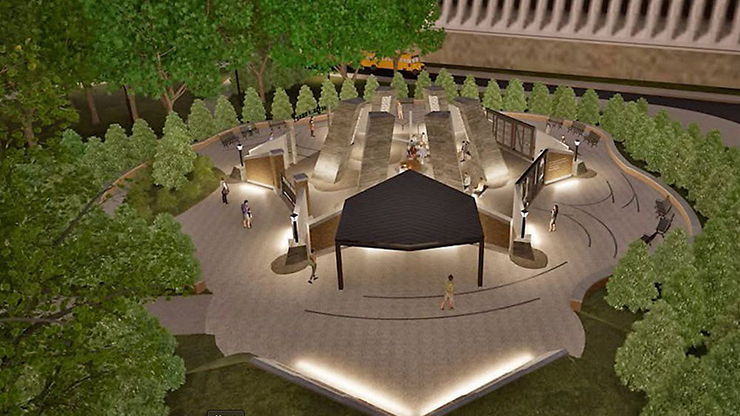
The preliminary architectural concept offers a sense of what the memorial could become.
Rafael Viñoly Architects prepared renderings centered on two cylindrical rings open to the sky. The “Ring of Immortality” is intended as a place of memory, while the “Ring of Peace” is envisioned as a garden for reflection. Between them, a “Path of Remembrance” would incorporate symbolic Holocaust artifacts, with 12 trees representing the Twelve Tribes of Israel.
The site is also intended to serve as a living classroom.
City officials have described student programs, Holocaust remembrance ceremonies, and community gatherings that would teach what unchecked hatred can produce. As the generation of survivors grows smaller, the memorial could preserve their testimony in a public setting encountered not only by Jewish visitors but also by jurors, court employees, students, families, and the thousands of residents who pass Borough Hall.
The renderings, however, remain preliminary.
The Department of Cultural Affairs is expected to lead a Percent for Art selection process in consultation with artists, historians, survivors, and community members.
Several major questions still remain unanswered: What will the memorial ultimately cost? Is the Mamdani administration’s $2 million new? Did the Queens Assembly delegation secure the additional funding it sought? And when will the formal design and construction process begin?
The project has nevertheless moved a considerable distance from the original idea.
Its significance, however, will not be measured only in dollars. If the final memorial remains faithful to its educational mission, it can become a place where Queens remembers the six million, honors those who survived, and teaches future generations why “Never Again” must be more than a phrase.
By Shabsie Saphirstein