
When Mayor Zohran Mamdani released his administration’s 33-page Strategy to Combat Antisemitism on September 29, much of the immediate debate focused on what the document said—and did not say—about Israel, Zionism, and the definition of antisemitism.
Buried deeper in the report are a different set of questions: How will the city measure whether the strategy works? When are agencies expected to deliver? How much of the funding is new? And what, legally, does the document actually require?
The plan contains significant commitments involving Jewish security, education, and cultural life. It also leaves many of its goals without numerical benchmarks or firm deadlines.
The strategy promises to confront antisemitism in all its forms, support survivors, educate New Yorkers, and protect Jewish life. It does not set a target for reducing antisemitic hate crimes, specify how many institutions should receive security improvements, or provide firm implementation deadlines for many of its major initiatives.
That omission stands out because the report itself stresses accountability and argues that a strategy matters only if New Yorkers can measure whether it is working.
The legal status of the document is also spelled out clearly - it does not modify existing rules or agency policies, has no force of law, and creates no enforceable right or benefit. It repeatedly promises to work with, encourage, expand, support, or coordinate programs rather than imposing new mandates tied to specific deadlines or outcomes.
The funding picture also requires a closer look.
In his introductory letter, Mamdani writes that annual hate-crime-prevention funding increased nearly ninefold, from $3 million to $29 million. Elsewhere, the administration describes a $26 million investment in the Office for the Prevention of Hate Crimes.
The two numbers refer to the broader expansion of hate-crime-prevention funding rather than a fund dedicated solely to antisemitism.
Within the strategy, $7.4 million is attached to specific allocations: $6.4 million for Partners Against the Hate, known as PATH, and $1 million for physical security.
PATH is an existing citywide program that serves multiple communities. Participating organizations include the Jewish Community Relations Council of New York as well as groups representing Arab, Asian, Hispanic, and LGBTQ communities.
One anchor organization, the Arab American Association of New York, has drawn scrutiny because of its pro-Palestinian advocacy and past ties to Linda Sarsour. The administration, however, did not award that organization $6.4 million. The money expands the PATH program as a whole.
That leaves an important practical question: How much of the new spending highlighted in an antisemitism strategy will ultimately be used specifically to combat antisemitism?
The report says the Mayor’s Office to Combat Antisemitism will join the Office for the Prevention of Hate Crimes’ selection committee for distribution.
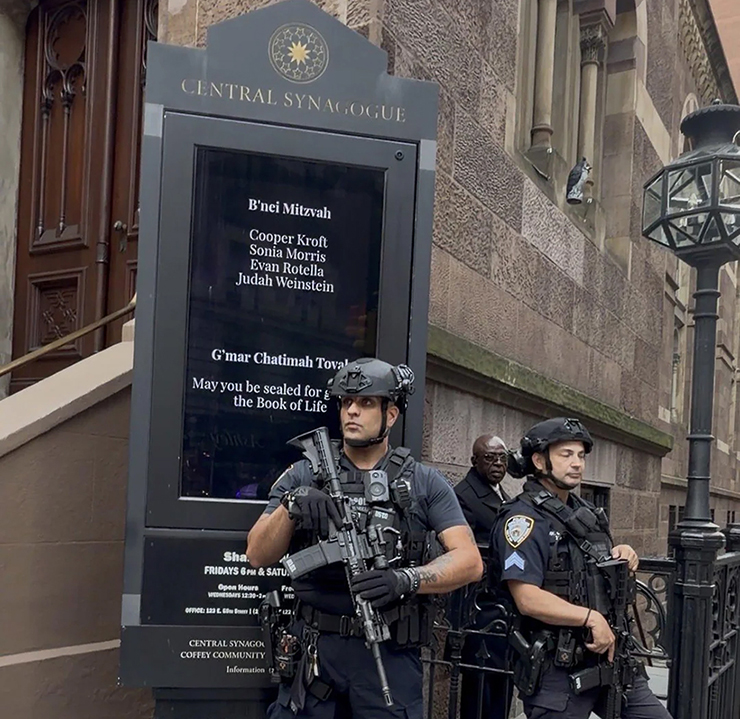
The $1 million set aside for physical security is intended to support vulnerable nonprofits and houses of worship, but detailed eligibility rules have not yet been released.
Several initiatives highlighted in the report also existed before the strategy was issued.
The Security Infrastructure Working Group is being relaunched. An interagency antisemitism task force has been reconvened. Existing school and hate-crime programs appear throughout the document.
The public debate surrounding the strategy has focused far more heavily on definitions.
The administration considered the IHRA definition of antisemitism, the Jerusalem Declaration, and the Nexus Document, but formally adopted none of them. Its position is that New York City can combat antisemitism without relying on a single official definition.
That decision drew criticism from several major Jewish organizations.
UJA-Federation of New York, JCRC-NY, AJC’s New York office, and the New York Board of Rabbis praised elements involving security and education while criticizing the plan for not sufficiently addressing rhetoric that demonizes or delegitimizes Israel.
More than 25 other Jewish organizations later called for revisions, arguing that anti-Zionist harassment can sometimes become a vehicle for targeting Jews.
The report gives more explicit attention to white-supremacist antisemitism than to antisemitism expressed through anti-Zionist or anti-Israel rhetoric and conduct.
For critics, the unresolved question is when hostility toward Zionism becomes hostility or discrimination directed at Jews.
Mamdani has defended the approach, saying his administration will protect Jewish New Yorkers regardless of their views on Israel.
Supporters, including the Nexus Project, welcomed the more pluralistic framework while also emphasizing that its success will depend on implementation.
The disagreement is over how government should identify antisemitism before conduct rises to the level of a crime or legally actionable discrimination.
The strategy places antisemitism within a broader anti-hate framework, emphasizing intergroup cooperation, community-based prevention, and non-law-enforcement responses alongside policing.
It also contains measures likely to directly benefit Jewish New Yorkers. The report recognizes the disproportionate danger faced by visibly Orthodox Jews, notes the diversity of New York’s Jewish population, and specifically acknowledges Bukharian Jews, Hasidic Jews, and other traditional communities that are often overlooked.
What happens next will determine how much of the document moves from policy language to visible results.
Where will the expanded funding and security money go? What standards will the city use to measure success? And how will officials respond when antisemitism appears through anti-Zionist conduct rather than more familiar forms of anti-Jewish hatred?
Through the first eight months of 2026, more than half of all confirmed hate crimes in New York City targeted Jewish New Yorkers, according to NYPD Commissioner Jessica Tisch, even though Jews make up about 10% of the city’s population. Confirmed antisemitic hate crimes were also higher than during the same period a year earlier.
The real test will come later - in whether Jewish New Yorkers see a measurable difference in their schools, synagogues, neighborhoods, and daily lives.
By Shabsie Saphirstein