
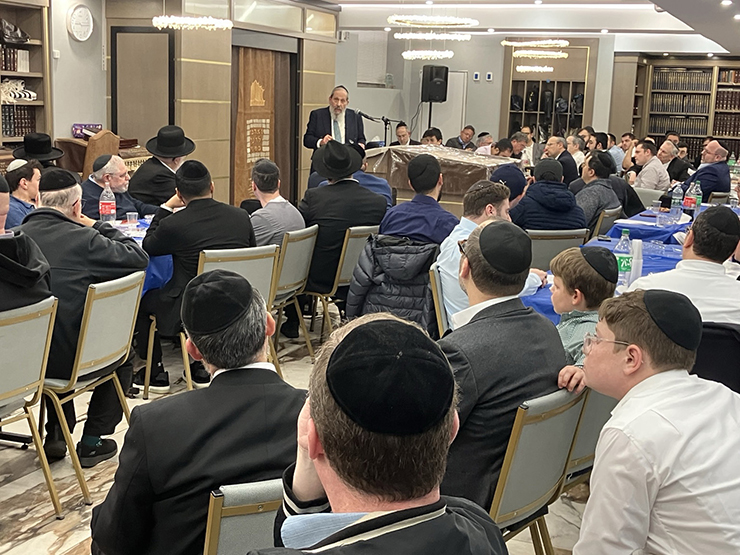
The Kew Gardens Hills Rosh Chodesh Yarchei Kallah drew one of its largest crowds to date on Monday evening, October 12, as men representing 18 local congregations and an additional learning group gathered to hear Rabbi Shaya Cohen, Rosh HaYeshivah of Yeshiva Zichron Aryeh. Every seat was occupied, prompting organizers to bring additional chairs from the garage.
Held at Bais Yosef D’Ulem, Rabbi Yaakov Friedman’s shul, the gathering featured Rabbi Cohen’s shiur, “Clarifying The Concept Of Bitachon And Its Power.” Participants first studied prepared mareh mekomos, followed by the presentation and Maariv. The central question was both fundamental and deeply personal: Does bitachon, trust in Hashem, mean accepting whatever the future brings, or can it provide confidence that a particular difficulty will end favorably?
Rabbi Cohen opened by observing that even a principle as cherished as bitachon can become controversial when examining what it requires and what it can accomplish.

He began with the Chazon Ish, who challenges the assumption that bitachon obligates a person to believe every uncertain situation will end favorably. Since no one can know Hashem’s plans, such an outcome cannot be presumed. Rather, the foundation of bitachon is recognizing that nothing happens by accident and that every development is governed by Divine Providence.
Yet the Chazon Ish himself describes a higher spiritual level in which a person experiences an inner conviction that Hashem will help him. Rabbi Cohen suggested that the distinction lies between what every Jew is obligated to believe and an elevated degree of confidence an individual may attain.
To explore this apparent tension, Rabbi Cohen turned to a passage in Maseches Brachos concerning someone approaching a city who hears cries of distress. Although the Mishnah teaches that praying for something already determined to be otherwise constitutes a tefilas shav, a futile prayer, the Gemara relates that Hillel expressed confidence that the cries were not coming from his own home.
Drawing upon the Vilna Gaon and the Meiri, Rabbi Cohen examined how such certainty could be justified when the event had already occurred. He suggested that Hillel possessed an extraordinary level of bitachon that allowed him to anticipate Hashem’s protection. The Chazon Ish, he proposed, was not rejecting the possibility of such confidence, but questioning whether it could be demanded of everyone.
Rabbi Cohen also cited the Chofetz Chaim, who encouraged Jewish soldiers facing danger to trust in Hashem’s protection and anticipate His kindness. His message suggested that meaningful bitachon was not reserved for individuals of exceptional spiritual stature. Even those who have not attained complete certainty can strengthen their trust.
A more difficult question concerned the suffering of righteous individuals. If bitachon possesses such power, why have great tzadikim endured extraordinary hardship?
Drawing upon the Leshem, Rabbi Cohen explained that some tzadikim accepted suffering as part of Hashem’s will rather than seeking to alter the Divine plan. Their experiences therefore could not automatically be understood as evidence of insufficient bitachon, underscoring the danger of judging another person’s spiritual standing by the hardships he experiences.
Rabbi Cohen further examined a teaching concerning Noach, whose future suffering and self-sacrifice were understood as contributing to his merit. Since Hashem is not bound by time, Rabbi Cohen suggested, future expressions of faith may have significance within Divine Providence even before they occur. He offered this as a possible explanation for Hillel’s confidence while acknowledging the difficulty of fully understanding the relationship between bitachon and events already underway.
Turning to practical application, Rabbi Cohen emphasized that the path toward greater bitachon begins not by attempting to guarantee a desired outcome, but by developing a deeper appreciation of Hashem’s kindness.
He cited David HaMelech’s words in Tehilim, “Va’ani b’chasdecha batachti, yagel libi bishuasecha.” The sequence, he explained, is significant: Trust in Hashem’s kindness precedes confidence in salvation. Rather than beginning with the result one hopes to achieve, a person begins by reflecting on Hashem’s compassion and the goodness already experienced throughout life.
Rabbi Cohen also referenced the Brisker Rav’s interpretation of the verse, “V’his’anag al Hashem v’yiten l’cha mish’alos libecha,” describing how profound trust in Hashem can itself become a source of joy and confidence that one’s heartfelt requests will be fulfilled.
To illustrate how such trust can be developed, Rabbi Cohen turned to the Vilna Gaon’s interpretation of the words recited in Nishmas: “Ad heinah azarunu rachamecha, v’lo azavunu chasadecha, v’al tit’sheinu Hashem Elokeinu lanetzach.”
The passage, he explained, teaches that Hashem’s assistance comes through compassion and kindness, not necessarily because it has been earned. Recognizing past blessings as expressions of Divine generosity provides a foundation for trusting that His kindness will continue.
This understanding also addresses a common obstacle to bitachon: the fear that one may not be worthy of Divine assistance. If previous blessings are attributed entirely to personal merit, uncertainty about one’s present spiritual standing can weaken confidence. Recognizing those blessings as undeserved kindness offers a more enduring source of trust.
Rabbi Cohen noted that the strength of bitachon can vary according to circumstances. At times, an extraordinary challenge may awaken greater confidence in Hashem than the routine difficulties of daily life. Such trust develops through a growing awareness of His kindness rather than an attempt to force certainty about the future.
He also explored whether the power of bitachon extends beyond essential needs to personal desires, recounting a well-known account involving Rabbi Yisrael Salanter, the Rashash, and a gold watch. The episode illustrated a longstanding discussion among Torah authorities about whether the benefits of bitachon are limited to necessities or may extend to other aspirations.
Concluding his shiur, Rabbi Cohen acknowledged the challenges confronting individuals and families, including health concerns, difficulties involving children, and personal struggles. Developing bitachon, he explained, offers more than hope for a favorable outcome. It can also bring menuchas hanefesh, the inner tranquility that comes from relying upon Hashem’s kindness amid uncertainty.
By Shabsie Saphirstein