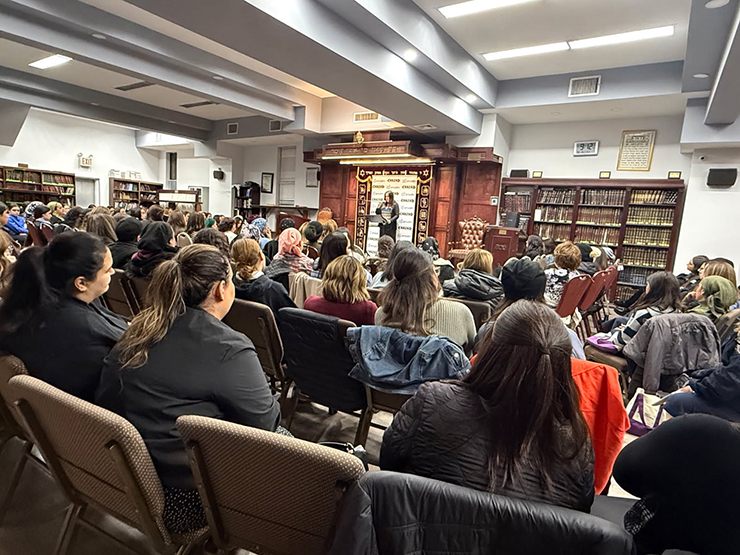

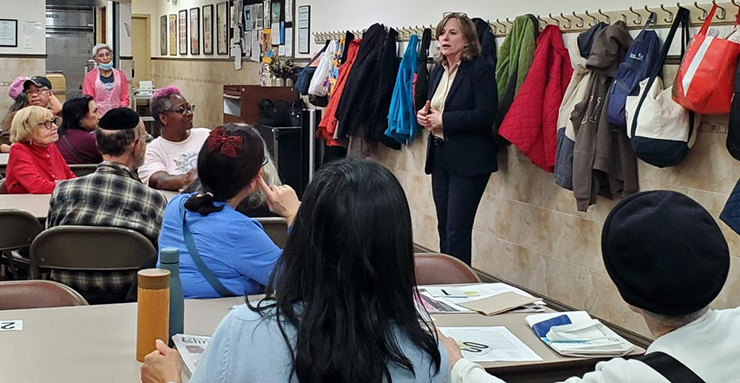
Queens District Attorney Melinda Katz stopped by the Young Israel of Forest Hills Senior League recently, bringing along members of her office’s Elder Fraud Unit to talk about the scams aimed at older residents and what to do when a phone call turns into a request for money.
The session covered the usual suspects: callers pretending to be relatives, government officials, or bank employees, and people fishing for personal information. Katz’s message was simple. If someone is rushing you to pay or pushing you to share private details, that alone is reason to be suspicious.
One of the most common tricks is the “grandparent scam.” The phone rings, and the voice on the other end says it’s a grandchild who’s been arrested, hurt, or is otherwise in trouble and needs money right away. And please, don’t tell Mom and Dad. The scammer is counting on a worried grandparent sending the money before stopping to check.
Others pretend to be from the IRS, Social Security, Medicare, a bank, or the utility company. They warn of arrest, cut-off benefits, or frozen accounts unless payment is made on the spot. Any request to pay with gift cards, cryptocurrency, a wire transfer, or cash is a red flag.
Don’t be reassured just because the number or the voice sounds familiar. Scammers can fake what shows up on caller ID, and with artificial intelligence, they can even mimic a family member’s voice.
The losses can be staggering. In March 2025, Katz announced charges against a Kew Gardens Hills woman accused of taking part in a nationwide scheme that allegedly cheated elderly victims out of more than $500,000. In one case, a 92-year-old woman wired $446,000 after a caller posing as a federal official told her that her accounts had been compromised. Prosecutors say the caller also warned that her children would face consequences if she told anyone. The defendant was charged with grand larceny and criminal possession of stolen property. Those charges are allegations, and she has not been found guilty.
If a call comes out of nowhere asking for money, hang up and check for yourself. Call your relative, bank, or the agency directly, using a number you already have or one you look up yourself, not a number the caller gives you. Never hand over your Social Security number, Medicare information, bank login, or passwords to someone who contacted you first.
Families should talk about these scams with their older relatives. Some agree on a code word that a family member would use in a real emergency. The goal is for older relatives to feel comfortable picking up the phone to ask, “Does this sound right to you?” without feeling like anyone is questioning their independence.
If you’ve already sent money or shared sensitive information, call your bank right away, lock down your accounts, and report it. The faster you act, the better your chances of stopping further losses.
The Queens DA’s Consumer Fraud Helpline is 718-286-6673, and the Elder Fraud Unit can be reached at 718-286-6578.
Queens Shmira’s 24/7 hotline, 718-329-4444, is also available to help residents with suspicious activity, though financial crimes should still be reported to law enforcement.
Online fraud can be reported to the FBI at www.ic3.gov, and the National Elder Fraud Hotline, 833-372-8311, helps victims and their families.
Many victims stay quiet out of embarrassment. But even if the money can’t be recovered, reporting a scam can help investigators track down the people behind it and keep someone else from being next.
Bottom line: No real emergency requires you to pay on the spot. Hang up, check the story, and talk to someone you trust first.
By Shabsie Saphirstein