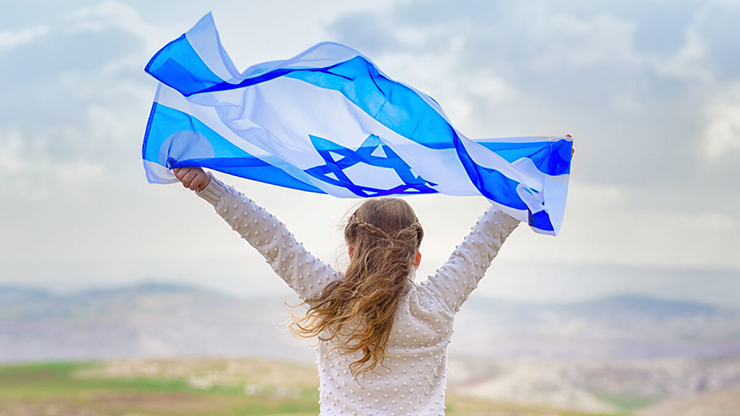
New Year. New Beginning. A Future In Israel.
As we welcome Rosh Hashanah and the beginning of a new year, all of us at Tivuch Shelly Real...
 Queens Jewish Link
Connecting the Queens Jewish Community
As we welcome Rosh Hashanah and the beginning of a new year, all of us at Tivuch Shelly Real...

Raised in Brooklyn, Rochel grew up appreciating that she was Jewish, and that was about it. Her only connection to Orthodox Judaism came through deeply religious relatives who, later in life, had a profound influence on her. After meeting her husband at Harper College, their journey together led them around the world. In 1971, after being married for seven years, Rochel and her husband were living in Taiwan due to a Fulbright Fellowship, and it was there that their lives took an unexpected turn.
The remarkable story of Yosef being sold into slavery is replete with many nuances and distinctions that require a great deal of studying and comprehension. On a basic level, when the brothers saw Yosef coming to them near Shechem, they convened a Beis Din and judged him on the spot. They decided to kill him as a “Rodef.” However, Reuven, the oldest brother, stepped in and rescued him. He literally gave Yosef back his life by suggesting that they sell him instead of kill him.
The Zohar states that 974 generations of souls were reincarnated in Lavan’s sheep. Before Yaakov’s arrival at Lavan’s home, they were trapped by the Sitra Achra. Yaakov rescued these souls by implanting emunah into them, in the form of the rods that he placed in the water, and when the sheep gazed at the rods, the souls inside them were transformed with purity.

Daniel and Neria Sharabi attended the Nova Festival on October 7, together with a group of friends, and soon after enjoying a beautiful sunrise, the missiles started falling and everyone began running. Daniel was a trained IDF medic and kept stopping to help wounded people along the way, but after watching an RPG blow up a car behind which his best friend Yosef and some others were hiding, he simply dropped everything and ran, together with Neriya, for their lives. Terrorists were everywhere, spraying machine-gun fire, and young people were dropping like flies. It was nothing short of heartbreaking.
World War I broke out on Tish’ah B’Av 5674 (1914) and lasted until 7 Kislev 5679 (November 11, 1918). The “Great War,” as it was known, pitted the armies of Germany, Austria-Hungary, and the Ottoman Empire (the Central Powers) against Great Britain, France, Russia, Italy, and Japan (the Allied Powers). The Allies were joined after 1917 by the United States. The four years of the Great War saw unprecedented levels of carnage and destruction, thanks to grueling trench warfare and the introduction of modern weaponry such as machine guns, tanks, and chemical weapons. By the time World War I ended in the defeat of the Central Powers in November 1918, more than nine million soldiers had been killed and 21 million more civilians wounded.
The Chazon Ish zt”l is quoted as saying: “The generation that became non-religious came from parents who were religious. These religious parents saw what was happening with their children but, for whatever reason, could not stop them. They cried lonely, bitter tears, they prayed, they fasted, but it was too late to stem the tide. But Hashem does not forget a Jewish tear. If those tears of sincerity did not help to save their own children, they have helped for the grandchildren and, in some cases, great-grandchildren. That’s the reason why these children come back to Yiddishkeit today—because Hashem doesn’t forget Jewish tears.”