New Year. New Beginning. A Future In Israel.
As we welcome Rosh Hashanah and the beginning of a new year, all of us at Tivuch Shelly Real...
 Queens Jewish Link
Connecting the Queens Jewish Community
As we welcome Rosh Hashanah and the beginning of a new year, all of us at Tivuch Shelly Real...

When the Chassidic movement began to blossom at the turn of the 19th century, many Torah scholars feared it would become nothing more than a populist movement that, in order to attract adherents, might be lax in demanding rigid observance of halachah. The movement had begun not long after the Shabbetai Tzvi (false messiah) debacle, and many people were also afraid that the Chassidic emphasis on Kabbalah might lead to similar defections. However, in the coming years, as Chassidus proved itself faithful to halachah, the differences between the two groups took on the flavor of feuding for the sake of feuding, and people who enjoyed fighting found a banner under which to do battle. For the most part, this did not last long, and eventually both groups learned to live with each other’s unique mannerisms and customs.
The yeshivos in Europe were unlike the yeshivos in our days. Today, the yeshivos take full care of all the needs of the bachurim, but it wasn’t so in Europe. The yeshivos didn’t have dormitories; most bachurim were far from home, and so boys would sleep on the benches in the local shul. Even then, the benches weren’t enough for all the boys; often only the older bachurim had the privilege of sleeping on a bench! The younger bachurim had to sleep on the floor.
The Baal Shem Tov zt”l notes that Parshas Terumah, containing the mitzvah of donating toward the building of the Mishkan, immediately follows Parshas Mishpatim, which concludes with receiving the Torah. The command to build the Mishkan was Hashem’s way of telling Klal Yisrael to actualize their acceptance of the Torah. It wasn’t enough to proclaim, “We will do and we will hear,” and then return to their normal lives as if nothing had transpired.
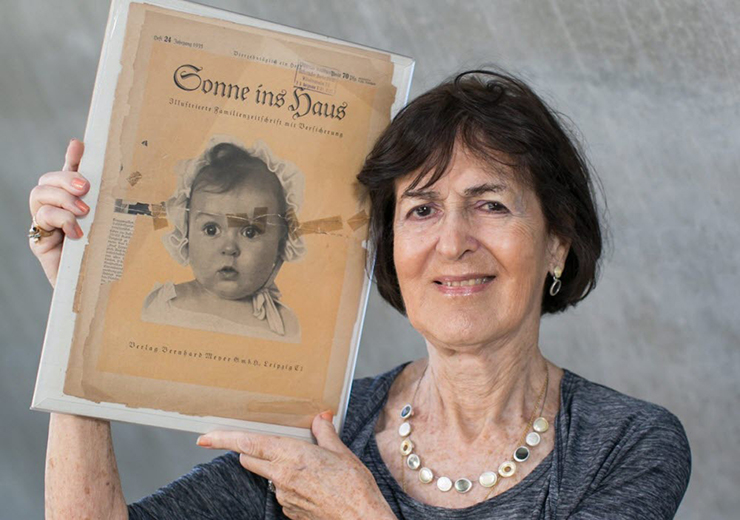
In 1935, the Nazi drive to isolate and demonize the Jewish people was soaring to new heights. A series of decrees known as the Nuremberg Laws made brutal distinctions between Aryans and non-Aryans: Jews, Roma, and Black people. Overnight, German Jews were stripped of their citizenship, forbidden from holding government jobs, and restricted from public spaces lest they “infect” Aryans. A key driver of this pseudo-racial propaganda was a magazine called Sonne ins Haus, or “Sunshine in the Home,” which promoted the Nazi myth of Aryan perfection and non-Aryan pollution. In 1935, the magazine ran a contest across Germany to find the perfect Aryan baby. Ten famous portrait photographers were asked to submit ten portraits of beautiful German babies. Joseph Goebbels, chief propagandist of the Nazi party, would judge the winner himself.
The tzaddik R’ Michoel Ber Weissmandl zt”l was famous both for his survival and rescue efforts during the Holocaust as well as his teachings based on what would later be termed “Equidistant Letter Sequences” (ELS), later popularized by Aish HaTorah and other programs as “Bible Codes.” Notably, the well-known code of the Nuremberg trials and “Purimfest 1946” was first attributed to him in 2002 by Rabbi Chaim Alexander Neiman. While the Nuremberg teaching is not itself an example of ELS, it is often mentioned in the context of other “Bible Codes” and viewed as part of that genre.
R’ Matisyahu Salomon, shlit’a, says that one cannot be a believer (ma’amin) unless he is first faithful (ne’eman). One cannot believe in the Torah and the word of Hashem unless he himself is a person who values a word. If it means nothing when I say something, then when Hashem says something, why should I believe it? The more trustworthy a person is and the more meticulous he is about his own words, the more he will be faithful to the word of the Almighty.