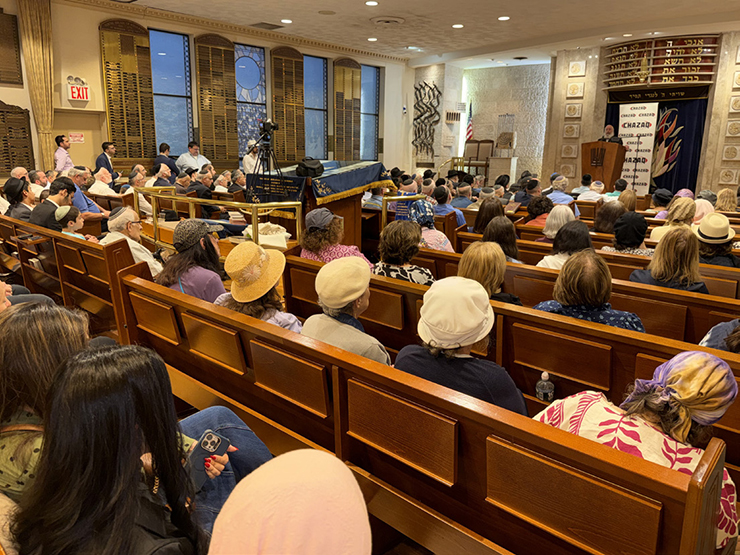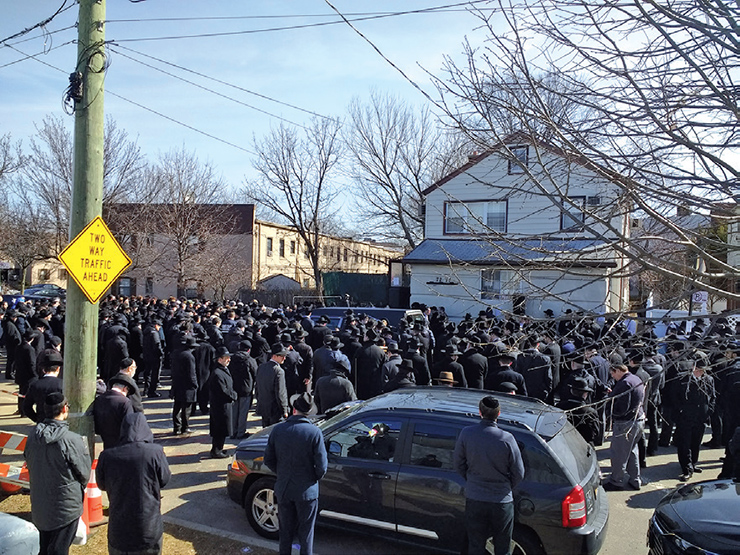


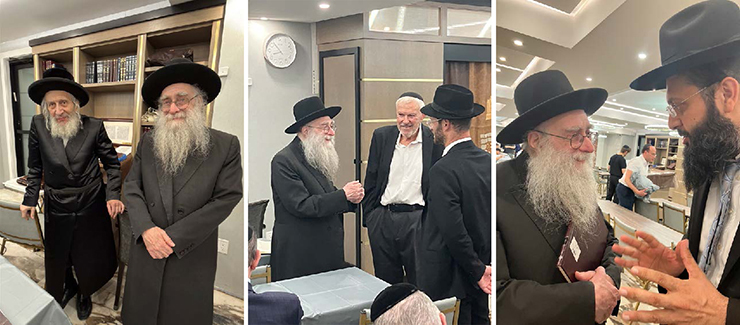
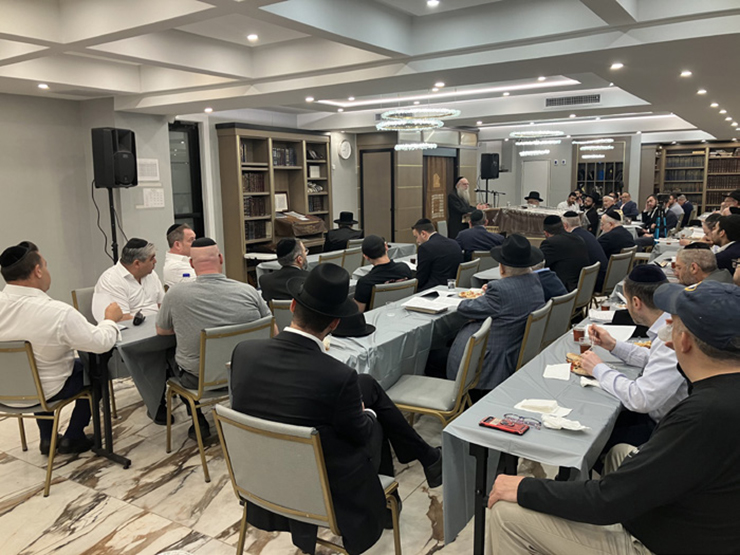
The beis midrash at Bais Yosef D’Ulem–Rabbi Friedman Shul was filled to capacity on Tuesday evening, July 14, as men from 17 neighborhood shuls and learning programs gathered for the KGH Rosh Chodesh Yarchei Kallah. The monthly initiative unites the Kew Gardens Hills Torah community for learning, this month with a six-page mar’ei m’komos packet and a Nine Days pareve buffet from Naomi’s Pizza.
The drashah was delivered by Rav Shlomo Avigdor Altusky shlita, Rosh HaYeshivah of Yeshiva Darchei Torah and Bais Medrash Heichal Dovid. Among the rabbanim in attendance were Rav Yaniv Meirov, Rav Yonah Nisanov, Rav Ilan Feder, and the mara d’asra, Rav Yaakov Yitzchak Friedman.
The evening centered on the restriction against ordinary Torah learning on Tish’ah B’Av. Rav Altusky began with the Rema’s ruling that after chatzos ha’yom on Erev Tish’ah B’Av, regular study is set aside in favor of the d’varim ha’ra’im permitted on the fast itself – a custom understood to include even Pirkei Avos when Erev Tish’ah B’Av falls on Shabbos.
The Taz and the Vilna Gaon challenged the practice. The formal dinim of aveilus do not begin until nightfall, public mourning is prohibited on Shabbos, and even the Nine Days restrictions on meat and wine do not apply. Why, then, should ordinary learning stop after chatzos? The Maamar Mordechai raised a practical concern: If people cannot learn their regular Gemara, they may spend the afternoon shmoozing or searching for distractions. What is gained by exchanging Torah for empty recreation? Rav Altusky compared this to Chol HaMoed, where work is restricted so the intermediate days can serve their purpose; when that time is given over to diversions, the purpose is lost.
Behind these halachic questions, however, lies a more fundamental issue: Why is regular Torah learning restricted at all? HaRav Altusky turned to the disagreement in Maseches Taanis between the Tanna Kama and Rabbi Yehudah. The Tanna Kama permits studying an unfamiliar topic, since a difficult sugya brings mental strain rather than immediate geshmak, and permits children to continue, since schoolwork lacks the intellectual enjoyment an adult learner experiences. Rabbi Yehudah prohibits both. The two opinions turn on a basic chakirah: Is learning restricted because of the simchah it produces, or is talmud Torah suspended as part of the unique message of Tish’ah B’Av?
The Rosh HaYeshivah contrasted this with the individual mourner. The Yerushalmi discusses one who is lahut achar haTorah – so attached to Torah that learning is not optional pleasure but, mamash, his spiritual chiyus. He cited the Rogatchover Gaon, who continued discussing Torah during shiv’ah and, when questioned, reportedly answered that if the consequence was Gehinnom, then being unable to learn was itself Gehinnom. That may apply to personal aveilus, but not to the national lesson of Tish’ah B’Av.
To explain that lesson, he turned to Maseches N’darim, which asks why Eretz Yisrael suffered such complete destruction. The Gemara answers that B’nei Yisrael did not first recite the blessing over the Torah. The Bach explains that the generation did not simply forget the words of Birchos HaTorah; they learned for brilliance, prestige, or practical gain, mastering the information while losing the heart of Torah. Talmud Torah is not limited to reaching a maskana – the learner enters the sugya with mind and heart, forming a bond with Hashem through the learning itself. When Torah becomes information rather than connection, the Shechinah departs, leaving the Beis HaMikdash as wood and stone that can be destroyed.
Applying the lesson today, Rav Altusky observed that artificial intelligence may produce an instant answer – and may get the facts wrong – but retrieving information is not talmud Torah. In any limud, the amal Torah is essential to that bond. He compared the pause of Tishah B’Av to a child entrusted with a sefer who fails to care for it: a parent may remove it temporarily, not to punish him but to teach him to value what was placed in his hands.
This explains why the Rema’s custom begins after chatzos. The character of an approaching day is felt already in the preceding afternoon: Tachanun is omitted at Minchah on Erev Rosh Chodesh, and Erev Yom Tov is devoted to preparing for the festival. So, too, even when Erev Tish’ah B’Av falls on Shabbos, refraining from ordinary learning is not public mourning; it begins realigning one’s relationship with Torah before the fast arrives.
Rav Altusky brought the lesson into daily life: When a person sits down with a sefer, the cell phone should be put away, so that talmud Torah never becomes casual reading between interruptions.
May the inspiration of the Yarchei Kallah remain with the community throughout the fast, and may we merit the rebuilding of the Beis HaMikdash speedily in our days.
By Shabsie Saphirstein