
Since I’ve begun teaching a class on Eastern Jews at Touro University, my syllabus has grown as I’ve found more books to enhance the students’ knowledge of Jewish communities in the Caucasus, Central Asia, and South Asia.
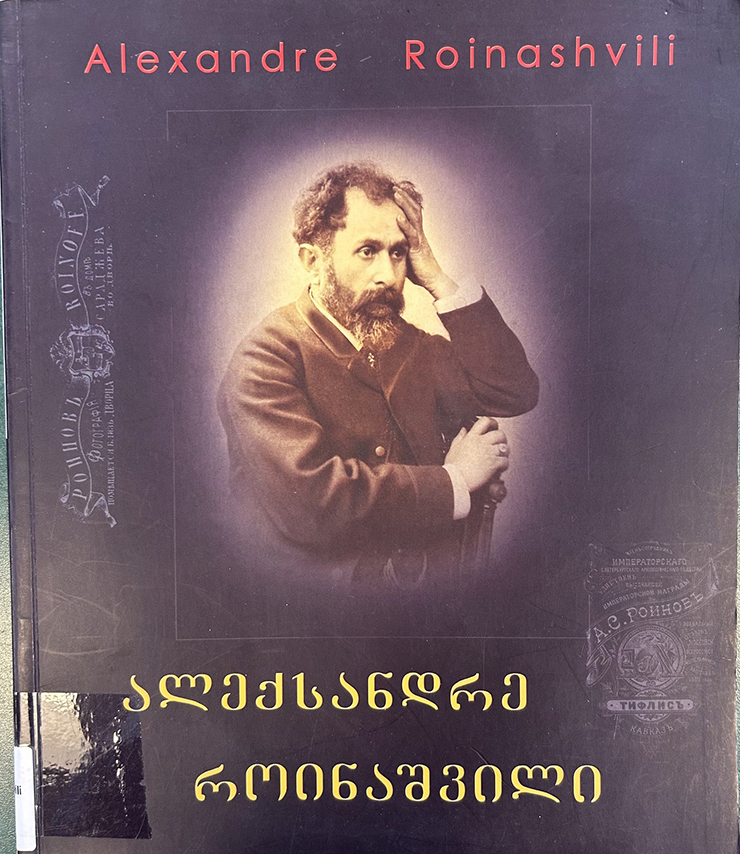
On a visit to the Central Library in Jamaica, I was pleasantly surprised to see a portfolio of Georgian photographer Alexander Roinashvili, who lived in the second half of the 19th century. His works covered the entirety of Georgian society, from the nobility to peasants, Russian officials, mountainous landscapes, and the dense urbanism of Tbilisi. His travels took him across the Caucasus and Central Asia, where he documented historical ruins and the many ethnic groups living in these regions, including Jews.
Considering the official anti-Semitism of imperial Russia, I expected Jews to be an afterthought in Roinashvili’s collection. At the same time, I also recalled that, unlike most Christian societies, Georgia had no history of anti-Semitism, and biblical names were popular among its people. They were ruled by kings named Jesse, David, Solomon, and Queen Tamar. Their national church had a positive outlook towards Jews.
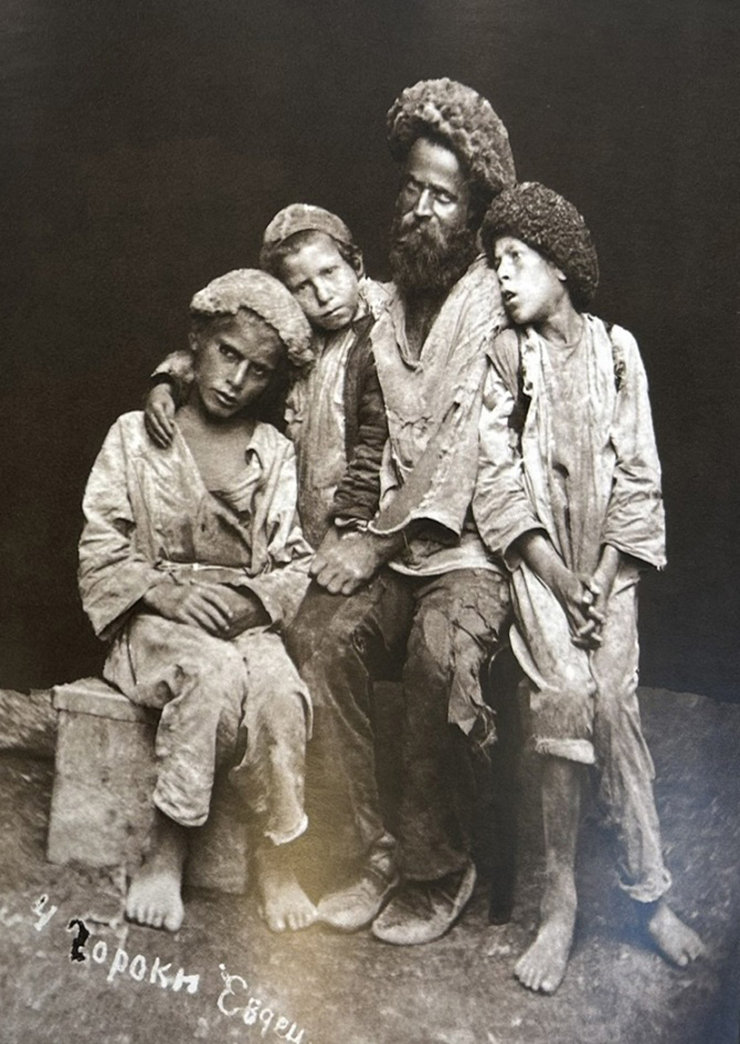
On page 103, a father and three sons are captioned as “Mountain Jews,” those residing in Azerbaijan and the Russian state of Dagestan. If not for the caption, I would not have known that they are Jewish, coming from a region where beards and sheepskin hats were standard attire. Their unkempt clothing and bare feet clearly showed poverty, which could be resolved either through faith, emigration, or revolution. We will never know which path these sons took, as the empire underwent upheaval in the subsequent generation.
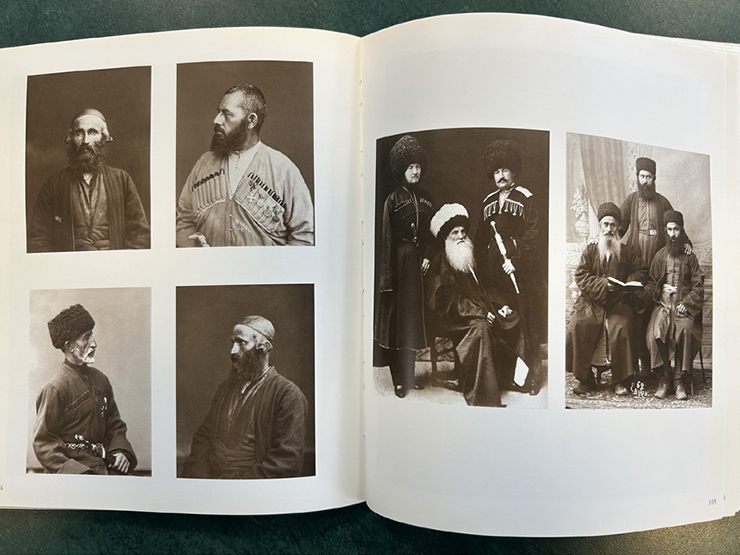
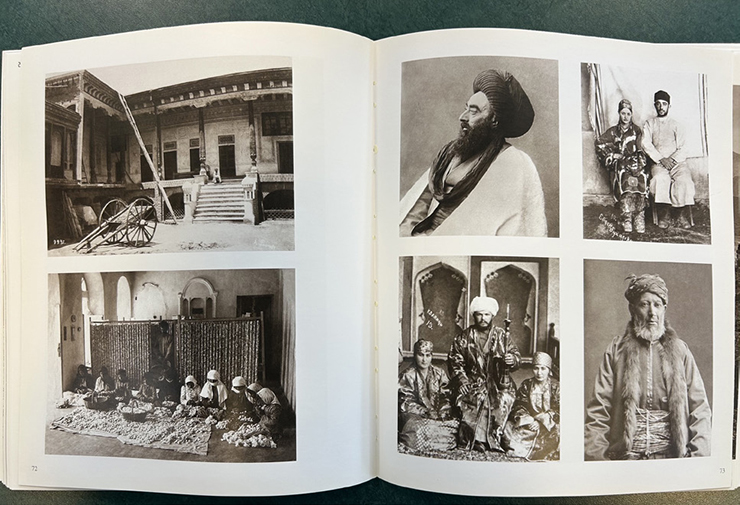
Page 104 has four Jewish men, with their kippahs and pei’os visible. Two of the men are wearing imperial medals. During Russia’s campaign against the Chechen uprising of the 1840s, Mountain Jews served in the military and provided intelligence to the empire. Russian rule was preferable to the religious fanaticism of Imam Shamil. In the aftermath of the Russian victory, Mountain Jews were given permission to settle across the northern Caucasus, building communities in Chechnya and Kabardino-Balkaria.
The Chechen cleric appears on the following page with two of his sons, photographed by Roinashvili after he surrendered to the Russians and was placed under house arrest. Perhaps as a contrast between militarism and nonviolent piety, the editor had Imam Shamil share this page with a bearded chacham and his two sons. In the place of daggers is a siddur. Behind them is a painted backdrop with a carpet under their feet, illusions of comfort in the photographer’s studio.
As noted earlier, Roinashvili’s travels took him to Kokand, a city in the Ferghana Valley of Uzbekistan, where the cotton industry produced a class of wealthy Jewish merchants. Three of the photos show the Muslims of the city with their turbans and long, dyed caftans. The photo titled “Bukharian Jews” shows a young couple sitting in the same position, the fabric and boots revealing their prosperity, along with confidence in looking directly towards the camera. This photo can be compared to the works of Dmitriy Yermakov and Sergey Prokudin-Gorsky, who also documented the many ethnicities and landscapes of the Russian Empire, including Bukharian Jews.
Born into poverty, orphaned at a young age, and divorced without children, Roinashvili devoted his life to photography. Today, he is regarded as a leading contributor to Georgia’s cultural rebirth, comparable to his contemporary, poet Ilia Chavchavadze.
“Wealth or property is not based on money, but on labor, diligence, and courage. Mr. Roinashvili is an example of this,” Chavchavadze wrote. “An absolutely unassisted, poor man who made up his mind to do something special.”
From the proceeds of his photography studio, Roinashvili funded a boarding school where boys were taught photography and participated in cultural organizations and literary circles.
“There’s almost no nation in the Russian Empire that doesn’t have its own home or museum,” Roinashvili wrote before his death in 1898. “And we, renowned for our past glory, art, and literacy, don’t even think about creating such a national home so that future generations can see this glory.” He dreamed of sharing his antiquities collection and photographs in a museum.
In the years after independence, Roinashvili’s portfolio became prominent again, preserved in Georgia’s National Parliamentary Library. That’s where the Jewish father and his three barefoot sons can be found today. They could never have imagined their faces in such a prominent location, in a country that welcomes Jewish tourists and preserves its Jewish heritage. Closer to our readership, Queens also has Georgian Jewish culture in the shul on Yellowstone Boulevard, the popular Marani Restaurant on 63rd Road, and this book at Queens Library.