

What does “America First” mean concerning foreign policy? In the past year, President Donald Trump reshaped alliances by reaching out to Russia to negotiate an end to its war with Ukraine. Following Israel’s shelling of Iranian military targets, Trump delivered the final blow, taking credit for the victory while Iran’s theocratic regime remained intact. The war in Gaza was paused with a ceasefire that freed all living Israeli hostages, but kept Hamas in power in the portion of Gaza from which Israel withdrew.
In this hemisphere, American warships are blockading Venezuela, blowing up boats accused of drug smuggling and stopping oil tankers carrying Venezuelan oil. This Monday at his Mar-a-Lago home, Trump stood by renderings of streamlined battleships that he dubbed the “golden fleet.”
“They'll be the fastest, the biggest, and by far 100 times more powerful than any battleship ever built,” he said. “We haven't built a battleship since 1994. These cutting-edge vessels will be some of the most lethal surface warfare ships.”
At the same time, Trump did not offer a definite policy on Venezuela. “There’s no answer. He can do whatever he wants. We have a massive armada—the biggest we’ve ever had, and the biggest we’ve ever had in South America,” he said. “He can do whatever he wants. It’s all right, whatever he wants to do. If he wants to do something, if he plays tough, it’d be the last time he’s ever able to play tough.”
During his first term, Trump made similar statements about North Korean leader Kim Jong-Un, calling him disparaging names and ordering plans for a bombing before a series of friendly handshakes that brought down tensions that changed nothing on the divided peninsula.
Trump is aware that within his party, America First is a slogan that offers no details on whether to retreat from international affairs or to secure a sphere of influence in Latin America while leaving the rest of the world to China and Russia.
Pressed on whether he would remove Venezuelan leader Nicolas Maduro from power, Trump was vague, saying that it’s “up to him what he wants to do. I think it’d be smart for him to do that.”
Having survived attempted coups, stolen elections, and a mass exodus of opposition-minded Venezuelans, Maduro is not likely to give up power without a fight. Trump’s offshore posturing has not led to rebellion within Venezuela. Maduro is as likely to consolidate power as Khamenei in Iran, Putin in Russia, and Hamas in Gaza.
Similar to his military posturing, Trump’s threats to hike tariffs on Brazil if it did not release imprisoned former president Jair Bolsonaro, a Trump ally, failed to sway his successor, Luiz Inácio Lula da Silva. Likewise, Indian Prime Minister Narendra Modi rolled out the welcome mat for Vladimir Putin in defiance of tariffs imposed on his country as punishment for purchasing Russian oil.
Perhaps the purpose of Trump-class warships is more about the optics of power, in the same manner as his redesign of the White House, renaming of the Gulf of Mexico, Department of Defense, Kennedy Center for the Performing Arts, military parade, free admission to national parks on his birthday, and insulting captions underneath portraits of previous presidents.
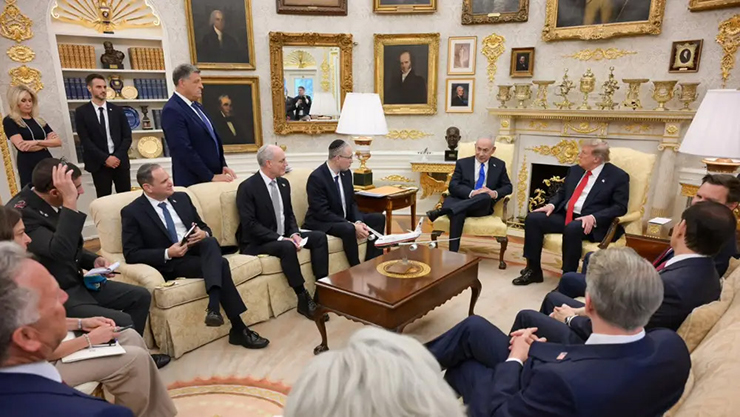
In the past year, foreign leaders flattered Trump with symbolic gifts: a replica royal crown from the South Korean president, a gold golf ball from the prime minister of Japan, a luxury airplane from Qatar, portraits from Russia, and nominations for the Nobel Peace Prize by the president of Argentina, the prime minister of Israel, and the opposition leader of Venezuela.
The last item remains the most elusive for Trump, whose entry into politics was inspired by his dislike of former President Barack Obama, who won the Nobel Prize shortly after taking office in 2009.
“He got a prize for doing nothing,” Trump said in October. “Obama got a prize; he didn't even know what he got. He got elected and they gave it to Obama for doing absolutely nothing but destroying our country.”
In his determination to earn the prize, Trump brought together the leaders of Armenia and Azerbaijan, Cambodia and Thailand, Congo and Rwanda, negotiating peace between these respective rivals, while seeking to add more members to the Abraham Accords and reduce tensions with China.
“President Trump will continue making peace deals, ending wars, and saving lives. He has the heart of a humanitarian, and there will never be anyone like him who can move mountains with the sheer force of his will,” his spokesman Steven Cheung tweeted after the Nobel committee awarded the prize to Maria Corina Machado of Venezuela.
Trump does not need to be a pacifist to win this prize. Machado welcomes the prospect of regime change in her country, as do Narges Mohammadi of Iran and Ales Bialitski of Belarus. Ukraine and its European allies argue that lasting peace would be achieved with a decisive defeat of Russia, and Israel understands that as long as Iran sponsors terrorism and Hamas holds territory in Gaza, the present ceasefire is temporary.
Trump does not need to retreat from international affairs to earn the Nobel Peace Prize. If he wishes to reduce the flow of refugees to this country, he can extend democracy and economic prosperity to their homelands so that they would have reasons to stay. Peace can be achieved through strength rather than optics.
By Sergey Kadinsky